A major investigation into the misuse of at least €500 million in European funds for smart water meters and remote water-management systems has expanded to at least 50 municipalities across Greece, according to findings from Greek authorities.
The European Public Prosecutor’s Office is investigating the responsibilities of mayors, municipal department heads and other officials following a months-long investigation. Greek judicial authorities are also examining the cases.
The municipalities under investigation include areas of Attica and Central Greece, tourist destinations in Crete and Halkidiki, Aegean islands and other parts of the country.
The cases concern allegations of inflated prices of more than 200% to 300%, excessive orders and technical specifications that may have restricted competition in public tenders. Authorities are also examining possible coordination between companies participating in the tenders and municipal officials.
The investigation has already resulted in disciplinary action against government officials who were removed from their positions.
EU-funded smart water projects
The investigation centers on the installation of digital or “smart” water meters and associated telemetry systems, several of which are financed through Greece’s European Union-funded National Strategic Reference Framework (NSRF) programs.
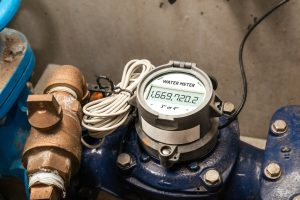
Smart meters are modern versions of conventional water meters. Connected to broader telemetry systems, they allow municipal water utilities and technical services to collect readings remotely, identify unusual consumption that could indicate leaks and better monitor water losses across networks.
The installations can include wireless communications systems, software, data collectors and monitoring platforms.
A funding call for the projects was published in December 2023 by the special management authority overseeing Greece’s Environment and Climate Change and Civil Protection programs under the NSRF.
Municipalities and municipal water utilities submitted proposals, with 55 projects in 55 municipalities ultimately approved at a total budget of approximately €500 million, or about €9 million per project.
Inflated prices and retaliation
A 28-page report prepared by a government auditor involved in examining the water-meter procurements alleges that officials repeatedly asked their superiors to intervene in what they considered improper and irregular procedures.
The auditor said officials sought to ensure that problems were corrected in time so the projects could proceed lawfully through tendering, contracting and the allocation of funds.
According to the report, however, no corrective action was taken to protect public funds. Instead, officials who objected in writing were allegedly removed from their positions or excluded from their areas of responsibility.
The report said this created a climate of intimidation among other officials, discouraging them from challenging decisions by their superiors.
The same complaint states that municipal services and some companies involved in the projects used significantly inflated prices, excessive and sometimes unnecessary quantities, and overlapping project specifications.
These practices, it said, created unjustified profits and corresponding losses to public finances that were estimated at more than €200 million.
One example cited in the report concerns the price of individual water meters. While the cost was approximately €80 in Athens, Thessaloniki and Cyprus, the meters involved in the projects under investigation were reportedly priced at €200 to €300 each.
The complaint also states that misleading documents were submitted by beneficiaries, resulting in inadequate or improper evaluations and approvals.
The complainants argue that officials responsible for managing the programs failed to properly investigate the allegations of irregularities and approved some proposals in a biased or improper manner while rejecting others unfairly.
According to the report, this resulted in tendering procedures that did not comply with European regulations and the rules of Greece’s public procurement authorities, creating conditions of opacity that could facilitate corruption.
Possible coordination between companies
A roughly 140-page report by Greece’s National Transparency Authority also identified potential links between companies participating in the tenders.
According to the report, bidders sometimes participated in groups of three or more companies, with the same company repeatedly winning the relevant tender. Investigators found that some of the companies appeared to be connected, including through membership in the same corporate group, sharing the same postal address or having common members on their boards.
The authority also identified indications that some bids may not have been genuinely independent.
It cited factors including consecutive protocol numbers on offers, companies responding and submitting bids within a single day, and similarities in the prices offered.
Taken together, the authority said, these elements raised indications of a lack of independence among the bids and possible distortion of competition.
Sources familiar with the investigation have also referred to meetings between representatives of municipal services, particularly in northern Greece, and company officials. Political figures have also been mentioned in connection with the allegations, although their alleged involvement does not appear in official documents or testimony, according to the report.
Investigation into Kilkis water utility
The National Transparency Authority also identified serious irregularities in the implementation of a contract involving the Kilkis Municipal Water and Sewerage Company, with a total budget of approximately €2.5 million.
The investigation, launched after two complaints — one anonymous and one filed by a municipal councilor — concerned the procurement of 10,350 digital water meters.
The case file has already been forwarded to the Athens Court of Appeals prosecutor to determine whether criminal responsibility should be attributed to individuals involved.
A separate investigation in a municipality in the Larissa region also found suspicious evidence.
Competition authority had already raised concerns
The case follows an investigation launched by Greece’s Competition Commission in 2024.
At the time, the commission said it had conducted on-site inspections at a large number of companies as part of an ex officio investigation into a possible horizontal agreement to distort public tenders involving the digital management of water networks.
The investigation concerned the supply and installation of integrated remote-monitoring and remote-control systems for household water meters and was examining possible violations of Greece’s competition law and Article 101 of the Treaty on the Functioning of the European Union.