There are roads that do not prepare you for what you will find. Roads where the noise of the city recedes, as if making room for something else. For a few steps, the tension drops and the sounds fade, even if you are two steps from the center of Athens.
Next to Amerikis Square, among apartment buildings that carry the stories of decades and balconies that “look” into each other’s lives without ever truly meeting, there is a small monastery that was not built to withdraw from the world, but to live within it.
If you walk a few steps further, without quite realizing it, the chapel of Saint Andrew appears before you. Small, Byzantine, almost soundless — and yet it carries one of the darkest memories of the city. Here, according to tradition, Saint Filothei was tortured.
Her life and memory
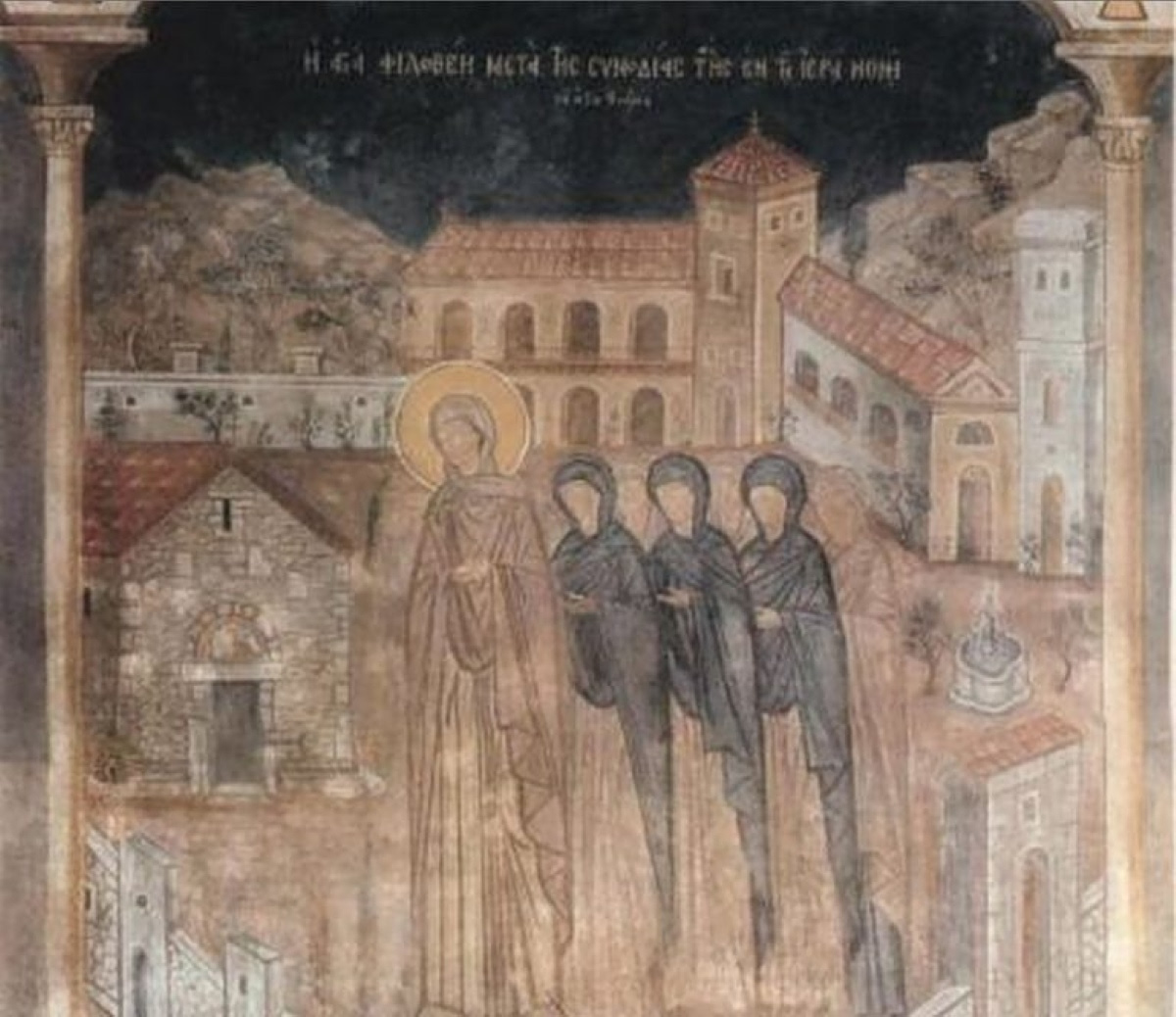
Revoula Benizelos, as her secular name was, was born in sixteenth-century Athens, around 1522, into one of the most powerful families of the era. The city, which was not yet the capital, lived under the harsh reality of Ottoman rule.
She married young, was widowed early, and chose a path that did not fit her time. From the mid-sixteenth century onward, she dedicated her life to her faith and above all to people who had no protection whatsoever — to women and girls, the poor and the excluded, people seeking something elemental: a place to stand without fear. She established refuges, organized structures of care, worked to free women from harems, and intervened where society looked the other way, building a network of assistance in an Athens that survived as best it could.
Her actions made enemies. On the night of October 2nd to 3rd, 1588, at Saint Andrew’s, men seized her, beat her savagely, and tortured her. She did not die there, but succumbed a few months later, in February 1589, to her wounds. Her memory remained in that place, like something that never left.
Centuries later, in the very place where a woman was tortured for standing against her time, another woman — bearing the same name — lives and leads the small monastery in the heart of Athens.
Abbess Filothei does not easily match what you expect to find. She does not carry the heavy, detached severity that many associate with monasticism. She speaks like someone who has passed through the world and is not afraid of it — perhaps because she has crossed it.
Keeping joy alive
“I was looking for a space that smelled of freedom,” she tells V magazine. “An environment that would keep my joy alive. That is what I found here, and that is why I never left.” She does not describe it as a spur-of-the-moment decision, but as something that grew within her slowly and steadily — an inner shift that came about not to leave the world behind, but to bring clearly to the surface what was already within her.
The person who, as she says, showed her this path was her elder, Father Gavriil. “He used to tell us something I never forget,” she recalls. “In the monastery you learn things your mind cannot contain. If you stay with what you already know, you are shortchanging yourself.” To him she also attributes the decision for a monastery to exist within the city. “He wanted it very much,” she says. “For there to be a monastery at this spot, close to people. Not far away. So they would feel it nearby.”
She herself did not grow up in a strictly ecclesiastical world. “I come from a refugee family, a believing one,” she says, “but we did not have that everyday relationship with the Church.” There was respect, but not what she describes as a “living experience.” That experience she sought on her own.
“From the age of eighteen I entered the Church more consciously,” she explains. “I wanted something deeper. It was not enough for Christ to be present only on Sundays or feast days. I wanted Him to be in everything.” She studied at the School of Theology — a choice that, she stresses, was not accidental. “I did it deliberately, with very high marks. And in the end I came to love theology even more when I connected it to church life. Because study on its own can be ‘dry’ if you do not live it.”
Unlike many conversion narratives, in the case of Abbess Filothei there is no dramatic turning point. The decision to become a monastic came as a natural continuation at the age of twenty-four. “I did not feel I was leaving anything behind,” she says. There was no “before” that was abandoned and an “after” that was imposed. She was moving, exploring, living normally within the world.
“I used to ride a motorbike then,” she says, almost smiling. “And I still ride one.” She does not present this as a contradiction. For her, it is not. “You do not need to change what you are,” she explains. “You just need to find where you belong.”
That is why she does not speak of a world she left behind, but of a different way of seeing it. This comes through clearly in the way she describes faith. “Faith is both a refuge and a struggle,” she says. “It is not something to hide in, but something to endure with.” She pauses for a moment, as if searching for the right image. “Like when you are climbing a mountain and you find a spring — don’t you stop for a moment to cool down? That is the refuge. But you do not stay there; you continue the ascent, the struggle,” she concludes. “Because the dead end of man,” she says, lowering her voice, “is the opportunity of God.”
A rise in young people attending churches
Monasticism, as she describes it, is not a rejection of the world but a different form of participation in it — without ownership, without exclusions, without the need to hold anything only for yourself. In recent years, she says, she sees more and more people crossing the threshold of the monastery. “Many young people come,” she reveals. “Very many. Children who had no connection with the Church before. And all of them are searching for something — a need for meaning that does not fit easily into the language of this era.”
Between the noise of the city and the silence of a small monastery at its center, Abbess Filothei of the Holy Monastery of the Panagia of Vryoulon offers no ready-made answers. She returns to the same questions again and again. What do you do with your life when you stop running? And, above all — what remains when everything else is gone?
Antonis Diniakos