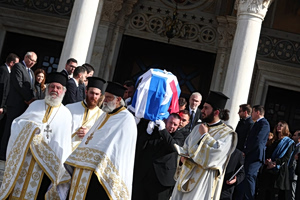
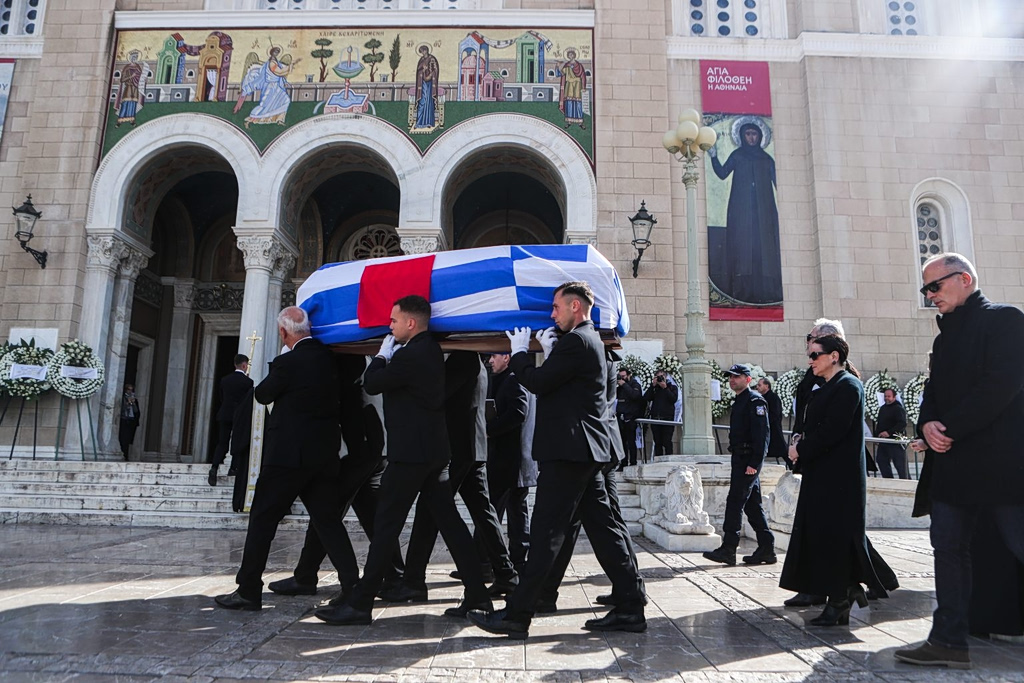
An exodios funeral service was held on Friday for renowned Greek-French academic and historian Hélène Glykatzi-Ahrweiler at the Athens Metropolitan Cathedral, with much of Greece’s political leadership and the academic world in attendance to mourn her passing.
Her body lay in state before the service at the Cathedral’s adjacent chapel in order to allow mourners to bid her a personal final farewell. Interment followed at the Vyronas municipal cemetery.
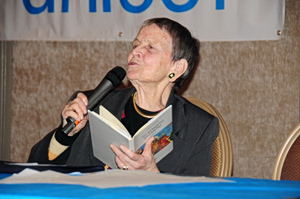
Hélène Glykatzi-Ahrweiler, August 1926-February 2026
The coffin was draped with the flags of Greece and France, while eulogies were delivered by Greek President of the Republic Konstantinos Tasoulas and Prime Minister Kyriakos Mitsotakis.
The service was officiated by the Archbishop of Athens and All Greece Ieronymos, in the presence of representatives of the state, the academic community and a large number of citizens.
Tasoulas: ‘She had erased the word ‘impossible’ from her vocabulary’
President Tasoulas describe Glykatzi-Ahrweiler as a “girl from Vyronas (a district in east Athens named for Lord Byron), a heroine of the national resistanc, and a historian who sought to confront history… she had erased the word ‘impossible’ from her vocabulary.”
He emphasized that Glykatzi-Ahrweiler did not rest on stereotypes but advanced by conquering new ground, particularly in the field of history. “Glykatzi-Ahrweiler uncovered and brought to light truths of Hellenism and the European spirit,” he noted.
In closing, Tasoulas stressed that “our grief today is eased by the countless things she offered us.”
Condolences from the Ecumenical Patriarch
During the funeral service, a sorrowful message of condolence was read out on behalf of the Ecumenical Patriarch of Constantinople, His All-Holiness Bartholomew I. The message highlighted that, through her work “Why Byzantium”, Hélène Glykatzi-Ahrweiler restored historical truth and the Byzantine heritage.
The Ecumenical Patriarch’s representative emphasized that the veteran Paris-based academic and university administrator was a “spiritual source” who “served scholarship, worked tirelessly, and did not keep knowledge as the possession of a few, but diffused it throughout society.”
The Ecumenical Patriarch’s message stressed that her work constitutes a bridge between East and West.
Her life and work
Hélène Glykatzi-Ahrweiler was an emblematic figure in Byzantine historiography. Born in Athens to a family hailing from Asia Minor, she studied history and archaeology at the National and Kapodistrian University of Athens and worked at the Centre for Asia Minor Studies before settling in Paris in 1953 for postgraduate studies.
Her academic career blossomed at the CNRS and at the Sorbonne, where she distinguished herself for her contribution to the study of Byzantine history and the Mediterranean world.
In 1976, she was elected rector of Paris 1 Pantheon-Sorbonne University, making history as the first woman to hold the position at an institution with seven centuries of tradition.
At the same time, she served in leading positions in academic and cultural institutions in France and Greece, while actively participating in public dialogue on issues concerning Greek society.

Mitsotakis bids farewell
“She became the first woman rector at the Sorbonne. She achieved what she originally wanted — to become a bridge.” With these words, Greek Prime Minister Kyriakos Mitsotakis referred to the course of Glykatzi-Ahrweiler, emphasizing her lasting influence.
Her legacy
Glykatzi-Ahrweiler’s journey was synonymous with academic excellence and humanism. Through work that bridged the Greek and French intellectual traditions, she left an indelible imprint on the study of the eastern Roman empire, subsequently called Byzantium, and on the international promotion of Greek culture.
Ta Nea interview
In June 2023, the distinguished scholar and humanist gave a rare and personal testimony to journalist Zoe Liaka and the newspaper “Ta Nea”.
In the interview, she spoke about her childhood during the Axis occupation of mainland Greece (1941-44), the resistance and the images that left an indelible mark on her.