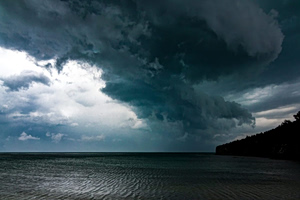

Greece is bracing for widespread disruption as Storm Adel sweeps across the country, bringing heavy rain, powerful thunderstorms and a significant risk of flooding. Authorities have placed four western regions — the Ionian Islands, Epirus, Western Greece and the Peloponnese — under Red Code emergency readiness from 26 to 28 November, following upgraded severe weather warnings.
According to Greece’s Civil Protection agency, additional regions may also be put on alert as conditions evolve. Forecasts indicate that Wednesday marks the beginning of the storm’s most active phase, with intense rainfall expected to expand rapidly from the northwest to much of the mainland and parts of northern Greece.
Early impacts are already being felt in the Ionian Sea and Epirus, where storms are accompanied by hail and very high rainfall totals. Lighter but still notable showers are forecast for the Peloponnese, central regions, the Cyclades and islands of the eastern Aegean.
On Thursday, the situation is expected to escalate further. Meteorologists warn of very heavy rain across the mainland, the northern and eastern Aegean islands and the Dodecanese. Large rainfall accumulations are forecast in the Ionian Islands, western inland regions, Eastern Macedonia and Thrace, placing these areas at particular risk.
Rainfall projections shared by forecasters show extremely high volumes in several regions, including 200–250 mm in parts of the Ionian, Eastern Macedonia, Thrace and the eastern Aegean. Attica, including the Athens area, may see 70–90 mm of rain along with intermittent thunderstorms.
The most critical period is expected to be Thursday and Friday, when the storm’s intensity peaks. Although short breaks in the weather are possible, unstable conditions are likely to persist nationwide through the end of the week. Temperatures will remain slightly above seasonal levels despite the severe rainfall.
Forecasters have identified numerous areas with heightened flood risk, including islands of the Ionian and eastern Aegean, western coastal regions of the mainland, sections of the Peloponnese and parts of northern Greece. Attica and Thessaloniki also face a lower but still noteworthy risk.
Maritime transport may be disrupted, particularly in the Aegean and, on Thursday, in the southern Ionian. Conditions are expected to gradually improve from Sunday as the system moves eastward.