Firefighting forces on the ground continued arduous efforts overnight and during the morning to contain a wildfire that erupted Saturday afternoon on the central Aegean island of Skyros, as aerial operations resumed on Sunday morning.

Reinforcements arrived by ferry boat from the port of Kymi in nearby Evia (Euboea) island, bringing the total firefighting force to 89 firefighters, six ground teams, 21 vehicles and volunteers. Two helicopters and four aircraft began operating with the first light of day on Sunday.
Strong northerly winds exceeding 7 on the Beaufort scale, with gusts reaching 8 Beaufort, have complicated the operation. Firefighters are concentrating on preventing the wildfire from advancing toward the settlement of Pefko, although the flames had not reached homes as of Sunday morning.
The wildfire is burning on two fronts, with one moving south toward Agios Fokas and another to the east toward Pefko. The western part of the island has shown signs of improvement, while the fire is now concentrated in the northeastern section.
The wildfire broke out at about 4 p.m. Saturday in a forested area near Atsitsa and spread rapidly under strong winds, initially moving south toward Agios Fokas. The 112 SMS emergency alert system was activated twice on Saturday as a precaution.
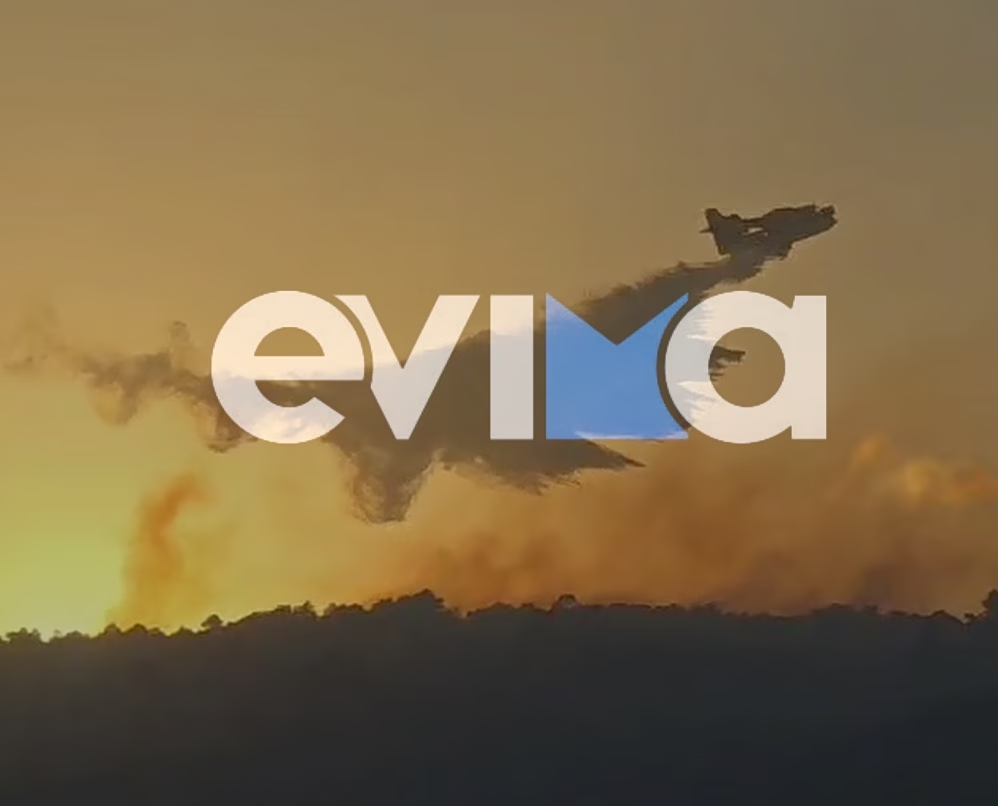
Two beaches, a taverna and a house were also evacuated as a precaution, according to the initial reports. The fire reached the coastline but did not, at that stage, threaten residential areas.
The European Union’s Copernicus Emergency Management Service has also been activated to map the areas affected by the wildfire. Satellite-derived mapping products will be provided to authorities to assist with emergency management and assessment of the burned areas.
Another difficult wildfire season
Greece entered the 2026 wildfire season with about 2,880 wildfires already recorded nationwide by early June, including 710 in western Attica, according to figures cited by To Vima. Authorities have attributed the overwhelming majority of incidents to human activity, particularly negligence, while deliberate arson has also accounted for a significant share.
The season intensified sharply in July, 96 wildfires reported in a specific 48-hour period, well above the roughly 30 blazes per day cited by the climate crisis and civil protection ministry.
By Aug. 2, more than 16,000 acres (6,500 hectares) had been burned across Boeotia and Attica prefectures in a series of major wildfires, according to a preliminary assessment by the National Observatory of Athens. Satellite estimates published around the same period also put the combined burned area from recent fires in Rethymno, Crete and on the island of Paros at more than 5,500 hectares (13,600 acres).
The season has also been marked by repeated periods of weather conducive for the spread of wildfires, such as strong northerly winds, high temperatures and low humidity.
Photographs and video by evima.gr