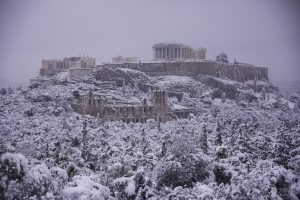

Greece remained in the grip of severe winter weather on Sunday as a surge of polar air drove temperatures sharply lower and brought snowfall to low and mid-altitudes across large parts of the country.
According to data from the national Meteo monitoring network, the cold was most intense in northern Greece, where daytime temperatures dropped as low as -9 degrees Celsius. Some of the coldest readings were recorded in rural inland areas, while western and southern regions saw significantly milder conditions, with temperatures climbing above 15 degrees Celsius in coastal locations.
Snow at Low Elevations, Sunshine on Mountain Peaks
Snow fell not only in mountainous areas but also at elevations below 500 meters, an unusual feature of the cold snap. At the same time, a striking weather contrast appeared on Mount Olympus, Greece’s highest mountain, where clear skies and sunshine prevailed at elevations above roughly 2,700 meters.
Meteorologists explained that extremely dry air in the upper atmosphere cleared clouds at high altitudes, while moisture trapped closer to the ground fueled cloud cover and snowfall at lower levels. Similar conditions were observed on Saturday, when satellite imagery showed snow-covered peaks rising above dense cloud layers.
Widespread Impacts Across the Country
Heavy snowfall affected mountainous and semi-mountainous areas of central and northern Greece, including parts of western and central mainland regions. In several locations, road traffic was restricted, with chains required on parts of the road network as snowplows and salt spreaders worked continuously to keep routes open.
Authorities temporarily closed or diverted traffic on mountain roads where ice and poor visibility created hazardous conditions. Civil protection services remained on high alert as strong winds, frost, and persistent snowfall continued to affect daily life in rural and elevated areas.
Forecast: More Snow Ahead
The cold spell is expected to intensify in the coming days. Forecasts indicate that from Tuesday onward, moisture from the Mediterranean will collide with the entrenched cold air mass, increasing the likelihood of heavier snowfall, potentially reaching near sea level in parts of northern and central Greece.
Meteorologists warn that while temperatures may gradually rise later in the week in southern regions, northern areas are likely to remain cold, with ongoing wintry conditions and intermittent snow. Authorities are urging caution, particularly for travel in mountainous and rural areas, as the country remains under the influence of the prolonged cold wave.