Greek authorities have imposed a new series of fines, removal orders and sealing orders on businesses accused of illegally occupying beaches and violating rules governing the use of public coastal areas.
The latest measures cover Rhodes, Kavala, Skiathos and Corfu, where authorities identified businesses operating without valid concession agreements or exceeding the areas permitted for commercial use.
On the popular Dodecanese island of Rhodes, five canteens at Tsambika beach were ordered sealed shut and fined a combined 174,000 euros. At the iconic Anthony Quinn Bay in Faliraki, a business was fined 37,000 euros and ordered to remove its equipment after two inspections found an unauthorized occupation of the beach without an active concession agreement.
Another business in the northern mainland city of Kavala was fined 28,889 euros and ordered removed, while four businesses on the Sporades island of Skiathos were fined about 44,000 euros. In Corfu, eight of 14 inspected businesses were fined a combined 107,665 euros and faced removal and sealing orders.
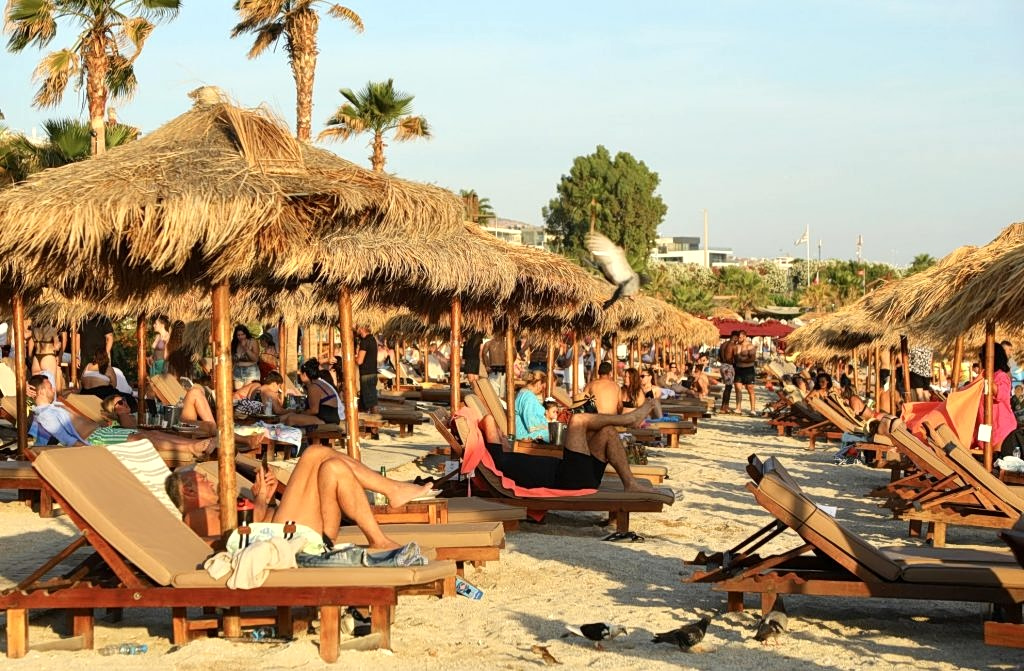
The latest enforcement forms part of a broader nationwide campaign to protect public access to Greece’s coastline. More than 1,500 inspections had been conducted at more than 300 beaches and 450 businesses by early August, with authorities using drones, remote monitoring and the MyCoast digital platform to identify violations. The largest number of complaints has been recorded in Halkidiki, eastern Attica prefecture, the myriad of Cyclades isles, the Dodecanese islands and Kavala.
The campaign follows Greece’s overhaul of its beach concession framework. Most previous concession agreements expired at the end of 2025, with responsibility for new concessions transferred to the Ministry of National Economy and Finance and the process conducted electronically. The transition has created complications for some businesses awaiting finalized contracts, but authorities have continued to enforce restrictions against unauthorized occupation.
Under the framework, beaches remain publicly accessible, even where sections have been legally granted to hotels, restaurants or other businesses. At least 50% of areas used by such businesses must remain freely accessible, while unobstructed passage to the shoreline must be maintained. Businesses cannot occupy areas beyond their authorized concession or obstruct public access.
Penalties can be substantial. Violations involving obstruction of public access can result in fines of up to 60,000 euros, while unauthorized occupation without a valid concession can lead to immediate sealing and removal measures. Authorities can also require offenders to clear illegally occupied areas at their own expense.
The rules are being applied alongside stricter environmental protections. In July, Greece designated another 251 ecologically sensitive Natura 2000 beaches as “Untouched (Untrodden) Beaches,” where commercial concessions, sunbeds, umbrellas and organized activities are prohibited.
The government has encouraged beachgoers to report suspected violations through MyCoast, which allows users to identify concessions, check their permitted boundaries and submit complaints, including anonymously.