 Μake us preferred on Google
 In Greece, her relatives had not even known she existed. Raised in the United States, Carson was confronting, for the first time, a part of her history that had remained hidden for nearly six decades: her biological family.
Carson is among an estimated 4,000 Greek children adopted abroad, primarily in the United States, during the 1950s and 1960s, often through opaque procedures. Decades later, she is also among those who have managed to reconnect with their biological families in Greece with the help of The Eftychia Project, a nonprofit organization that provides free assistance to Greek adoptees seeking their roots.
A journey of reconnection
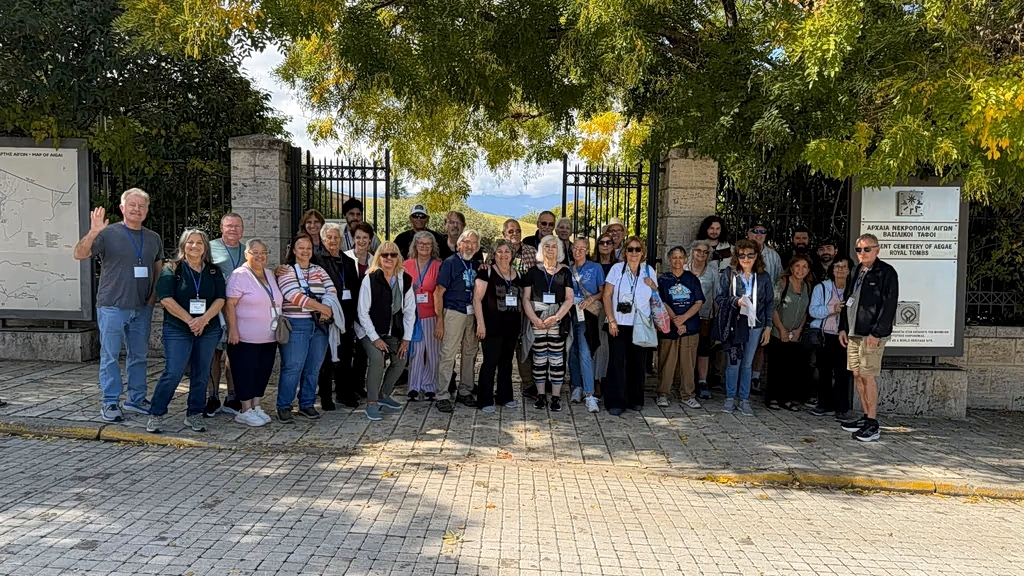
Carson has returned to Greece for the fourth time, joining more than 40 other people who share a similar beginning. They have traveled from the United States to attend the fifth annual gathering of Greek adoptees organized by The Eftychia Project, the largest such gathering ever held in the country.
The event is more than a reunion. It is an opportunity to discover their country of birth, a collective homecoming and a chance to reconnect with histories that, for many, have remained incomplete.
From Sunday through Saturday, the group is traveling across Greece on an itinerary linking personal discovery with the country’s history and culture. Thessaloniki, Vergina, Metsovo, Ioannina, Nafpaktos, Messolonghi and Kalavryta are among the stops, with visits to historical monuments and museums, walks and time spent together.
“Walking the streets of Greek cities, hearing the language, smelling the aromas of the food and learning the history of this place can offer them the connection they have been seeking all their lives,” Linda Carol Forrest Trotter, also known as Eftychia Noulas, the driving force behind the project, told Ta Nea.
Trotter herself located her biological mother in Greece in 2017, nearly six decades after her adoption.
‘We’re not tourists’
“This is not a vacation. We are not tourists; this is a profound journey to reclaim our identity,” said Dimitrios Christou, secretary of The Eftychia Project and an adoptee himself.
For many participants, the search remains difficult. Incomplete or missing records, sealed files and bureaucratic obstacles continue to stand in their way.
Kevin Johnson, attending the gathering for the second time, has yet to find his biological mother. He was adopted alongside a girl three months younger than him who became his sister, and grew up in Utah. He knew from childhood that he was adopted, but his different appearance made him feel like an outsider among his peers.
“I still haven’t managed to find my biological mother, although I know her name. It is Maria Gioti. It would be wonderful if I could find her,” he said.
“My Greek name is Anastasios. I don’t know where or by whom I was baptized.”
Returning to Greece evokes emotions he struggles to describe. “I am proud to be Greek. And I find strength in being among people with shared experiences. This contact gives me hope,” he said.
Carson, by contrast, has located relatives on both her mother’s and father’s sides.
“I feel wonderful that I found them. I had an excellent life in the United States and a very good family there. But getting to know my family in Greece enriched my life in a different way,” she said.
She has also been struck by the number of people who share her experience. “All my life, I believed that only my brother and I had been adopted from Greece. Now an entirely new world has opened up before me. There are thousands of people with similar stories.”
Trotter compares their search to the story of Oedipus, who sought to discover the truth about his origins.
“When Oedipus heard someone at a banquet say he was not his father’s son, he wanted to know the truth. He went to the Oracle of Delphi to discover his origins. We, too, return to Greece to find the truth about our own roots,” she said.
She hopes all participants will find peace and a sense of completeness, even if they cannot locate their biological families.
“Everyone has the right to know where they come from.”