
 Μake us preferred on Google
 In the year since thieves stunned the world by smashing their way into the Louvre Museum and stealing France’s crown jewels worth at least $101 million, art heists have only intensified. From Wales to Sicily, more than 14 museums have been hit by smash-and-grab criminals since early 2025, suggesting museums haven’t cracked the code on how to safely protect their treasures.
Police are still looking for the Louvre’s stolen trove of 19th-century jewelry, though French authorities arrested eight people in connection with the crime last October. But the subsequent heists across Europe suggest the Louvre heist wasn’t a one-off and might have emboldened copycats, as well as organized criminal gangs to target museums.
Experts have myriad theories about why art heists are increasing, from soaring gold prices making golden antiquities and precious gems more valuable to the misguided notion that stolen art can reap higher sums on the black market—it cannot. But museum directors and security firms agree the Louvre breach set an ominous precedent.
“The Louvre was a wake-up call that anywhere can be hit,” said Chris Marinello, chief executive and founder of Art Recovery International, a London-based firm that chases down stolen art.
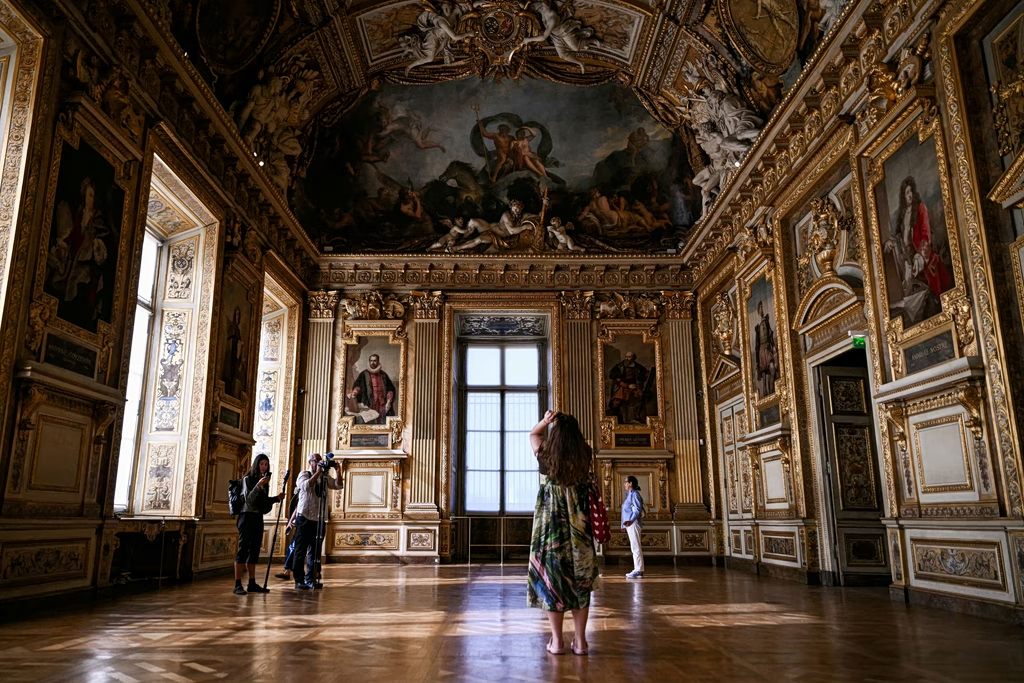
For its part, the Louvre created a new security coordinator position now held by Olivier Goupil, a veteran police officer known for modernizing the Paris Transport Authority’s security command center. Goupil is constructing a similar security hub within the Louvre; the museum also added more crowd-control barriers and anti-ram devices around its exterior. There are now window railings at the upper-level Apollo Gallery where thieves broke in. Within a year, the museum said it will also have video surveillance of its entire perimeter. In a statement, the museum said the challenge is to balance its mission of protecting its collection while also sharing it with roughly 30,000 visitors a day. “Museums are not fortresses,” the museum said in an email.
Below, what the past year revealed about the art-crime onslaught.
Gems and gold are the first to go
The Louvre heist revealed that thieves are increasingly stealing gold, bronze and jewels more than traditional paintings—a turnabout from a century ago when a thief stole its “Mona Lisa,” later recovered. In 10 of the subsequent museum break-ins across Europe over the past year, thieves bypassed paintings to steal objects that could be dismantled or melted down because such commodities retain value as precious metals and gems. Black-market jewelers from Antwerp to Tel Aviv are often willing to re-cut and reshape bigger jewels into smaller untraceable ones that can be resold anywhere, investigators say.
On Oct. 5, thieves broke into the C. Karoutzos Contemporary Art Center in central France and hauled off a 330-pound bronze book cover decorated with gold, gems and shells designed by surrealist Salvador Dalí. Museum owner Christian Karoutzos said his video cameras captured a few shadowy figures leaving the scene, but the book cover remains missing. “This is a true tragedy,” he said.
On the other hand, authorities have had better success recovering stolen paintings. The Magnani Rocca Foundation in Parma, Italy, and the Renoir Museum in Cagnes-sur-Mer, France, reported losing seven paintings between them to heists in March and September, respectively, but police have since tracked down and returned every single canvas, including canvases by Pierre-Auguste Renoir, Paul Cézanne and Henri Matisse. It likely helped that the works were identifiable and only valuable if left intact, Marinello said. “You can’t melt down a Renoir.”
Thefts are getting faster
In 1990, two men disguised as police officers spent 81 minutes crisscrossing Boston’s Isabella Stewart Gardner Museum to cut out and carry off masterpieces by Vermeer and Rembrandt. This year’s heist at the Magnani Rocca took less than three minutes.
Geoff Kelly, a former FBI agent who investigated the Gardner heist and now works with other former art-crime agents at the museum-security firm, Argus, said thieves are breaking in, grabbing what they can and fleeing the scene within minutes—before the police arrive. Even if museums or individual artworks are alarmed, the real chase tends to begin only after the thieves have fled, Kelly said.
Major cities like Paris, São Paulo, Amsterdam and Vienna are saturated with surveillance cameras, Kelly said, which is helping police with the chase. Last year, security footage outside a Sao Paulo library showed two thieves staggering down the cobblestone sidewalks of the city’s historic center under the weight of eight Matisse prints they had just stolen. Authorities used the footage to track down the thieves and in August the prints were recovered.
Cyberattacks pave the way for smash-and-grabs
In July, Paris’s Museum of Natural History suffered an undetected cyberattack that disabled its alarm and surveillance systems, police said. Two months later, robbers monitoring the digital breakdown were able to saw through an emergency exit door and use blowtorches and other weapons to steal about 13 pounds of gold worth around $2 million, including historic pieces from the California Gold Rush.
The Louvre is also aware of cybersecurity threats and is creating a dedicated unit within its security team to bolster its digital protections. It’s also tightening some of its own self-inflicted vulnerabilities, including its passwords. An earlier audit of the museum’s security protocols found that the Louvre’s video surveillance and physical security systems relied on a weak password, “LOUVRE.” It was immediately changed, the museum said.
Marinello said thieves are beginning to use artificial intelligence to identify museums with hefty holdings of gold or those housed in smaller, historic buildings that might be easier to breach. It’s “something that should scare the bejesus out of museum directors,” he said. As an experiment, Marinello asked an AI tool to help him steal a painting; the tool refused to participate in a possible crime but still assisted him in locating rope and sledgehammers and other gear from the nearest hardware stores.
The flip side: Museums say they’re using AI-assisted video surveillance to help guards scour for potential bad actors by analyzing people’s behavior as they move through the galleries rather than recording footage passively. Kelly said he’s often hired by museums to assess their security protocols and they’re shocked when he tells them they can upgrade their video cameras for “hundreds, not thousands” of dollars.
Museums reopen with less
Victimized museums are often compelled to cope by closing indefinitely or reopening with fewer treasures on view. The Louvre has reopened its Apollo Gallery, but all the remaining jewelry in it has been removed, resulting in an empty, 17th-century ceremonial gallery.
In Spain, Villena’s Municipal Archaeological Museum has been shuttered since Aug. 27 when thieves pried open a side window, broke into a bulletproof case and made off with dozens of Bronze-Age gold objects silver and amber objects, including bracelets, bowls, bottles and three crowns. In about three minutes, the museum lost its main attraction.
In Vienna, on the same day, thieves stole a 1939 Van Cleef & Arpels necklace containing 673 diamonds from the Museum of Applied Arts. But instead of closing the exhibit, the museum deliberately reopened it the next day as a show of confidence in its security measures, adding that the exhibit ultimately received more than 70,000 visitors.
Véronique Brumm Schaich, director of the Lalique Museum in France, said she and her staff were initially in shock after thieves in July smashed six display cases with sledgehammers and stole 27 works, mostly jewelry—including pieces designed by René Lalique.
After upgrading its security, Brumm Schaich said the museum is readying to reopen Nov. 28, but with one noticeable change: Its gallery devoted to Lalique’s early jewelry designs will not showcase any objects but will be filled instead with photographs of his works.
“Reopening without jewelry inevitably means telling that story differently,” she said, “but we felt it was better to reopen in this way rather than prolong the museum’s closure.”
At the Louvre, staff are still discussing when and how to put the theft’s lone survivor back on public view: Empress Eugenie’s 19th-century crown, which thieves dropped and crumpled outside the museum during their getaway. Conservators say one of its eight golden eagles is missing and so are 10 of its 1,354 diamonds, but its 56 emeralds and central globe survived. “It will be exhibited at the Louvre when we have found the ideal location to create a dedicated, secure exhibition space,” the museum said, “but for now, not all conditions are in place.”
Write to Kelly Crow at kelly.crow@wsj.com