–
By Angeliki Korre
Lately, conspiracy theories seem to have turned toward epistemology, setting aside older, fantastical imagery — such as reptilian shapeshifters — and adopting the rhetoric of the natural sciences, with references to viral genomes, artificial intelligence architectures, and statistical models, particularly in the wake of the COVID pandemic and the rapid rise of AI.
Yet the same informational turbulence that bolstered this pseudo-scientific veneer has also contributed to the resurgence of older narrative patterns: cases such as the Epstein files and the war in Gaza have reactivated classic conspiratorial motifs — the secret Satanic Jewish lobby — suggesting that conspiracy theories function largely as resilient cultural structures, adapting to new technological contexts without abandoning their historical core.
So, as the word “Jew” returns to the conspiratorial foreground, there is no better line for anyone growing bored at the Easter table with aunts and uncles than the one a professor of mine at the School of Theology once offered: “Christ was a perfect Jew.” Christianity is not merely a historical continuation of Judaism — the two traditions (along with the last of the three, Islam, which closes the nuclear triad of the so-called Abrahamic religions) are inseparably linked, both doctrinally and culturally. Many customary practices of the Eastern Orthodox tradition, especially those connected with the celebration of Easter — the use of symbolic foods, the ritual consumption of meat after fasting, the preparation of festive breads, the emphasis on the communal table — bear clear traces of origin in earlier Jewish practices. The very dating and theological structure of Christian Easter is historically grounded in the Jewish Passover, as described in the Book of Exodus, where the consumption of the paschal lamb (korban Pesach) and the ritual use of specific foods mark the passage from slavery to freedom.
Of particular significance is the egg (beitzah), which since rabbinic tradition has been placed on the Seder plate — the dish of the traditional family gathering — as a symbol of mourning, rebirth, and the cyclical nature of life. The later Christian practice of the red egg may be understood as a theological reinterpretation of these same symbols, linked to the blood of sacrifice and the victory over death, in analogy to the blood of the lamb that marked the protection of the Israelite households. The presence of festive breads and meats following a fast, likewise, reflects the deeper ritual logic of the passage from deprivation to abundance, which is a central motif in both Jewish and early Christian liturgical experience. Thus, even when individual elements diverge historically and geographically, the functional and symbolic structure remains embedded in a long historical and theological continuity that connects the early Christian communities with the festive tradition of ancient Israel.
Historical knowledge proves itself once again as fundamental to human beings as speech and walking — when we consider that its chronic absence makes our neighborhood resemble the planet’s saloon, with the pianist as the first to be shot. Otherwise, what exactly is it that Jews, Christians, and Muslims have to divide among themselves? (And what have we ever had to divide, if not, in reality, land and resources that belong to none of us?) Our differences are purely doctrinal. You can love your Abrahamic cousin even so — just as you love your biological one, even though you listen to BTBAM and he listens to Christos Kotsonis.
The trouble lies in the great paradox: we obsessively honor doctrine without even possessing knowledge of doctrine. Because doctrine is precisely that toward which we simultaneously converge and diverge. We follow broadly shared rituals without having any idea that they are shared, while at the same time failing to grasp when, how, and why the divergences in their theological content arose. Religious faith can become something so dangerous precisely because it demands a great deal from those who seek to act in its name: it shows them that it cannot exist without doctrine and, at the same time, cannot exist confined to doctrine alone. The gods demand balances more often than they demand sacrifices — but we are not yet ready for that conversation.
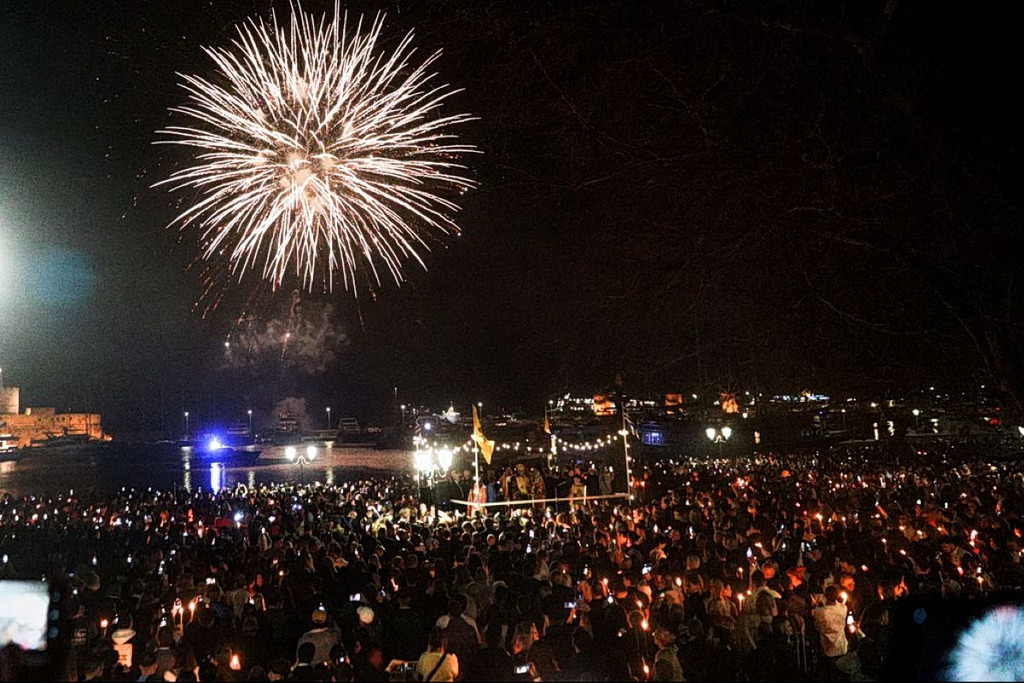
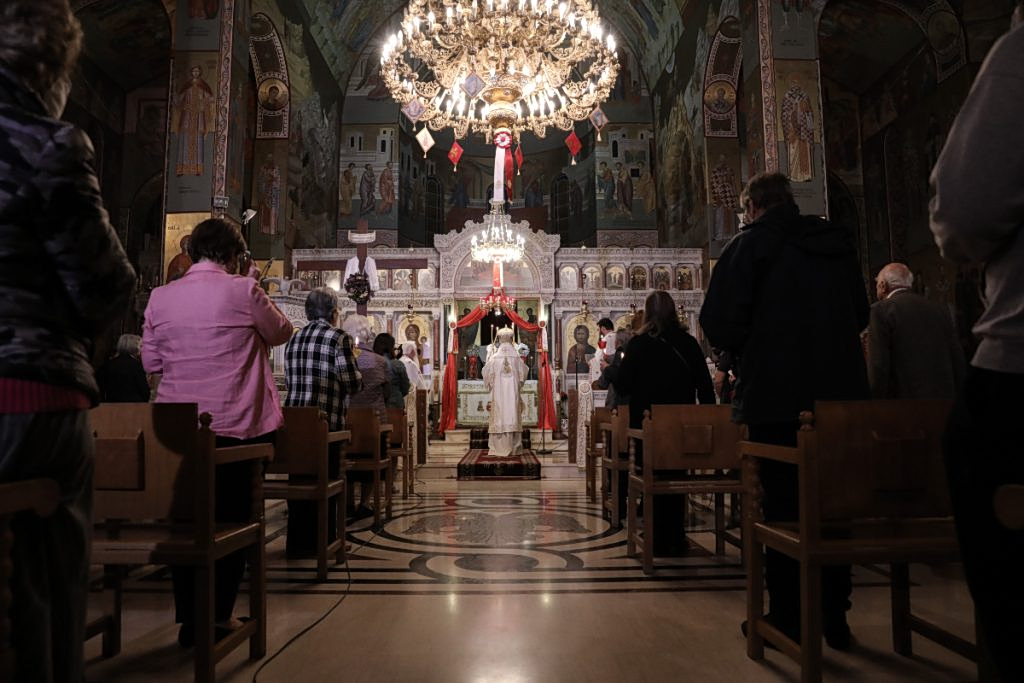
What meaning can Easter hold in our century, then, at once hyper-dogmatic and anti-dogmatic — revolving around a tradition we do not understand and reduced to a folkloric experience stripped of theological content? The restoration of Easter means entering a space where ritual memory persists with greater endurance than doctrinal certainty. Even in societies that define themselves as secular, the arrival of Easter produces an observable disruption in the rhythms of everyday life: people prepare, people celebrate. It could be argued, with due methodological caution, that Easter survives ultimately not because faith has remained unchanged, but because practice has proven more resilient than theory.
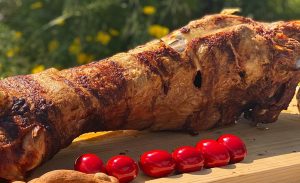
In a manner reminiscent of a kind of “realist anthropology,” Easter appears less as a purely theological abstraction and more as a dramatized sequence of gestures: fasting that renders hunger meaningful rather than arbitrary; waiting that transforms time into anticipation; and celebration that elevates digestion into a symbolic act of triumph. The lamb roasting in the courtyard is not mere feasting. It is the re-dramatization of a narrative logic inherited from ancient ritual economies, in which sacrifice, deprivation, and abundance constitute a recognizable cycle. Even the fiercely competitive clinking of red eggs can be read as a miniature cosmology: shell against shell, rupture followed by revelation, destruction reinterpreted as renewal.
Easter today must be understood not only as a theological proclamation of resurrection, but also as a social technology of repetition — one that organizes memory, redistributes attention, and temporarily reorders the hierarchies of our household, both literal and figurative. An Easter observed purely as practice is not faith — it is bad faith, one that causes the blood of sacrifice to erase the blood of History. Of course, a reference to our world as soaked in blood would be something of a cliché. Besides, when has the world ever not been soaked in blood? For this reason, perhaps the key word at Easter is not blood, but home. Home as planet, as century, as everything lived, present, and your own. Because if you do not tend to what is yours — if you do not gather it and honor it — you will lose it both in memory and in existence. And if there is one more conversation for which we are not yet ready today, it is this one: whoever believes in something is your own.