
 Μake us preferred on Google
 Twelve billion years ago, the first stars released their breath into the cosmos. Today, a young Greek scientist has caught that echo, reminding his generation that the greatest discoveries begin not with certainty, but with wonder.
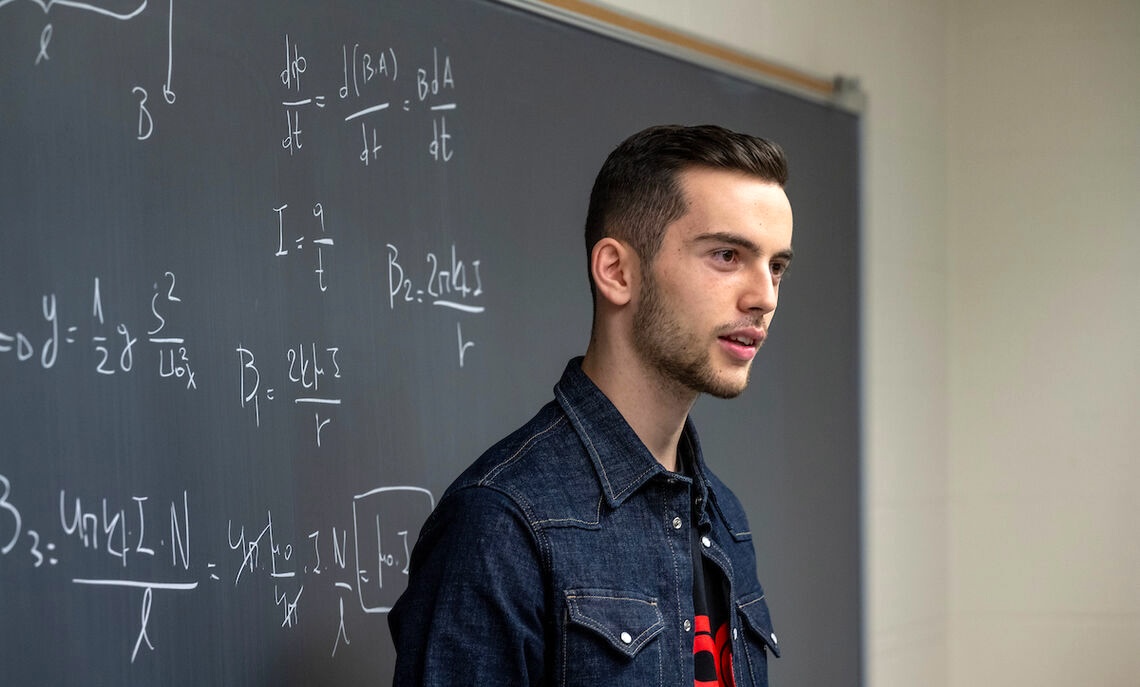
Earlier this year, that same echo reached a small observatory in Pennsylvania, where 21-year-old Greek physics student Menelaos Raptis and his team at Franklin & Marshall College (F&M) detected oxygen; the first sign that the cosmos was already seeding itself with the ingredients for life.
Sound exciting? But what does this breakthrough really mean? TO BHMA International Edition spoke with Raptis about his discovery, his academic journey, and what it takes to make the leap from dream to reality.
The Universe Taking its First Breath
Raptis described his breakthrough as “the Universe taking its first breath”.
“Seeing oxygen that far back in time felt like witnessing the moment the cosmos began enriching itself with the elements needed for everything that followed.”
“We were detecting traces of light that traveled 12 billion years before reaching our telescope; light that set off long before Earth, the Sun, or even our galaxy existed,” he tells TO BHMA International Edition.
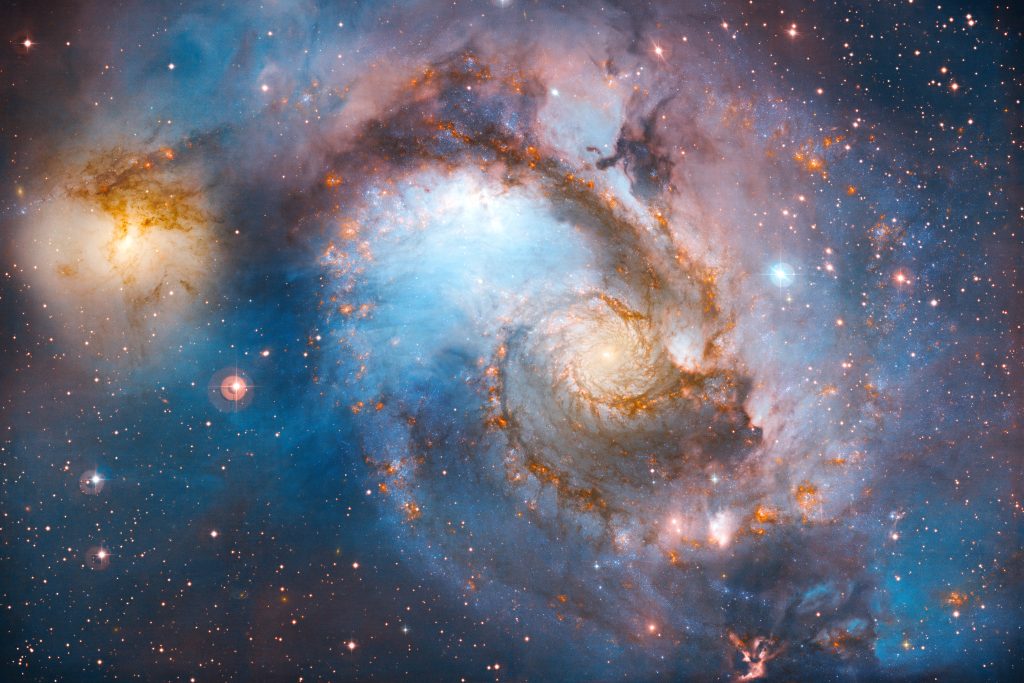
Galaxy in outer space. Beautiful science fiction wallpaper. Elements of this image furnished by NASA
It’s a discovery that stretches imagination to its limits: evidence that the first stars had already lived, died, and scattered oxygen into their surroundings only a couple of billion years after the Big Bang. For astrophysicists, this means the young universe was already evolving: producing and recycling heavy elements essential for the formation of galaxies, planets, and, ultimately, life itself.
For Raptis, the experience was both humbling and exhilarating, and the result of hard work and persistence.
From Thessaloniki to the Stars
Born in Thessaloniki, Menelaos Raptis first became fascinated with space at age seven, when his father got him a telescope as a gift. It was only a matter of time before his childhood dream became a reality.
Years later, when he sat the Greek university entrance exams, he ranked first among the candidates for the Aerospace Science and Technology program at the National and Kapodistrian University of Athens. Yet, despite his success at home, he made a bold choice: to study abroad. F&M in the U.S. offered what he calls “the chance to be part of something huge in astrophysics”. He also believed the US is the place where this could be possible.
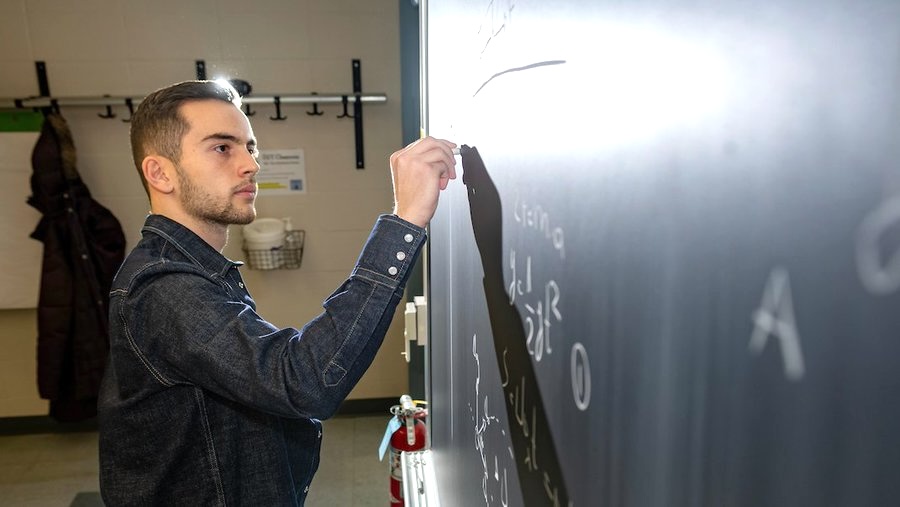
Photo: Franklin & Marshall College
“This isn’t just where you study the universe, it’s where you learn how to change it,” he explains. F&M also offered research opportunities, mentorship and a supportive community, and “that’s how I knew it was the right home for me”.
On the idealistic side of things, Raptis felt he would also be continuing the legacy of his ancient Greek ancestors in astronomy and the sciences, and taking it forward with the resources available today.
Greece Brain Drain: A New Generation Rising
Raptis’ story stands in stark contrast to that of many of his peers. After the economic crisis that struck Greece in 2010, followed by the Covid-19 pandemic, an entire generation of young Greeks saw their dreams shattered. Despite being highly educated at some of the world’s most prestigious universities, many faced uncertain futures. At home, their prospects meant a basic full-time salary of around 800 euros gross ($925), with limited opportunities to progress on merit.
The result was a deep social wound: a “brain drain”, as thousands of talented Greeks left in search of better prospects abroad. The new reality created a generation hesitant to dream, while many lost faith that their hard work could change anything.
This appears to be changing in recent years, albeit at a very slow pace. And Raptis is a bright example. I asked him what advice he would give to young students in Greece who are just discovering their passions.
“Look up at the sky, ask questions, and dream boldly. Picture yourself winning an award, walking on the Moon, or exploring a parallel universe. Then open your eyes and give everything you have to make it real,” he says. “Be ambitious, because imagination is the first step. But it’s persistence that turns it into reality.
Building Blocks at Home
In addition to dreaming big, persistence, and hard work, Raptis says several Greek initiatives had laid the groundwork for his path. One was Odysseus II, a European Space Agency competition that invites young minds to imagine the future of space. “Through the innocent and creative lens of my younger self, I submitted drawings of robot-doctors and space hospitals,” he recalls. “That’s where it all began.”
From there, Raptis participated in the NASA Space Apps Challenge, a global hackathon where teams work to solve real-world problems in 48 hours. An intense experience, he says.
But the most formative for his future was Eduact, a Thessaloniki-based organization that introduces children to robotics and innovation. “I remember spending endless hours assembling robots out of Lego bricks, designing projects to protect the ecosystem or solve everyday problems,” he says. “Working with those small building blocks taught me something larger: how to recognize the building blocks of life itself: creativity, problem-solving, and collaboration.”
“Robotics also showed me that when you connect the smallest pieces with patience and vision, you can create something far greater than the sum of their parts.”
The Challenges Abroad
The journey from Thessaloniki to Lancaster, Pennsylvania, was not without challenges, Raptis tells TO BHMA International Edition. The language barrier, cultural differences, and the intensity of advanced research all tested his resolve. “It was quite the opposite of easy,” he says.
“But what kept me motivated was the dream my own Ithaca. I close my eyes and see myself conducting experiments in space as an astronaut, or analyzing the chemistry of faint baby galaxies. When your vision is that big, every difficulty becomes small.”
For Raptis, that vision is also about gratitude. “Any victory I achieve is never mine alone,” he says. “It belongs to my family, my mentors, and everyone who believed in me.”
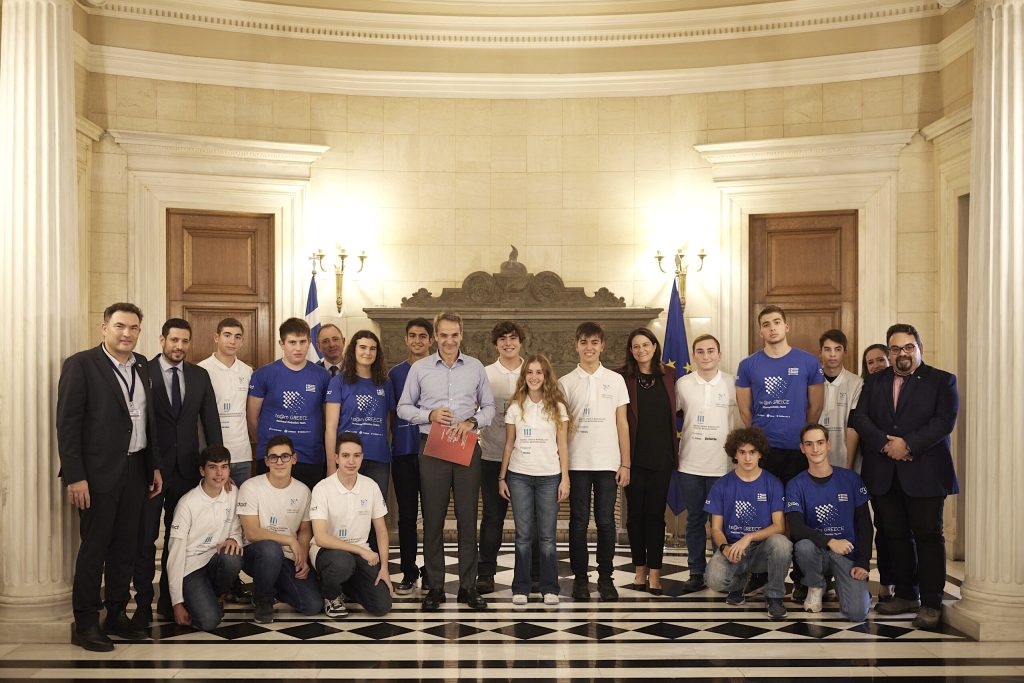
Greek Prime Minister Kyriakos Mitsotakis welcomes the EduACT Greek national robotics team at Maximos Mansion to congratulate them on winning the gold and bronze at the FIRST Global Challenge in Switzerland, 2022. Photo: EduACT
Of Science & Spirit
Asked what he hopes people take away from his discovery, Raptis doesn’t talk about data or telescopes, but about emotion; about “a sense of awe”.
“Even in its earliest stages, the universe was already laying the groundwork for galaxies, planets, and eventually life. Humans are made of stardust, the same materials forged inside stars at millions of degrees. To detect those same fundamental chemicals across such vast distances and timescales is what truly fascinates me.”
This connection between science and wonder defines his approach. He sees physics not as a cold discipline, but as a lens to explore creation itself. “Space exploration is unpredictable. There are no textbook answers; you need problem-solving skills, adaptability, and the courage to pursue ambitious goals, even when they seem impossible.”
Above all other skills, Raptis, who is one step closer to his childhood dream of becoming an astronaut, says mindset matters most. “Curiosity, persistence and resilience are everything… and the courage to pursue ambitious goals, even when they seem impossible.”
Bringing our interview to a close, I asked him what he would tell a high-school student in Greece who thinks their dream might just be too big. His reply: “No dream is too big. If it feels that way, that’s amazing. Aim for 100 and even if you reach 50, you’ve gone farther than you ever imagined. Aim for 50, and you might only reach 10. The key is to keep dreaming, aim high, and take the steps you need to get there.”