Once, summer on Greece’s islands was measured by the first seasonal winds (locally known as meltemia), the growing frequency of ferry routes, and groups of friends gathering on the beach just before sunset. Today, it is measured in entirely different terms: cubic meters of water and megawatts of electricity consumed, rising volumes of waste and sewage, building permits issued, new lodgings added, and steadily increasing arrivals.
Across much of the Cyclades, the Dodecanese, and the Ionian Islands, tourism has become the dominant economic force, driving investment while simultaneously reshaping landscapes and the daily lives of permanent residents.
The picture emerging across the Grecian isles is deeply contradictory. At a time when numerous islands—including Astypalaia, Karpathos, Tinos, Alonissos, Symi, Corfu, Leros, Meganisi, Patmos, and Aegina—have already been declared in a state of emergency due to water shortages before the peak of the summer season, tourist accommodation continues to multiply quietly.
Hotels, short-term rental properties (such as Airbnb-style listings), and holiday homes are expanding, often accompanied by swimming pools of every size and shape in places where water has long been a scarce and pressured resource.
Construction ‘championship’ across Greek islands
The footprint of this relentless expansion is visible in the surge of building permits, particularly in Santorini and Mykonos, but also in Tinos, where approvals nearly doubled in 2025 compared with the previous year. A similar construction boom is recorded in Paros, Naxos, Milos, Antiparos, and even Upper Koufonisi.
Data on overnight stays and built-up land further highlight the scale of spatial pressure caused by overtourism on Greek islands. According to the 3rd Report of the Aegean Sustainable Tourism Observatory —scientifically supervised by professor emeritus Ioannis Spilanis of the University of the Aegean— the Ioanian Sea Island of Corfu (including the Diapontia Isles) records nearly 12 million overnight stays annually, in a population of just 98,127 residents. Santorini follows with 5.8 million.
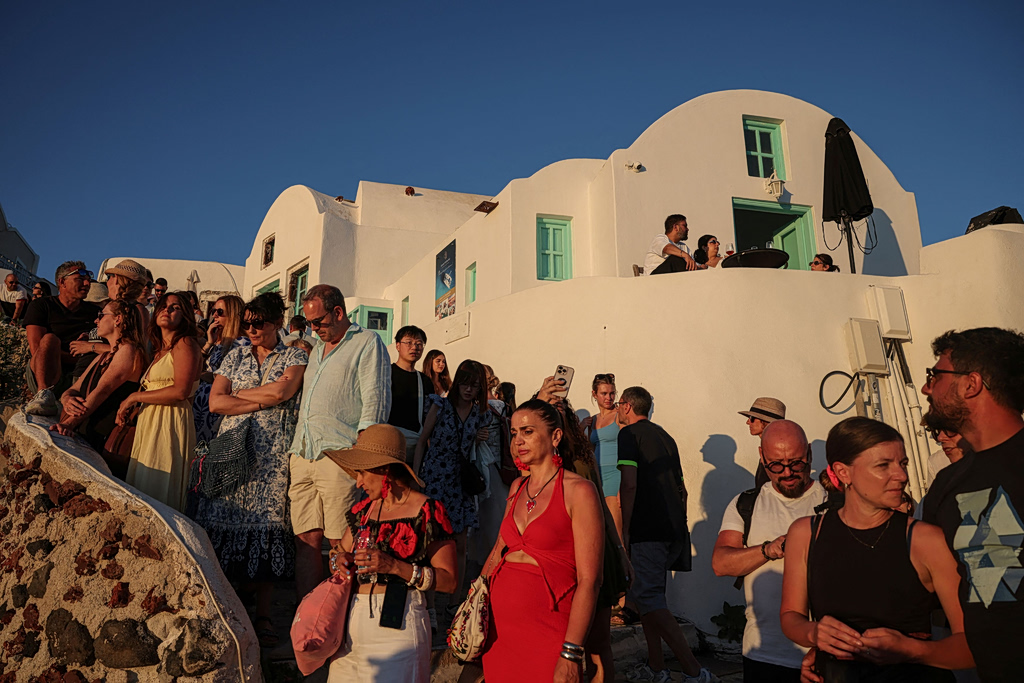
Tourists gather to watch the famous sunset in the village of Oia, on the island of Santorini, Greece, June 23, 2026. REUTERS/Louisa Gouliamaki
On Mykonos, 4.6 million overnight stays translate into more than 430 per resident, while built-up land reaches 23.29% of the island. On Santorini, concrete covers 20.22% of the territory, and on Paros 7.09%, with signs that development pressure remains strong, as the island records more than 3.7 million overnight stays. Even smaller destinations such as Koufonisi, home to just 148 permanent residents, show significant tourism intensity, with built-up land exceeding 8%.
Spilanis criticizes the dominant development model, which measures success primarily through arrivals. He argues that continuous increases in visitors and tourism infrastructure do not necessarily lead to sustainable development. Instead, they push destinations, especially small islands, beyond their carrying capacity. Mass tourism increases consumption of scarce natural resources such as water, land, and energy, while also multiplying waste generation (estimated at 1.8 to 2 kg per overnight stay) and wastewater.
When water runs short
Nowhere is the cost of this model more visible than in water consumption. Seasonal demand on Greek islands reveals one of the most extreme cases of water stress in the Mediterranean due to overtourism.
On Mykonos, with just 10,700 permanent residents, daily water consumption jumps from 1,600–2,000 cubic meters in winter to 10,000–18,000 cubic meters in summer, up to nine times higher. Santorini records increases of more than 500%, while Paros and Karpathos see rises of 344% and Naxos 238%, respectively, revealing severe seasonal overload.
Professor Dimitrios Emmanouloudis, Director of the ASSIST Laboratory and UNESCO Chairholder on Conservation & Ecotourism of Riparian and Deltaic Ecosystems at Democritus University of Thrace, notes that high-end hotels are exceptionally heavy water consumers. While a tourist in basic accommodation uses around 450 liters per day, luxury hotel usage can reach 1,000 liters per person daily. When multiplied across hundreds of beds, the strain on already stressed island water systems becomes clear.
Hydrologist and assistant professor Elissavet Feloni of the University of West Attica adds that water demand is surging due to tourism pressure and unregulated off-plan construction, with the state often reacting through crisis management rather than prevention. She cites desalination plants as a key example: from around 80 units in 2009, Greece now has over 150. Many projects, she notes, are fast-tracked under emergency procedures, bypassing environmental licensing. She also highlights losses of 30%–50% of water through outdated municipal distribution networks. For water-scarce islands, Feloni warns that authorities have abandoned proven solutions such as rainwater collection tanks, while hotel and vacation home development with swimming pools continues without hydrological oversight.
In 2025, the government attempted to address water scarcity through a plan involving more than 100 water supply and desalination projects across 61 island municipalities. However, most have yet to be tendered. Meanwhile, water transportation by tanker trucks or ships remains an essential stopgap measure.
Six months of peak energy demand
Overtourism’s impact is also reflected in electricity consumption. According to the Observatory, summer energy demand compared with winter rises by 235% in Rhodes, 194% in the Sporades islands in the central Aegean, 193% in Kos, and 190% in Mykonos.
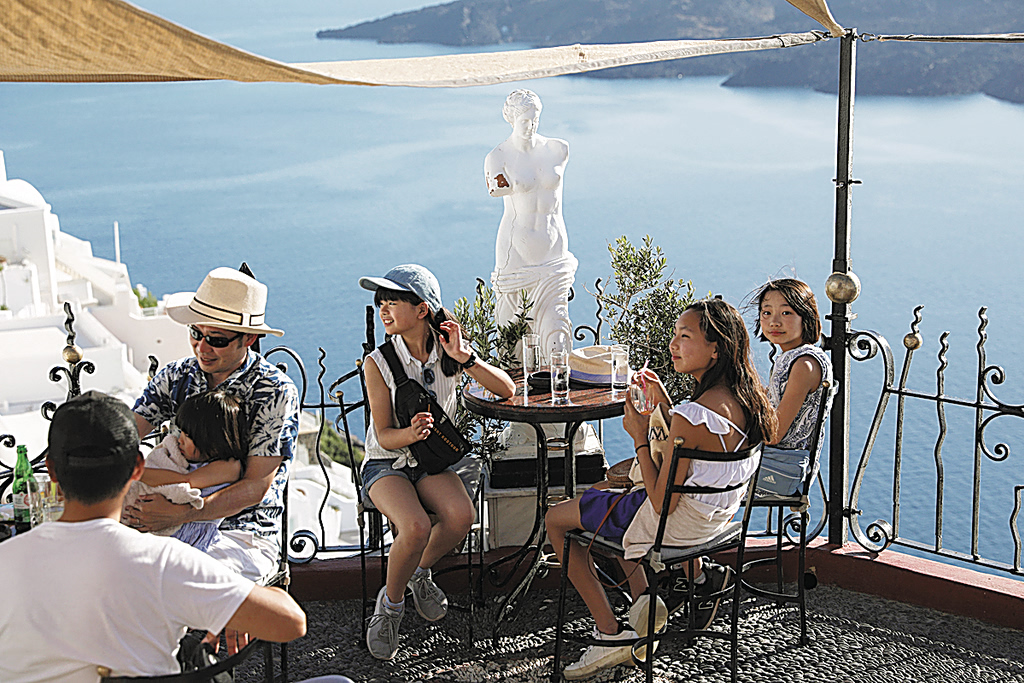
Tourists sitting at a coffee shop overlooking the iconic Caldera in Santorini.
The pressure is not limited to peak summer months but extends from spring to autumn. Rhodes experiences nearly six months of elevated demand (April–September), while Kos, Corfu, and Zakynthos also face prolonged high-consumption periods. Mykonos, although its peak season is shorter—around four months—still records extreme spikes.
It is no coincidence that Greece’s electricity operator (HEDNO) begins preparations for each tourist season immediately after the previous one ends. For the current summer, it has already requested additional support for 14 non-interconnected islands, including Rhodes, Kos, Lesbos, Santorini, Chios, Samos, Lemnos, Milos, Karpathos, Patmos, Skyros, Serifos, Kythnos, and Amorgos.
The trap of monocultural economies
The consequences of overtourism extend beyond utility meters into the structure of local economies themselves. Professor Spilanis warns that overreliance on tourism creates “monoculture” economies with low productivity, limited innovation, and heavy dependence on external capital.
Several island municipalities, including Megisti (Kastellorizo), Astypalaia, Amorgos, Sifnos, Santorini, and Mykonos, show employment rates in accommodation and food services exceeding 50% of total jobs. In the Dodecanese, 33.9% of Gross Value Added comes from hospitality and catering.
While tourism generates significant economic benefits, it simultaneously intensifies pressure on islands’ carrying capacity. It also disrupts daily life through housing shortages, rising living costs, traffic congestion, and strain on public services and infrastructure. Compounding the issue is the absence of a unified national system to record the full impact of overtourism, with data fragmented across multiple agencies—hindering both analysis and effective policy design.
Have the islands reached a saturation point?
The key question now is whether the islands have already reached or exceeded their saturation limits.
Data from the Sustainable Tourism Observatory shows Santorini has the highest overall density, with 964 beds per square kilometer (or 1,164 including permanent residents), surpassing even the Attica region. It is followed by Salamina, Mykonos, Skiathos, Aegina, Spetses, and Poros. The European Environment Agency’s recommended threshold of 100 beds per square kilometer has now been exceeded in many islands.
Santorini Mayor Nikos Zorzos has warned of a threat to the very existence of the islands in a recent letter to the Regional Union of Municipalities of the South Aegean. Many other local officials echo similar concerns, accusing large-scale tourism investment of becoming a vehicle for altering the islands’ natural, cultural, and social fabric. On the other hand, South Aegean Regional Governor Giorgos Hatzimarkos argues that tourism is not the problem but the solution, stating that the real deficit lies in infrastructure and enforcement mechanisms.
What is not disputed is that tourism has brought wealth and development to the islands. The question is no longer whether it is needed, but how much more it can sustain, and under what conditions. In places where water is delivered by tankers, electricity demand surges within weeks, and construction spreads across every available slope, the issue of carrying capacity is no longer theoretical.
As an alternative, Spilanis advocates a model of sustainable “slow tourism,” focused on quality over quantity, longer stays, deeper connection with local communities and culture, and the protection of both the environment and the islands’ identity.