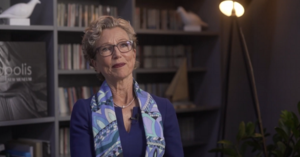
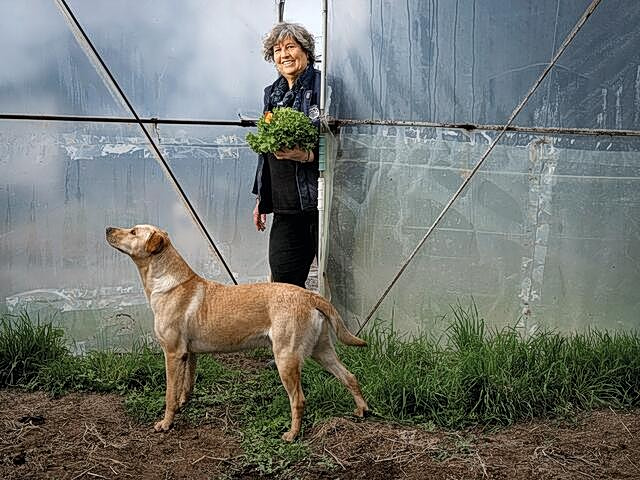
In Metochi, near Epanomi in northern Greece, Chrysoula Skorditi cultivates land that was once poor and depleted. Together with her husband, she made a bold decision in 1995: to convert their farm to organic production at a time when the idea was still difficult to explain—even to neighbors. Their motivation was straightforward: concern for the soil, for their children growing up beside the fields, and for the food that reaches other people’s tables.
Before becoming a farmer, Skorditi worked as an accountant. Those skills proved invaluable. She brought order to the farm’s finances, planned investments carefully, and gradually built a sustainable business.
At a time when organic farmers sold their produce in open markets in what was essentially a grey legal zone, she believed things could—and should—be different. She went on to serve as president of the Union of Organic Farmers of Northern Greece, dedicating countless hours to securing recognition for organic markets.
Looking back, however, it is not her achievements that stand out most in conversation with her. It is the simplicity of her words—and a quiet optimism that seems to shine through her constant smile.
Sowing change, reaping plenty
It was the chemical spraying of the vegetables that gave Chrysoula Skorditi the idea of converting the estate to organic farming. Dressed in full-body suits “like astronauts,” they would spray the fields that were right next to the family home, where the children were growing up. Talking with other women farmers, she realized her concerns were widely shared. “We worried about our own children,” she says, “but also about other people’s children who would eat this food.”
The decision to transition to organic farming was not easy. In the beginning, yields dropped and plant diseases were harder to manage. But for Skorditi and her husband there was no turning back. They experimented with agroecological practices and companion planting. “We plant basil next to eggplants, and strong plants like onions and garlic to help prevent bacterial and fungal diseases. I have also planted roses, which act as indicators for powdery mildew and downy mildew.” Gradually, nature began to restore balance. “If you let nature do its work,” she says, “things eventually find their way.”
The accountant who never stopped thinking in numbers
Numbers fascinated Skorditi from an early age. Excellent at mathematics, she initially pursued a career in accounting before her love of the land took over. Today, she notes, many farmers still lack the tools for proper financial management, especially when it comes to calculating the true cost of production. For her, careful bookkeeping became a cornerstone of the farm’s success. “Everything we built was done without loans,” she says. “The vehicles, the greenhouses, the house, the machinery—everything was financed entirely from the farm’s profits.”
From legal grey zone to official recognition
For ten years, Skorditi represented organic farmers across Northern Greece. She attributes her effectiveness partly to a strong sense of self-confidence. “You should never say, ‘I am weak because I am a woman. I am a strong person, and this is my work. What matters most is that you stand firmly on the ground.” In fact, she believes being a woman sometimes worked in her favor. “I was respected for my knowledge. At meetings in the Ministry, the other presidents of farmers’ unions—who were all men—would say: ‘Let Ms. Skorditi begin speaking.’”
The endless hours and trips to Athens eventually paid off: in 2019, organic farmers’ markets gained official recognition, allowing hundreds of producers to sell within a regulated framework.
Leadership from women farmers
Anyone visiting the organic farmers’ market in Thessaloniki quickly notices its distinctive sense of order. According to Skorditi, this identity began with a previous president, Dora Evangelinou, who introduced uniform standards: three-meter stalls and identical umbrellas.
Skorditi’s long tenure as president later helped inspire another woman to step into leadership. “Two years after I stepped down, Anna Aivazidou became president of the body overseeing Thessaloniki’s organic market—a woman with love for the land and a vision for organic markets. I am honored that she looks to me for advice and asks for my opinion.”
Younger women farmers are also bringing fresh ideas, particularly in entrepreneurship and small-scale food processing. “I see young, educated women entering agriculture who focus not only on production but also on processing—creating sauces, biscuits and specialty foods that add value to their crops and are beautifully packaged.” She smiles. “Women have a kind of creativity that men often don’t.”
Guardian of vanishing seeds
At her stall in Thessaloniki’s organic farmers’ market, Skorditi currently sells the fluffy “Macedonian” cabbage and “Kalemi,” a slender leek variety. These are traditional landraces — shaped over long periods of time, adapted to Greek soil. She now keeps around twenty varieties that have all but vanished from the fields, driven out by higher-yielding modern cultivars. Saving her own seeds helps cut costs, but what drives Skorditi above all is the diversity of colors, flavors, and stories that each variety carries. One of her favorite examples is okra. “I found the seeds from an elderly man in Serres who had posted an ad online,” she recalls. “He had four varieties—red, green, white and a plump one. I paid 250 euros for 240 grams of seed.”
Her long-term vision is to see farmers who preserve heirloom varieties collaborate with genetic scientists to protect and promote them. She herself worked closely with the late geneticist Nikos Stavropoulos, director of the Greek Gene Bank in Thermi, to learn the techniques of seed saving. “It’s work that takes time,” she says. “Consumers must learn to appreciate traditional varieties, and farmers need access to seeds. It is a difficult goal—but I believe we will get there, step by step.”