The road that climbs from Alexandroupoli toward northern Evros seems to transport you not just to another place, but to a different scale of time. As if you leave behind not only the city, but an entire “narrative”: the construction projects, the energy discussions, the grand statements about ports, the references to the strategic importance of the region, the language of investments and geopolitics—all of this “disappears” into the background, and in front of you opens another Evros. Less talkative, and much more revealing.
Here, depopulation does not take the spectacular form of a mass exodus. It resembles more a slow, silent withdrawal of life from the place.
An elderly person dies, a house closes, a family moves to Orestiada or Alexandroupoli for the children. Then a young person decides the daily wage is no longer enough, a service leaves, a class is abolished, a café runs at minimal capacity. This is how a place shrinks. Without dramatic intensity or shouting. Quietly, almost administratively, until at some point the absence ceases to be a detail and becomes the landscape itself. Villages learning to live with fewer people, fewer jobs, fewer opportunities for tomorrow.
“I pay like in Mykonos”
In Mikra Doxipara, Chrysoula Kitsiouki’s café opens at six in the evening. That is when the few regulars of the village appear. Six, seven, at most eight people. All elderly. The café, she says, has been around since 1976, back when the village still had energy, neighborhoods, pathways, more open houses than closed ones. Today, about eighty people live in the area. She remembers that in the past there were over three hundred.
“The expenses no longer add up,” she says bluntly. Then, almost with a tired irony, “I pay like in Mykonos.” The phrase describes a permanent Greek paradox: a café in a village of a few dozen inhabitants bearing costs as if it serves an entire tourist market. Electricity, phone, internet, fixed fees, obligations. Only here there is no tourism. No hordes of visitors, no summer market miracles. There is only the determination to keep a space open that, if it closes, will take with it more than a small business.
In Mikra Doxipara, there is no grocery store, no other shop, basically nothing. For shopping, residents go to Kyprinos or Megali Doxipara. So the café is not just a café, but the last point of public life. It has a microphone system; announcements about the doctor’s visits or pension deliveries are made through it. “Whoever hears it comes,” says Mrs. Chrysoula.
In other areas, the state reaches people through platforms, notifications, apps. Here it arrives via a café microphone and Chrysoula’s voice. A small transmission that keeps the village coordinated, where central administration rarely reaches anymore. In her neighborhood, she says, four people remain. “Three women and one man. From here on, all the houses are empty,” she points out. The phrase comes without flourish, as a simple record—and perhaps that is why it hits harder.
The Dead End of an Active Age
In the same village lives Christos Michoglou, 50 years old, beekeeper and operator in a cereal cleaning facility. The fact that he is considered “young” by Mikra Doxipara standards is enough to describe the demographic trend of the place. Christos had left for Germany and returned in 2008, during the crisis. “I came back from Germany in 2008 and lost everything,” he tells To Vima.
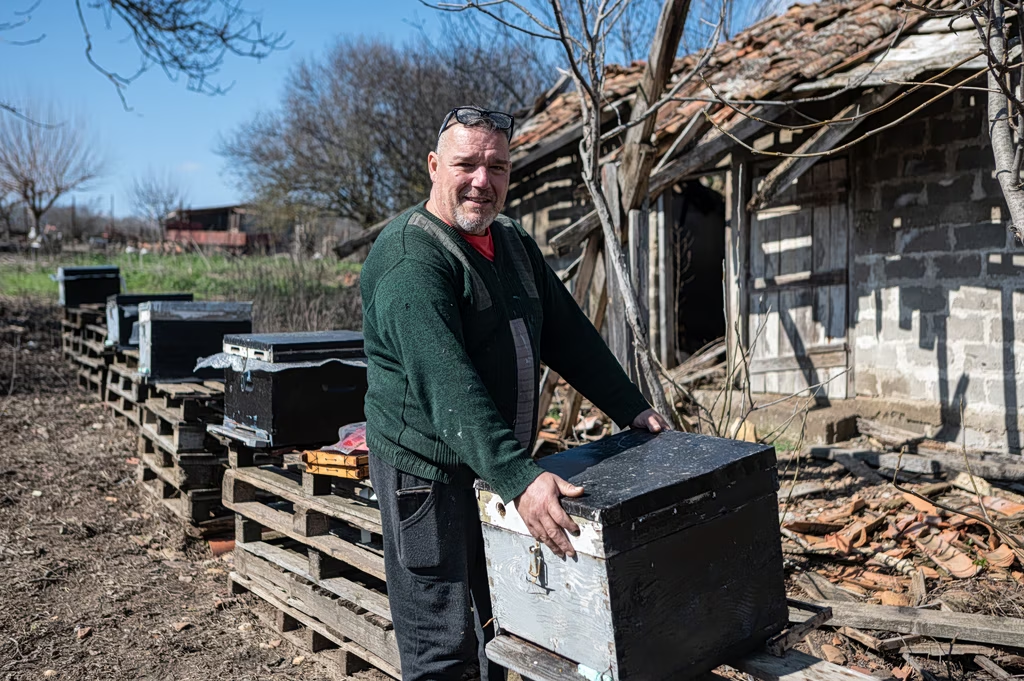
“I want to leave from here. Life isn’t easy. But with what courage could I start somewhere else?” says Christos Michoglou.
“When you ask him if he thinks of leaving again, he doesn’t hesitate. ‘I want to leave from here. Life isn’t easy. But with what courage could I start somewhere else?’”
This sentence contains all of northern Evros: the deadlock of an active age that can no longer breathe here or elsewhere. It’s not only villages that are aging, but villages where the present itself is drying up. Places where even those who remain seem to be in a strange, endless waiting room.
“Half the village was lost in four years”
In Therapeio, the image is even starker. Apostolis Mavroudis, president of the community, now counts the village by absentees. Today, he says, Therapeio has 27 residents. When he was a child, there were 350–400. “It used to be a festival here every night,” he recalls, pointing to the square’s café that was once family-run. The village did not empty in a single year; it has been emptying for years. Recently, however, the pace has accelerated. “In four years, 50% was lost,” he reveals.
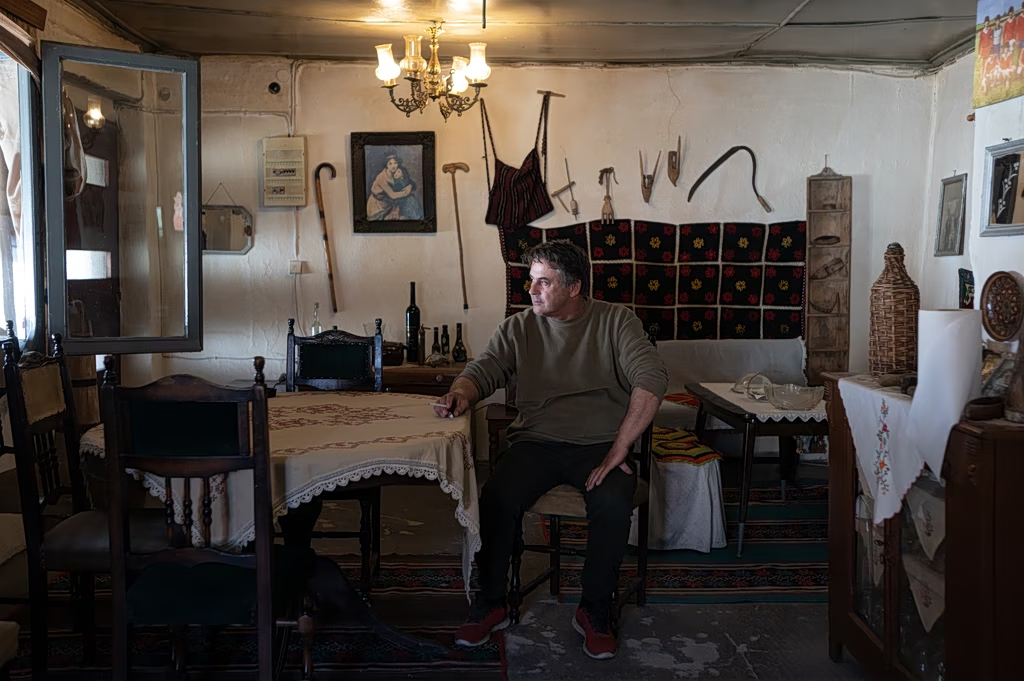
Apostolis Mavroudis, president of the community in Therapeio, now counts the village by its absentees. “Every funeral that takes place here feels like I’m losing one of my own,” he says.
Most residents in Therapeio today are elderly, mainly women, many widows. The men are few, and not all able to leave the house. In a village of 27 people, depopulation is reflected not only in numbers but also in the small acts needed to keep life going at all. Apostolis Mavroudis describes to To Vima how care often becomes the responsibility of the residents themselves: “A few days ago, we went to someone in the village who was alone. The house had no electricity, a broken window. We went with two others, fed him, lit the stove, cleaned up.”
“Every funeral here feels like losing someone of my own,” he says.
The narration comes without dramatization, almost like a daily duty. Yet within this simple description lies the reality of a place that is aging and emptying. When structures are absent, the community becomes the last line of care. “Every funeral here feels like losing someone of my own,” he says, his voice breaking with emotion as he wipes his eyes. “You cannot understand, children, what we go through here,” he concludes.
“There is no good daily wage”
For over a decade, Panagiotis Zisidis’ life in the village of Elia revolved around animals, seasons, and work in the fields. His herd reached four hundred sheep—until disease struck and the herd was destroyed. He describes the process starkly, almost as if enumerating events frozen inside him. The crew came, separated the animals, killed them, buried them. First they were there, then they left. “It was total destruction,” he explains. “Work that took over ten years to build, gone in one day.” The village today has just over 150 residents, with an average age exceeding 70. “Every few days there’s a funeral; births are practically nonexistent.”
He does not focus only on demographics, but also on the cause. “The first and main reason villages are deserted is that there is no good daily wage,” he believes.
In the region, everything depends on agriculture and animal husbandry. If these sectors become unstable, the place begins to empty. The village economy is not an abstract concept, but fields that must be watered, animals that must be fed, seasons that must take their course. Yet in recent years this balance has become increasingly fragile. Winter rains often turn to floods, while in summer water decreases and irrigation becomes uncertain. Panagiotis Zisidis sums it up with a phrase that sounds almost like a local proverb: “In winter we flood, in summer we say the water is little water.”
In a place where work depends on these balances, any failure opens a small crack. When asked if he feels driven away from his land, he doesn’t raise his voice. He answers almost quietly: “That’s where things are heading.”
A Small Counter-Movement
Yet within this shrinking landscape, there is a small counter-movement. In Ormenio, Thodoris Vassiliadis, a 47-year-old speech therapist, decided to make the reverse journey. He lived in Alexandroupoli, worked in Orestiada, and ultimately settled permanently in Greece’s northernmost village, buying a house. The city, he says, does not always deliver on its promises.
“Alexandroupoli has become chaos. There is noise, and although there are many people, you are alone.” In the village, he emphasizes, not everything is ready-made. “Here, you must contribute; you must be an active member of the community.” And that is exactly what he does. He gathers children for drawing, experiments, treasure hunts, small activities that did not originate from any state plan, but from someone’s need to prevent the village from dying, even at the level of children’s lives. “Recently we held a treasure hunt. We expected ten children from the village, and fifty showed up from surrounding villages,” he recalls enthusiastically. “Some even came from Orestiada.” For an afternoon, the small square and the courtyards around the old school were filled with voices, bicycles, and children running from place to place searching for game clues.
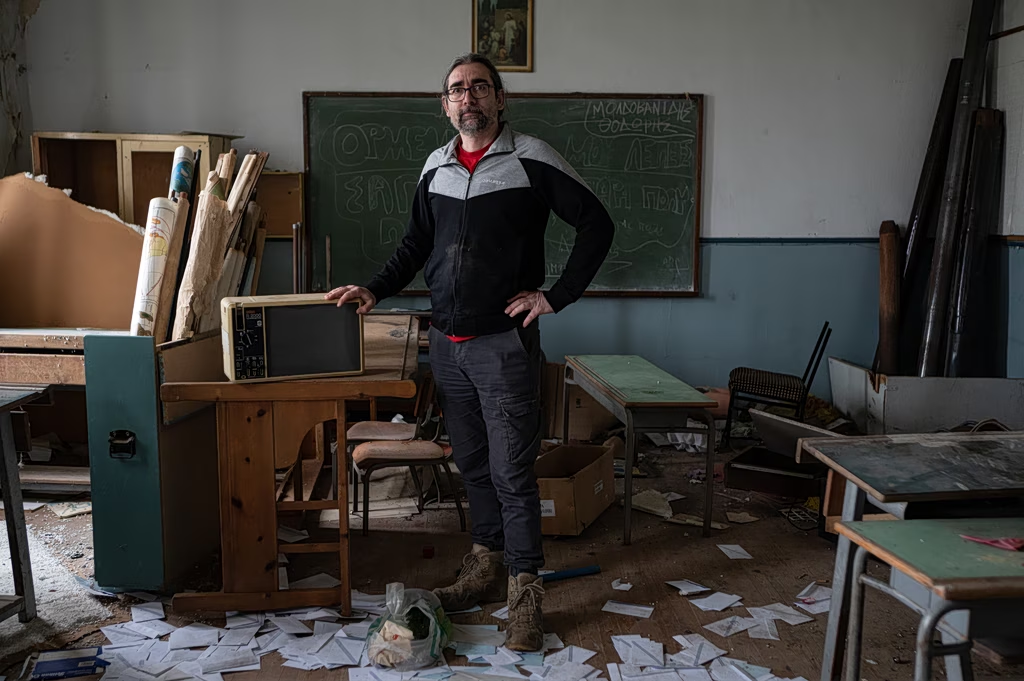
Thodoris Vassiliadis at the old primary school of Ormenio, the village where he decided to stay, contributing to the local community.
Most activities take place in the village’s old elementary school, a building technically owned by the municipality but kept alive because some people use and maintain it. In many villages of the region, such buildings have closed permanently and stand empty, as signs of a bygone era. Here, for now, something different happens. For a few hours at a time, the old school reminds once again of what it once was: a meeting place, and a point where a village, even temporarily, seems to have a future again.
“The state withdraws, and the people follow”
In northern Evros, this repeats as a consistent pattern. If you want something to exist, someone must keep it standing. Water it, dust it, defend it from decay. This pattern is described by Manolis Chatzipanagiotou, former mayor of the Trigono Municipality and today deputy mayor with multiple responsibilities. His language is more institutional, but the underlying reality is the same. Northern Evros, he says, did not empty only due to historical decay or residents’ personal choices, but because administrative and developmental decisions continuously shifted the center of gravity downward, toward Orestiada and especially Alexandroupoli.
He explains that when smaller communities and older municipalities were absorbed into larger administrative units, villages lost voice, access, and autonomy. Distances became an administrative problem, accompanied by the degradation of services, schools, and infrastructure. For residents of border villages, daily life began to revolve around larger towns tens of kilometers away. For a simple administrative matter, a doctor, or a public service, travel became almost inevitable. “When the state withdraws, the people follow,” he emphasizes. “And when services begin to leave, sooner or later the people leave too.” Every service that closed, every school merged, every office moved south, removed a little more weight. “Until, at some point,” he says, “a place begins to lose the critical mass it needs to survive.”
A Place at the Limits of Endurance
Today, northern Evros does not just resemble a declining border zone, but a place testing its limits of endurance every day. The depopulation evolving here is not only about a few border villages. It concerns the way the country manages its own region, and the question of whether life can still remain viable in its most remote corners.