A dog may be man’s best friend, but sometimes it is also a monkey’s or gorilla’s best friend. And dogs are far from the only ones. An international study led by researchers at the University of Oxford has documented, for the first time, unexpected friendships between primates and species no one might have imagined, including deer, squirrels, mice and pigs. The study, recently published in the scientific journal Primates, also sheds light on the human need for companion animals, suggesting that the behavioral “foundations” of our relationships with animals that eventually become members of our families may be far deeper in evolutionary terms than previously thought.
Unusual observations
As the study’s lead author, Dr. Cyril Grueter, associate professor of Evolutionary Anthropology at the University of Oxford’s Institute of Human Sciences, explained to TO VIMA-Science, the idea for the study, which was essentially a review of all existing evidence on the subject, came from some observations of his own that he described as “unusual.”
“I first saw a gibbon (family Hylobatidae) in a zoo holding and stroking a mouse that had entered its enclosure, and later I saw a young snub-nosed monkey (genus Rhinopithecus) repeatedly playing with pigs in China. I then began searching the scientific literature and discovered many similar reports, but they were scattered across several decades, and no one had ever brought them together. This led both myself and my team to wonder whether these were isolated incidents or whether they reflected a broader pattern of primate behavior.”
And once the researchers started looking, they found plenty. They combined evidence from the scientific literature, a total of 303 cases, with 58 cases reported in the media and another 66 cases gathered through interviews with primatologists, creating the most comprehensive review to date of primates’ social behavior in their interactions with other species.
In total, the researchers collected records of 427 friendly interactions involving 88 different primate species and 127 species of “companions,” 55 of which were non-primate species. The records revealed an entirely new world, previously unknown to science, in which monkeys and apes frequently play with other, unexpected species, groom them, hold them, carry them and, in some cases, even adopt them.
The most striking examples
Some of the most striking examples identified by the researchers involved bear macaques (Macaca arctoides) grooming the fur of stray dogs in Thailand, tufted gray langurs (Semnopithecus priam) gently stroking giant squirrels in Sri Lanka, young black-and-white snub-nosed monkeys playing with pigs in China, and ring-tailed lemurs (Lemur catta) grooming bamboo lemurs (genus Prolemur).
Researchers also documented an extraordinary case in Brazil in 2006, when capuchin monkeys (family Cebidae) adopted a baby marmoset (family Callitrichidae) and cared for it for several months.
Dr. Grueter highlighted several other examples that particularly caught his attention.
“There are numerous records of Japanese macaques (Macaca fuscata) that not only regularly groom sika deer (Cervus nippon), but often ride on them for a walk! Other remarkable examples include a mountain gorilla (genus Gorilla) that lulls a baby galago — a small, nocturnal African primate with large eyes from the family Galagidae — to sleep, as well as bonobos (Pan paniscus) that tenderly hold mongooses (small carnivorous mammals from the family Herpestidae).”
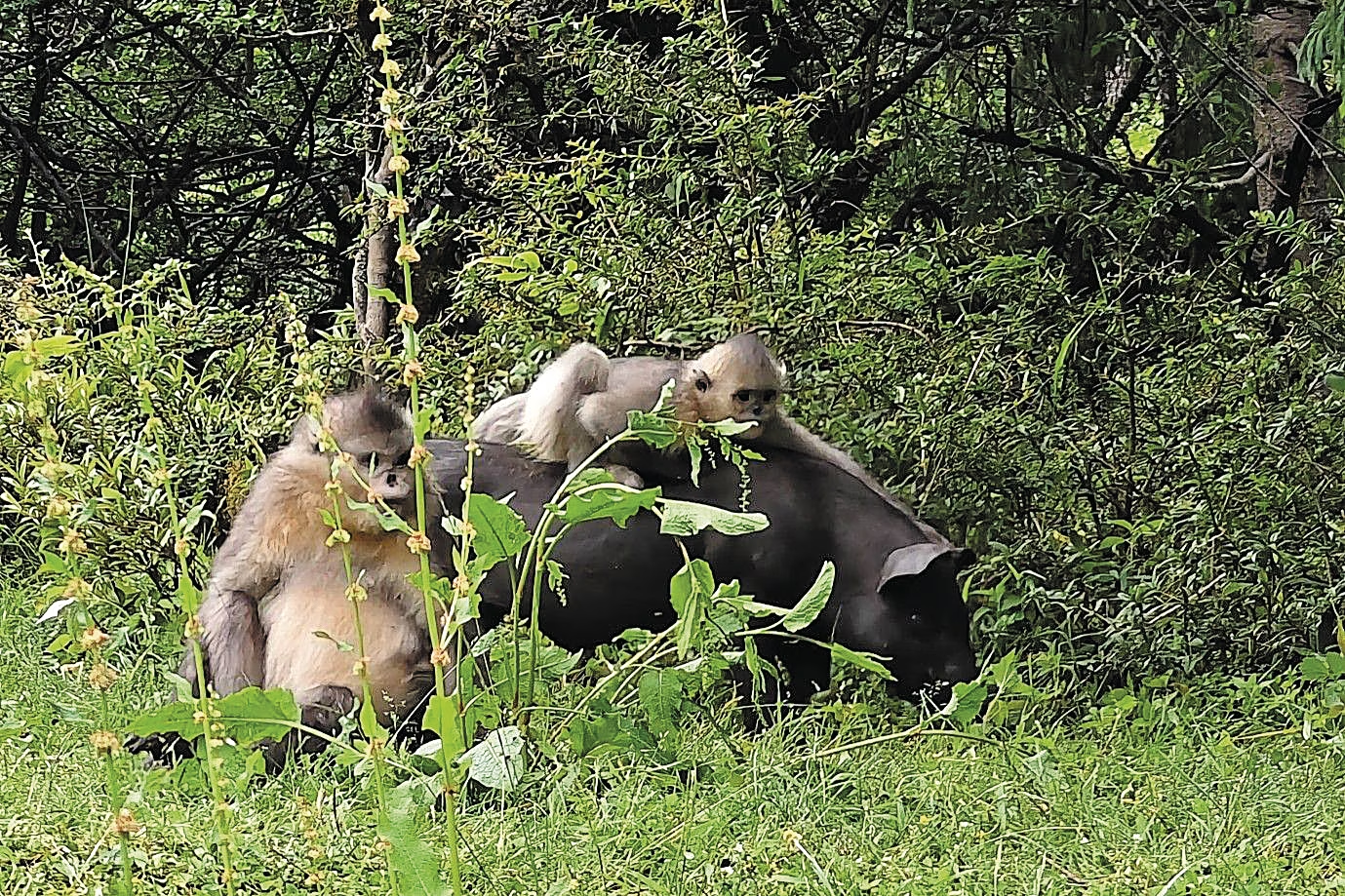
A young black-and-white snub-nosed monkey (Rhinopithecus bieti) plays with a domesticated pig in Yunnan Golden Monkey National Park in China. PHOTO BY YANPENG LI
Play and grooming
But what were the main forms of interaction between primates and other species? According to the analysis, play was the most common, with 139 cases, followed closely by grooming, one of the main forms of social behavior among primates, with 136 cases.
Younger animals were far more likely to play with members of other species, while adult females were much more likely to engage in grooming, as they typically do with their own young. Adult males, meanwhile, were far less likely to engage in friendly interactions with other species.
The researchers also found that primates were more likely to develop social relationships with closely related species. That did not rule out unexpected friendships with birds or even reptiles, however. Notably, it was mainly the primates that took the first step toward social interaction — essentially asking, “Do you want to be friends?”
But what do all these findings tell us, both about the social behavior of other primates and about us humans, who, let us not forget, may be the highest branch but are still part of the very same tree? We asked Dr. Grueter.
“For a long time, there was a belief that humans were unique in their ability to form relationships with other species. Our study shows that many primates also display great curiosity, as well as patience and care, toward animals that do not belong to their own species. We cannot say that these behaviors prove that primates have pets, in the strict sense of the term as we understand it, but they likely represent the evolutionary foundations from which the close companionship between humans and animals eventually emerged.”
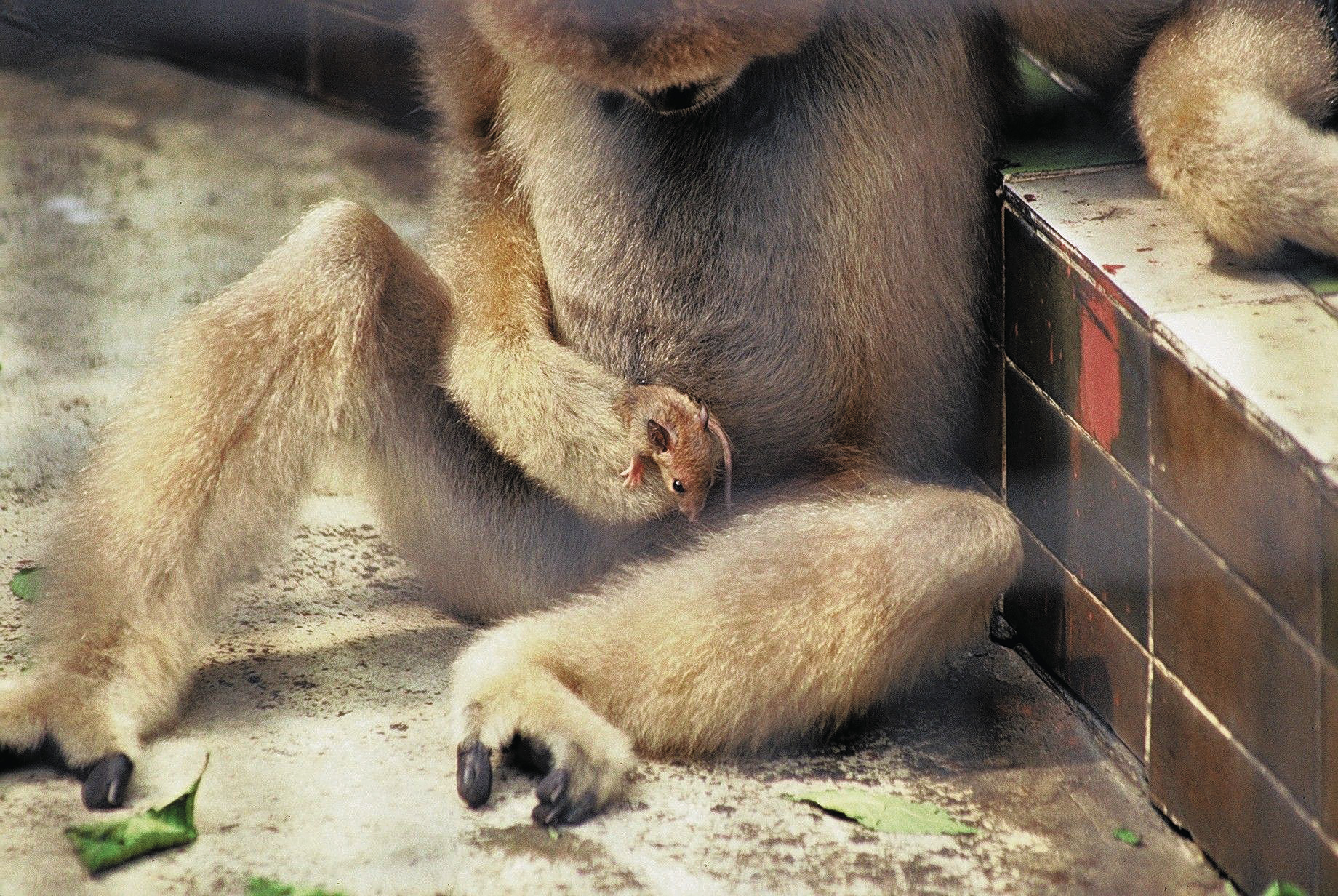
A female northern white-cheeked gibbon (Nomascus leucogenys) holds a mouse at Shanghai Zoo in China. PHOTO BY CYRIL GRUETER
The professor explained that when animals from different species “hang out” together, it usually happens for practical reasons. There is safety in numbers: a larger group means more individuals and therefore a greater chance of confronting a potential threat. At the same time, being together can make finding food easier.
“However, the primates we documented in our study went not just one but many steps further, playing with, grooming, carrying and caring for other animals without any obvious reward for doing so. This suggests that they developed relationships out of social curiosity and showed an unparalleled willingness to make friends with members of other species — something that feels very familiar to us, right?”
Practical applications
The new analysis does more than shed light on the roots of relationships between primates and other animal species, and ultimately on the relationship between humans and animals.
According to Dr. Grueter, it could also have practical applications for the treatment and welfare of animals in zoos and sanctuaries.
“Understanding why some species form positive relationships with other species could help improve the management of mixed-species groups in zoos and sanctuaries. At the same time, it is expected to improve our knowledge of how the increasingly frequent contact between wild animals, domestic animals and humans can affect disease transmission, species conservation and animal welfare.”
In closing, Dr. Grueter expressed hope that now that this “friendly” beginning has been made with the study, it will encourage primatologists to systematically document in the field these important but, until now, largely overlooked interactions between primates and other species.
“More detailed observation is expected to answer key questions, such as why some species develop friendly relationships while others do not. At the same time, our research team plans to investigate whether these types of interactions become more common as wild animals gradually lose their habitats and come into more frequent and closer contact with humans and domestic animals. We hope that now that the process has begun, what comes next will be even more illuminating.”
Because better knowledge will translate into better animal management. And then the apes, monkeys and their great, wonderfully diverse circle of friends may be able to play even more carefree.