Royal Family on Edge
Dawn broke quietly over Windsor, but the calm was deceptive. Beneath the bare winter trees and behind the high gates of Royal Lodge, the rhythms of royal life had been replaced by the low hum of engines and the measured movements of unmarked police vehicles. Vans came and went. Doors opened, closed. For a house long associated with privilege and permanence, the scene spoke instead of uncertainty and consequence.
Against this backdrop, the government is understood to be considering legislation that would remove Andrew Mountbatten-Windsor from the line of royal succession, a move that would ensure he could never become King.
On Thursday evening, he was released under investigation 11 hours after his arrest on suspicion of misconduct in public office, an allegation he has consistently and strenuously denied.
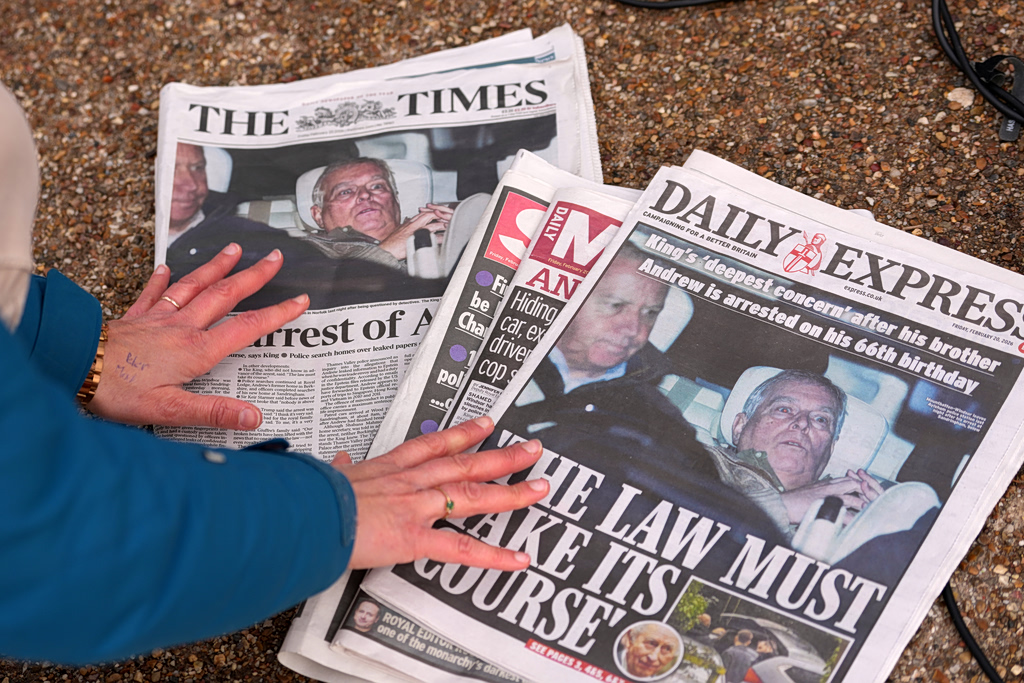
A journalist looks at today’s newspaper front pages in London, Friday, Feb. 20, 2026 after Andrew Mountbatten-Windsor was arrested and held for hours by British police on suspicion of misconduct in public office related to his links to Jeffrey Epstein.(AP Photo/Kin Cheung)
By Friday, the focus had shifted firmly to Royal Lodge, the 30-room property where Andrew lived for many years. More than 20 vehicles were seen parked at the estate at various points, though it remains unclear how many were directly connected to the investigation. Thames Valley Police, which carried out the arrest, is expected to continue searches at the property until Monday.
What unfolds next will depend on the slow, methodical progress of the law. But for now, the image is a stark one: a royal residence under scrutiny, a prince under investigation, and a centuries-old institution facing another moment where tradition meets accountability.
From Scandal to Criminal Inquiry
The arrest of Andrew Mountbatten-Windsor has pushed a long-running controversy into a new and far more serious phase, raising legal, political and constitutional questions that extend well beyond one individual. Triggered by the release of millions of documents linked to Jeffrey Epstein, the case now sits at the intersection of criminal law, public office and the monarchy’s ability to protect its institutional standing while one of its own remains under investigation.
For Dickie Arbiter, who served as press spokesman to Queen Elizabeth II from 1988 to 2000, the chain of events unfolding over recent days was not unexpected.
Speaking to TO VIMA, he said: “What we’re seeing is the result of the release of the Epstein papers, three and a half million documents a couple of weeks ago,” explaining that the material allegedly includes emails suggesting Andrew passed on sensitive documents during his time as a UK trade ambassador.
According to Arbiter, those documents were not only inappropriate for Epstein to possess, but were also material that Andrew “should never have had on his person”. The legal consequences followed swiftly.
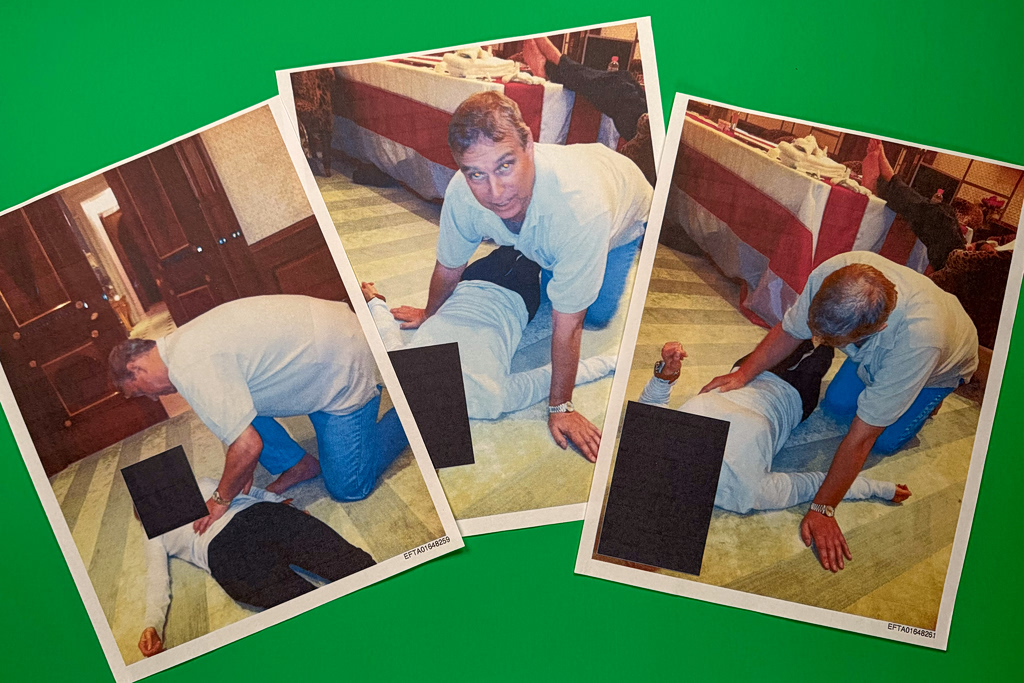
EDS NOTE: GRAPHIC CONTENT – Images from an undated and redacted document released by the U.S. Department of Justice, photographed Saturday, Jan. 31, 2026, show Andrew Mountbatten-Windsor, formerly known as Prince Andrew, leaning over an unidentified person. (AP Photo/Jon Elswick)
“They Arrested Andrew… Now They Want Answers”
“What happened yesterday was that he was arrested by the police who are investigating him as having committed misconduct in public office.”
What struck Arbiter was the speed of the police response. Only days earlier, Thames Valley Police had said they were still assessing potential wrongdoing.
“Less than a week later, they arrest Andrew on the basis that obviously, they’ve done their assessment, now they want answers to questions.”
Andrew was taken into custody, questioned for around 11 hours and then released under investigation. While in custody, police searched his current temporary accommodation at Wood Farm, and for days afterwards officers have continued searches at his former home, Royal Lodge in Windsor.
“So it’s not a happy scenario for him,” Arbiter remarked.
A Legal Grey Area
Yet despite the dramatic nature of the arrest, Arbiter cautioned against assuming a clear legal outcome.
“It’s a bit of a grey area, this misconduct in public office, because this has changed over the years,” he said, adding that the alleged passing of documents could be interpreted in different ways, including-but not necessarily amounting to-a breach of national secrecy.
Ultimately, he stressed, the decision lies first with the police and then with prosecutors.
“It’s up to the police to decide whether there is a case to present. The Crown Prosecution Service will then assess whether there is a case to answer.”
Only if prosecutors decide to proceed would the matter reach court.
“Should it go to trial, it would then be up to the courts to decide whether he has committed misconduct in public office or he hasn’t.”
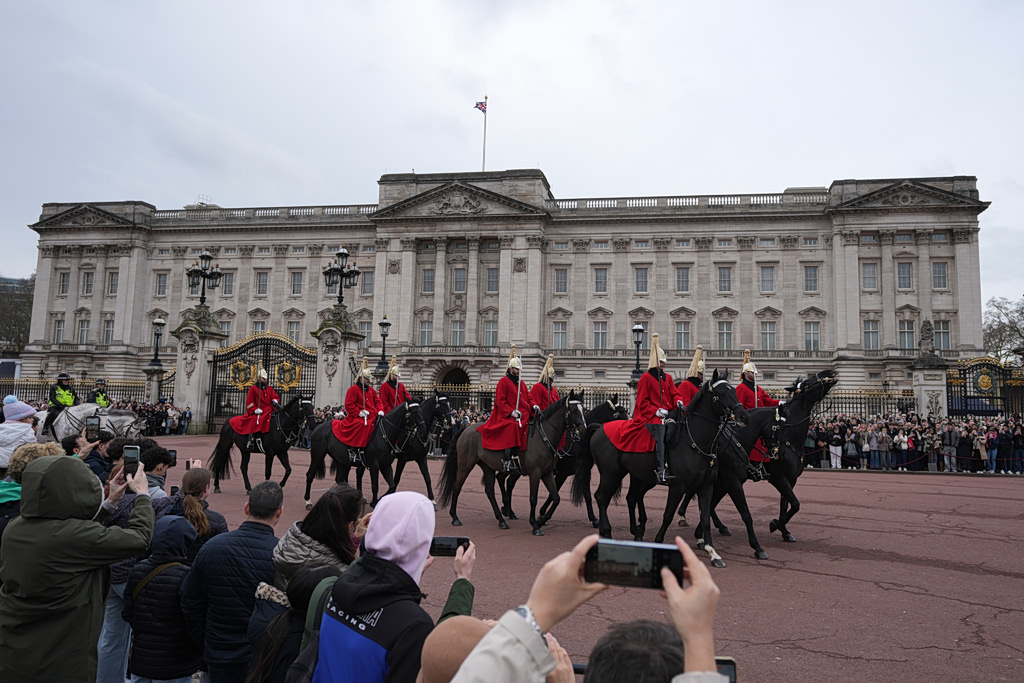
Soldiers parade during Guard’s Change at Buckingham Palace in London, Friday, Feb. 20, 2026 after Andrew Mountbatten-Windsor was arrested and held for hours by British police on suspicion of misconduct in public office related to his links to Jeffrey Epstein.(AP Photo/Kin Cheung)
Separating Brother from Crown
On the question of damage to the monarchy, Arbiter was clear that the institution itself is unlikely to be fundamentally shaken.
“The monarchy is a strong institution, and its longer-term effect is more on the family, because it’s one of their own.”
He pointed to the King’s statement following the arrest as particularly revealing. Issued explicitly in his role as head of state, it referred to “Andrew Mountbatten-Windsor” rather than “my brother”.
“Which is very telling,” Arbiter said, arguing that the King is deliberately separating the alleged actions of his brother from the authority of the Crown.
That separation, he added, extends to Andrew’s associations with Epstein and to unresolved allegations of sexual misconduct.
“There are innuendos, there are allegations, but separating Andrew from the state.”
Despite the turbulence, Arbiter noted that royal life has continued largely uninterrupted. Even while undergoing ongoing cancer treatment, the King and senior royals have maintained public engagements.
“It was business as usual… and they will continue with, as the King said, duty and service, while the due process of law continues.”
“A Crisis for the Family – Not the Institution”
That distinction between personal scandal and institutional stability is echoed by Robert Hazell, Professor of Government and the Constitution, who argues that the fallout should not automatically be read as an existential threat to the monarchy itself.
“Yes, and no. It is a crisis for the family: any family would be devastated when told that a close family member had been arrested for a serious offence.
“But it is not necessarily a crisis for the monarchy as an institution. The public are perfectly capable of distinguishing between their attitude to an individual, and the institution. In January YouGov reported that 90% of Britons had a negative opinion of Mountbatten-Windsor, but that had no knock-on effect on other royals. 60% of people had a positive view of King Charles; and 64% believed Britain should continue to have a monarchy, consistent with the 61–67% who have felt so throughout his reign.”
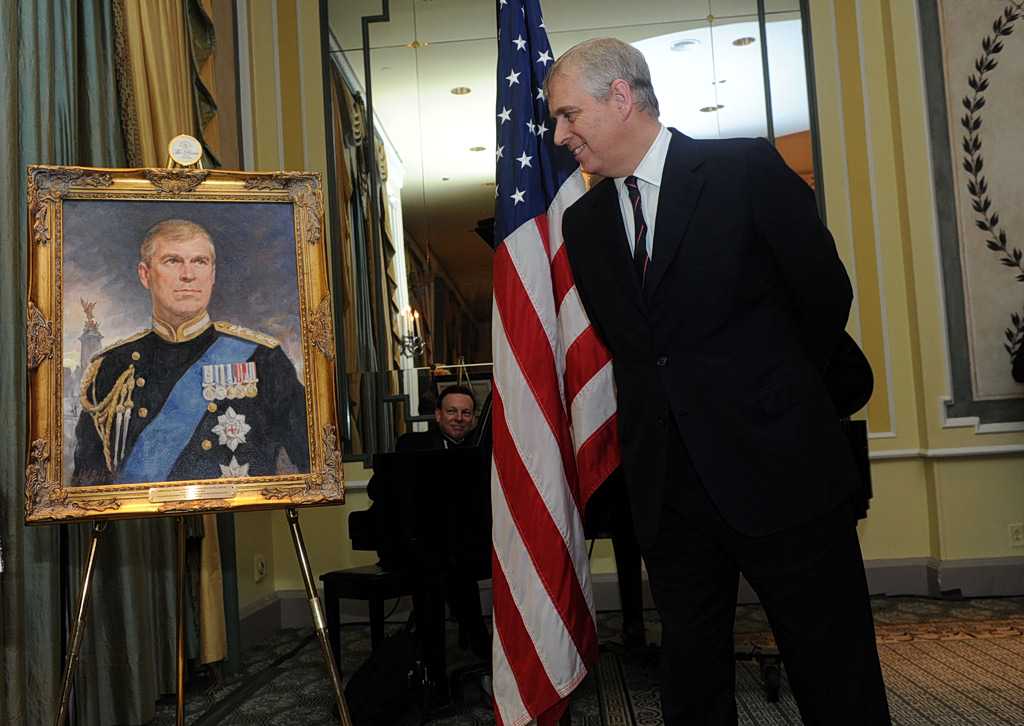
IMAGE DISTRIBUTED FOR SOLDIERS’, SAILORS’, MARINES’, COAST GUARD & AIRMEN’S CLUB – His Royal Highness, The Prince Andrew, Duke of York, views a portrait presented to him by the Soldiers’, Sailors’, Marines’, Coast Guard & Airmen’s Club (SSMAC) during their 17th annual Military Ball, Friday, Oct. 4, 2013, at the Hotel Pierre in New York. Since 1919, SSMAC has provided a “home away from home” for active duty military, their families and veterans from all over the world when visiting New York. (Photo by Diane Bondareff/Invision for Soldiers’, Sailors’, Marines’, Coast Guard & Airmen’s Club/AP Images)
What ‘Released Under Investigation’ Really Means
Legal realities were underlined by Tom Frost, Senior Law Lecturer at Loughborough University, who emphasised that UK reporting restrictions sharply limit what can be said at this stage.
“Because an arrest has been made there’s an ongoing investigation… nothing can be reported that may prejudice an ongoing investigation.”
Speaking to TO VIMA, Frost explained that Andrew’s release under investigation is a standard procedure in complex cases.
“It means that the investigation is ongoing, there are no restrictions placed on him, but the police are effectively reserving the rights to take action in the future.”
Crucially, he stressed what this does not imply.
“This does not mean that he could be charged, it does not mean that he will face any charges.”
In many cases, Frost said, individuals are released under investigation only for police to later conclude that no offence has been committed. Any decision to charge would not be made by police alone.
“Any decision as to whether a charge will be forthcoming will legally not be made by the police, but it will be made by the Crown Prosecution Service.”
If charges were brought, misconduct in public office is an indictable offence.
“If it does go to trial, it would be a jury trial in a crown court,” he said, adding that while imprisonment is a possible outcome, “We are talking a long way in the future.”
On the monarchy’s standing, Frost drew a sharp distinction between hostility towards Andrew and support for the institution.
“Over 80% of the public want Andrew to be removed from the line of succession. That’s different from wanting the monarchy removed.”
Republican sentiment, he argued, remains limited.
“Generally I don’t see a Republican movement that’s really growing any major political strength in the UK.”
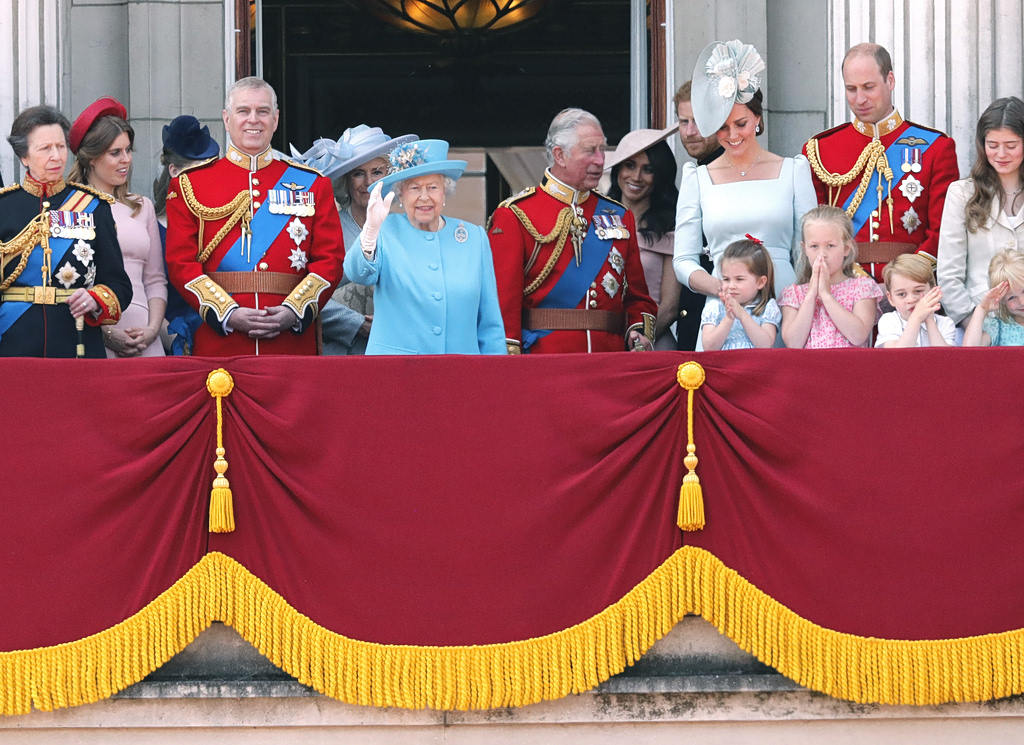
FILE – In this Saturday, June 9, 2018 file photo, members of Britain’s royal family, from left, Britain’s Princess Anne, Princess Beatrice, Prince Andrew, Camilla Duchess of Cambridge, Queen Elizabeth, Prince Charles, Meghan Duchess of Sussex, Prince Harry, Kate Duchess of Cambridge and Prince William attend the annual Trooping the Colour Ceremony in London. Britain and its royal family are absorbing the tremors from a sensational television interview with Prince Harry and Meghan. The couple said they encountered racist attitudes and a lack of support that drove Meghan to thoughts of suicide. The couple gave a deeply unflattering depiction of life inside the royal household, depicting a cold, uncaring institution that they had to flee to save their lives. Meghan told Oprah Winfrey that at one point “I just didn’t want to be alive anymore.” Meghan, who is biracial, said that when she was pregnant with son Archie, there were “concerns and conversations about how dark his skin might be when he’s born.” (AP Photo/Frank Augstein, File)
Beyond Britain: A Growing International Dimension
A broader international dimension was highlighted by Nikos Passas, Professor of Criminology and Criminal Justice at Northeastern University.
“Andrew Mountbatten-Windsor now faces both a serious domestic criminal inquiry and also mounting international pressure that could reshape expectations of royal accountability,” he told TO VIMA.
Passas pointed to ongoing investigations in the United States, including renewed scrutiny of activities linked to Epstein’s Zorro Ranch in New Mexico, and to calls by UN human rights experts for an independent investigation into the Epstein files. Such developments, he warned, risk elevating the case beyond a national scandal into a transnational accountability process.
Looking ahead, Passas anticipates further disclosures, possible cross-border cooperation and growing scrutiny of those who may have enabled or ignored warning signs.
“The long-term impact on the British monarchy will hinge on whether it embraces full transparency and distance from implicated figures.”
For now, the legal process remains slow, constrained and uncertain.
What is clear, however, is that the case has become a defining test of how the British state-and the monarchy at its centre-responds to allegations that strike at the heart of public trust in those who serve it.