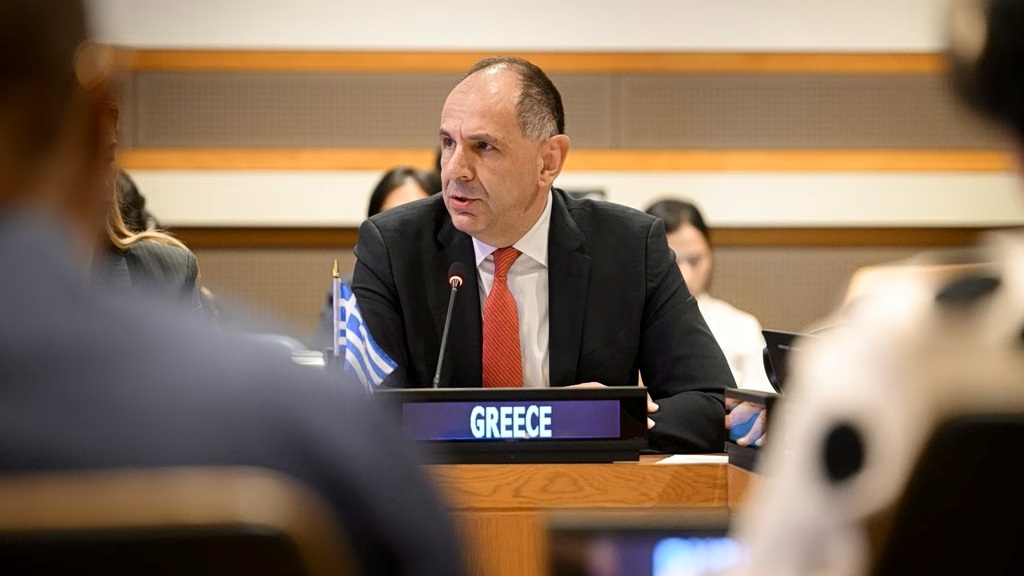
Holding the Gladstone Professorship of Government at All Souls College, Oxford – one of the most prestigious chairs of political science internationally – Stathis Kalyvas is at once one of Greece’s most prominent public intellectuals.
A regular contributor to the centre-right daily Kathimerini, his work in dismantling what he views as left-wing ideological shibboleths – from his deconstruction of long prevalent interpretations of the Greek Civil War to his view that the seven-year military dictatorship (1967-1974) led to the democratization of Greece – have often placed him at the centre of intense controversy, a position in which he seems quite comfortable, often forcefully fending off vitriolic criticism.
In a monumental new 700-page book, co-written with the distinguished theatre director Natasha Triantafylli, Kalyvas sets about debunking the conventional view that the junta cast a pall over and covered Greece’s entire social and cultural activity with a veil of darkness, lifted only in July, 1974, when the regime collapsed, after having triggered the Turkish invasion of Cyprus by launching an abortive coup against president Makarios.
Entitled Big Bang 1970-1973: The Flowering of Culture During the Years of the Dictatorship, the book is a veritable encyclopedia of all the major artistic, literary, film and other cultural activity of the period, which alone makes it an important reference work.
“Our book argues, in a nutshell, that the military regime was unable to control the rapid social and cultural transformation of Greek society and, that on a deeper level, societies will not always bend to political will, however forceful,” Kalyvas tells TO BHMA International in an exclusive, exhaustive interview. “The social contract on offer was that if you refrain from challenging the regime you can do your own thing.”
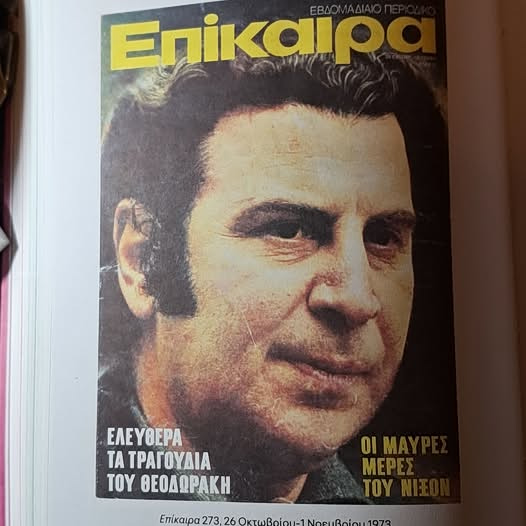
Epikaira Magazine: Banned from the start of the dictatorship, the public playing of anti-junta opposition icon Mikis Theodorakis was legalized in October, 1973, less than one month before the bloody Athens Polytechnic students’ uprising
In arguing that the 1970-1973 period as a cultural “Big Bang”, you suggest that from literature to poetry, theatre, and film, inter alia, artists and writers found ways to circumvent any censorship by the Colonels’ junta, and that indeed in some sense, there was a greater impetus for creativity than throughout the 1960s, despite the fact that dictator Georgios Papadopoulos famously declared that he put all of an ailing society in a “plaster cast”. Is there not a basic paradox here?
Your question identifies the key motivation behind our book, namely the fact that, despite the advent of an authoritarian regime on the 21st of April 1967, a surprising creative boom succeeded in taking off a few years later, while the Colonels were still ruling. It is important to point out here that we do not undertake a comparative assessment, i.e. we do not compare this cultural boom to previous ones, such as the well-known and oft-studied cultural boom of the early 1960s. All we are saying is that contrary to what we believed until now, Greek society did not experience the authoritarian rule in a silent and passive way.
On the contrary, it metabolized it into a vibrant, public, and high-quality cultural output. Our book establishes this fact beyond any reasonable doubt by exhaustively surveying a variety of cultural fields. We then move to ask how this cultural “Big Bang” became possible given the political conditions prevailing at the time and why it was forgotten following the demise of the authoritarian regime. In short, we identify a paradoxical outcome, confirm that it was real, and set out to explain it.
It took you and theatrical director Natasha Triantafylli two years to research and write the book. Give us a sense of how you came together and of the synergy and the intellectual division of labour needed to produce a monumental, 700-page study.
The origins of this book lie in a hunch I had a few years back, when I was writing Modern Greece: What Everyone Needs to Know for Oxford University Press. While writing the section on the Colonel’s dictatorship, I stumbled on the fact that many songs that are still very popular and/or highly appreciated had been written during that period, the late sixties and early seventies. That included what is allegedly the most popular record in Greek history, Mimis Plessas’ and Lefteris Papadopoulos O dromos (The road), but also iconic records by Dionysis Savopoulos, Manos Loizos, Stavros Kouyoumtzis, Dimos Moutsis, Loukianos Kilaidonis, Apostolos Kaldaras, Yannis Markopoulos, and Manos Hadjidakis, among many others. I wondered at that point whether this was just a coincidence or there was more to it and did some preliminary research that confirmed this very early hunch. However, as I was involved in other projects at the time I did not have the time to pursue this lead. Fast forwards a few years later, when I met Natasha who was working at the time on a play about the Marshall Plan for the Athens Festival.
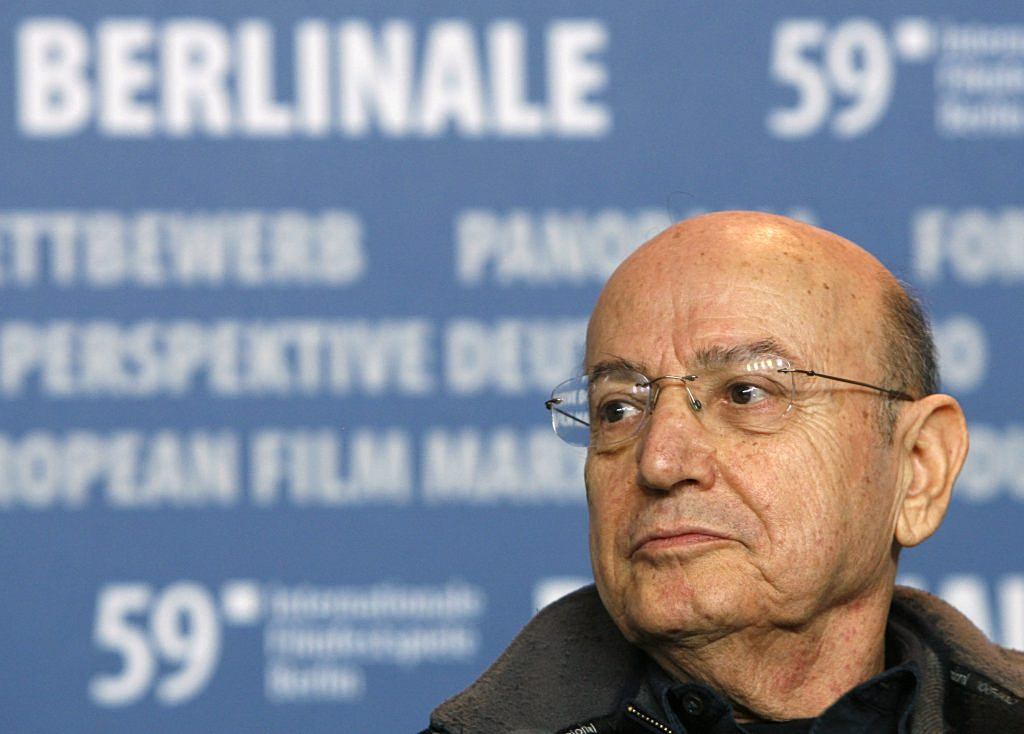
World-renowned filmmaker Thodoros Angelopoulos said that in his 1972 political masterpiece that showed state oppression in the runup to the Metaxas dictatorship, “Days of ‘36”, he had to resort to coded language, ellipsis and oblique historical references to circumvent junta censorship.
She approached me for historical advice and in the course of this process we realized that we shared a similar fascination about the intersection of history, politics, and culture. After her play was done, I suggested the idea of a collaboration about what I initially thought would be an article and later on a small book on culture during the dictatorship. She accepted and we embarked on the project. We began by reading as broadly as we could and once the broad outlines of the story emerged, we divided the material in a way that reflected our respective strengths. For example, Natasha focused more on theatre, cinema, and the visual arts.
The process was very collaborative, particularly because the topic kept surprising us. We kept making surprising discoveries and inevitably, the book grew to its final size. We then decided to adopt an unusual, hybrid structure in three parts: the first part is historical, political, and explanatory, the second part is comprised of biographies of eleven writers and artists (including one of Mikis Theodorakis running to about 70 pages!), and the last part covers the five fields we study in detail. Our ambition was to write a book that was at once readable and enjoyable (after all, this is also a book about culture and the arts!), but also a reference book. Lastly, we pushed for a high-quality edition with photographs, color, and attention to graphic design (we collaborated with Thessaloniki-based Hervik Studio). We are very happy with the final product, and we hear that readers are equally appreciative.
A basic premise of the book is that you are writing a revisionist cultural history that debunks a prevalent notion that the dictatorship created a cultural wasteland by limiting freedom of speech and expression. Yet, some critics of your thesis have argued that in fact that has not been the prevalent post-junta perception and that you in fact have created a cultural bogeyman that you then proceed to rip apart. Who are the main political and cultural historians and intellectuals that have created the false impression you discern?
Frankly, this is a bogus claim. There is no question that the general perception, up to the publication of our book at least, is that the colonels did create a cultural wasteland and that the regime’s censorship and repression that left Greek society culturally stunted. We provide extensive evidence in the book about the prevalence of this perception and reference the lacunae of the existing literature in detail. But the best evidence in this respect was the initial reaction caused by our book, which was one of shock and disbelief, including suspicion about our motives. Now, the absence of a thesis about a cultural boom does not equal the absence of scattered observations referencing significant cultural activity during the dictatorship. However, these observations were scattered, fragmented, and never impacted the general feeling about the period.
If one looks at research on the dictatorship, one easily sees that most writers focus on the regime and to a lesser extent the resistance to it; or they approach culture exclusively through the lens of political opposition. Overall, the literature exhibits a shocking lack of concern with the social and cultural dynamics of the period. We believe that our book corrects this omission.
You have said that the junta was the regime and not society, which has fallen by the wayside in studying the period for over half a century. How can these two possibly be separated? It seems paradoxical that you can have an oppressive regime ruling a (relatively) free society.
Both the research on this period, but also more generally the way we approach and understand it, exhibit a surprising blind spot: the focus has been almost exclusively on the regime (and to smaller extent, the political opposition to it), while society tends to be ignored. The assumption seems to be that the regime totally bent the society to its will; put otherwise, that Greek society went to sleep in April 1967 only to wake up in July 1974—no wonder that it remained subservient and silent in those seven years. While regime and society are connected entities, it is important to keep in mind that they do not overlap. After all, the regime clearly sought to impose its will by force on a reluctant society. But we should not assume that the regime’s intentions translated into actual reality.
The regime sought to control society, but its ability to do so was constrained by various factors. It could successfully suppress political opposition, but was unable (and to some degree unwilling) to shape society in its own image. Furthermore, this was an authoritarian rather than a totalitarian regime—a difference that matters here. The regime sought to depoliticize society rather than mobilize it. It is telling that it never set-up a political party to promote its cause. As a result, people quickly understood the social contract on offer: if you refrain from challenging the regime you can do your own thing. Which is how Greek society eventually found a way to bypass a regime it could not realistically hope to confront directly.
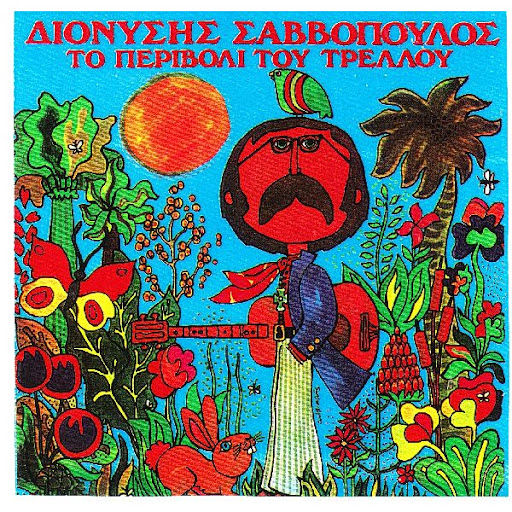
One of major songwriter-singer Dionysis Savvopoulos’s most important albums, To Perivoli Tou Trellou (The Madman’s Garden) was released in 1969.
That begs the question, in what ways did the widespread, brutal torture and exile to remote islands of its direct political opponents – decried internationally – impact directly or indirectly on the social dynamics and the intellectual and artistic currents of the period?
An uncomfortable reality about the period of the dictatorship is that resistance to the regime, with the partial exception of the Polytechnic School uprising in November 1973, was successfully contained by the regime. A key reason was that it was very small in size. Although those few who dared challenge the regime had to face terrible consequences, the fact is that most people kept out of politics and found in the cultural sphere a way to not only entertain themselves but also to interact with each other and occasionally critique the regime. But we shouldn’t overstate the importance of politics. For instance, we were surprised by the extent to which social life during that period was infused by a great deal of optimism—one that was nurtured from two sources: a social demography overwhelmingly dominated by youth and an economy that kept booming until the end of 1973. Reading the newspapers and magazines of the time, we were impressed by the prevailing sense of possibility, even joy permeating everyday life and reflected in culture, both highbrow and commercial. Culture can sometime escape from the boundaries set by politics which makes it what it is.
This is not to say that a considerable amount of culture was political. For example, Yannis Markopoulos’ and K. Ch. Myris’ (pseudonym of Kostas Georgousopoulos) 1970 record Chroniko (Chronicle) is a thinly disguised retelling of modern Greek history from a leftist perspective. Likewise, the publishing boom that materialized after 1970 included the publication of hundreds of Marxist titles (which were not forbidden, as most people still seem to believe). The communist poet Yannis Ritsos enjoyed great publication success those years, and so on and so forth. However, what made this political activity noteworthy was that it was independent of political parties and avoided the trap of parroting short-lived political slogans. The absence of short-term, instrumental logics gave it a remarkable quality. At the same time, an equally considerable part of culture was not political. This included high quality commercial songs (the work of Manos Loizos and Lefteris Papadopoulos, for example) but also work that was explicitly positioned as non-political. In a provocative interview he gave in 1973, the great Greek composer Manos Hadjidakis argued forcefully against placing art at the service of politics. In his view, the quality of the artistic pursuit was a function of its true artistic integrity. A year before this interview, he had prefaced the text accompanying his towering work, The Great Erotic, with an amazing statement reflecting this view: “The Great Erotic is not resisting.”
Among the artists you cite to bolster the Big Bang argument are composers Dionysis Savopoulos and Yannis Markopoulos, filmmaker Theodoros Angelopoulos, and novelist Kostas Tahtsis, all of whom produced important works during the dictatorship. Aside from Angelopoulos’ “Days of ‘36” (which is a devastating portrayal of the Greek right-wing state’s oppression of leftists leading into the Metaxas dictatorship, and which was released in 1972 when Papadopoulos was preparing a certain liberalisation supposedly to transition to democracy), none of their works present a real challenge or existential threat to the junta. Is it not a bit strained to say that all the creative artistic “production”, that is not political in nature, can fit into a “Big Bang” theory (scientifically that a whole universe evolves out of an infinitely small point) with political underpinnings, especially since you note that major works by the Nobel Prize-winning poets Odysseas Elytis and many others in the arts were created in the 60s before the junta?
We use the term “Big Bang” metaphorically, to denote a cultural boom; we certainly do not claim that this period was the only cultural book in Greek life. Indeed, the early 1960s witnessed another cultural boom, a period of great artistic accomplishment that has been studied extensively. After 1965, however, there was a pause and the 1967 coup obviously made things much worse. However, we show that by late 1969, a series of institutional reforms and social developments created the conditions for a cultural restart. If there is something that is distinctive in this “Big Bang” it was both its particular political character, as well as its non-political dimension.
The fact that this work did not represent an existential threat to the regime should not lead us to ignore the fact that it contributed to the emergence of a radicalized student body that went on to challenge the regime with the Polytechnic School uprising in November 1973. More importantly, it helps explain its remarkable quality and timeless appeal, in contrast to the cultural output of the early Metapolitefsi years which fell victim to an intense politicization.
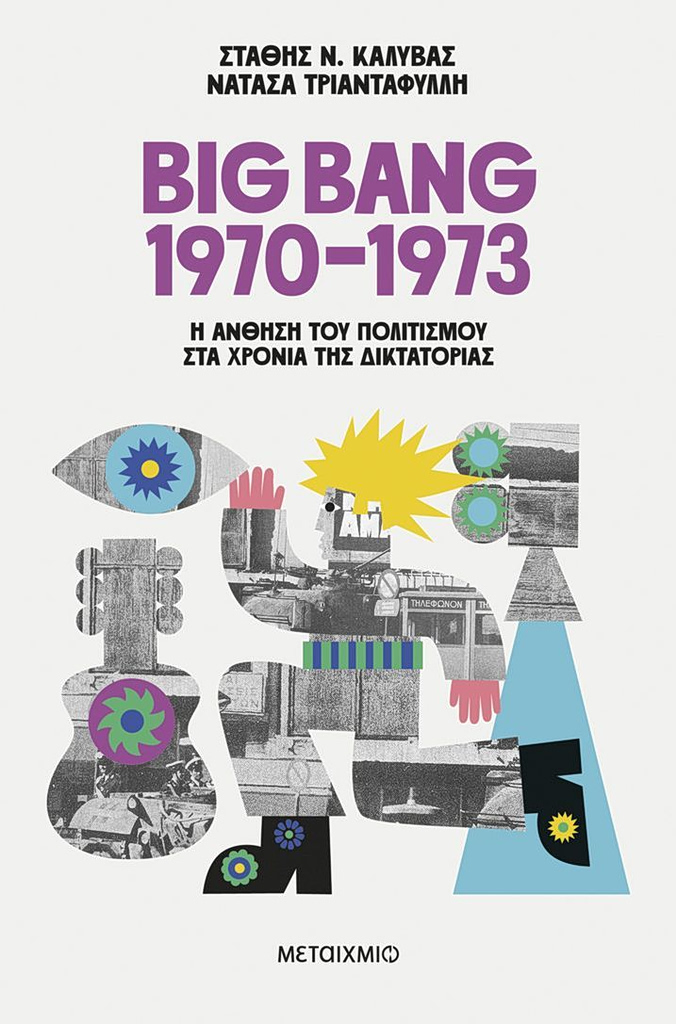
Big Bang 1970-1973: The Flowering of Culture in the Years of the Dictatorship, book cover.
Regarding his masterpiece, “Days of ‘36” Angelopoulos said in an interview that it was impossible to use direct references, so he sought to create a ‘secret language’, historical innuendo and ellipsis as an “aesthetic principle”. That clearly required some masterful pirouettes. How did he manage that, and what are some other outstanding examples of artists inventing a personal code of expression to circumvent censorship?
One way to circumvent the regime’s censorship was to trade literal language for a much more metaphorical language. To put it differently, this amounted to the spread of a much more poetic language than was common before. This was most visible, obviously, in poetry where a new generation of poets emerged at the time, known as the “70s generation.” It was also clear in Savopoulos’ lyrics and Angelopoulos’ cinema. But it would be an error to see this poetic language simply as a way to circumvent censorship; it was a response to a deeper urge that reflected a bigger global creative shift in a context of a society that was becoming more educated and more sophisticated.
Is the fact that there was never a mass popular resistance or uprising against it give the dictatorship breathing room from 1970 on to adopt a more tolerant approach to artistic and intellectual activity, perhaps in order to solidify tacit acquiescence to its rule?
At the end of 1969, the regime felt safe; it had defeated the opposition and had managed to entrench itself. As a result, it began to relax its repression; it did so to project a more palatable image abroad but it also had to accommodate a society that was changing very quickly. What we do not appreciate enough, I think, is how fast Greek society was changing during these times. A new urban middle class was emerging along with an expanded body of university students. It is clear that this was a society that could not be controlled only through repression.
This gradual opening was, of course, controlled by the regime but it was nevertheless real: it created more space that could filled by culture since culture constituted, in the absence of politics, the core of the public sphere. This space kept growing in many significant ways and reached its apex in the autumn of 1973 when the regime attempted to liberalize. In retrospect it is easy to say that this liberalization process was stillborn or fake, but at the time it represented a real opening that produced the most vibrant moment of the cultural Big Bang.
The first time perhaps that you drew a connection between the junta and cultural flowering was a reference en passant in an article you wrote on the 50th anniversary of its coup, offering an incisive overview of its legacy. In it, you adopted the rather unorthodox view that the dictatorship was a prerequisite for Greece’s democratisation and that it led to a rapid modernisation of values and culture. Is that the framework and prism through which you developed your theory on the process leading to the Big Bang?
This article was an attempt to sketch an explanation for the surprising smoothness of the transition to democracy in 1974—a smoothness we take for granted. At its core, the success of this transition was based on the liberal transformation of the Greek Right which was predicated on its ability to sacrifice two of its most important symbolic resources: monarchy and anticommunism. Both were legacies of the two great civil conflicts of the twentieth century, the National Schism and the Civil War. What I argued in this article was that this transformation owed a great deal to the Colonels’ dictatorship. Why so? Because this was a regime that justified its existence through its rejection of politicians, all politicians, including those of the Right. By doing so, it inadvertently brought the political Right much closer to the political Left and facilitated the liberal transformation of the Right in a way that would have been impossible to predict back in 1967.
Although not formulated in this way, this point is widely accepted and rather uncontroversial among historians. Our book makes a different point: it argues, in a nutshell, that the military regime was unable to control the rapid social and cultural transformation of Greek society and, that on a deeper level, societies will not always bend to political will, however forceful. The two arguments are not necessarily incompatible, but they are distinct. For example, one thing that emerged out of our research (and which we do not pursue in the book) is a tantalizing, unrealized counterfactual possibility: what if the transition to democracy in Greece had been negotiated rather than the result of a rupture?
What, in other words, if Greece had followed the Spanish model? How different would the country be in this scenario, its political institutions, its culture, and its trajectory? Clearly, we cannot answer in any definitive way. The social sciences are not experimental; therefore, we cannot study historical processes in the way that physicists study the physical world, through controlled experiments. However, it is worth asking such questions because they expand our understanding of what happened.
You maintain that the cultural outburst between 1970-1973 was due to the fact that there was no political activity and no political parties. As hypotheticals about history are always perilous, this argument appears to fall into the domain of the post hoc ergo propter hoc fallacy (after this, therefore because of this). How can one demonstrate such a contention?
As I just mentioned, counterfactual reasoning is both necessary and important, but our book is not an exercise in counterfactual reasoning. Nevertheless, what is beyond contention (and is an original argument) is that there really was a cultural boom in Greece between 1970 and 1973. What we try to do is explain what happened rather than speculate about what could have happened otherwise. Our book identifies a fascinating puzzle and proposes an explanation (or historical interpretation) which we believe is plausible and defensible. Simply put, we argue that the cultural boom that took place in Greece between 1970 and 1973 can be attributed to three broad factors: first, the expansion of the economy; second, the global cultural boom of the late sixties and early seventies; and third, the suppression of the political sphere by the regime which elevated, in an unintended way, the cultural sphere. Right now, this is the most complete, thorough, and evidence-based explanation for this fascinating phenomenon.