 Μake us preferred on Google
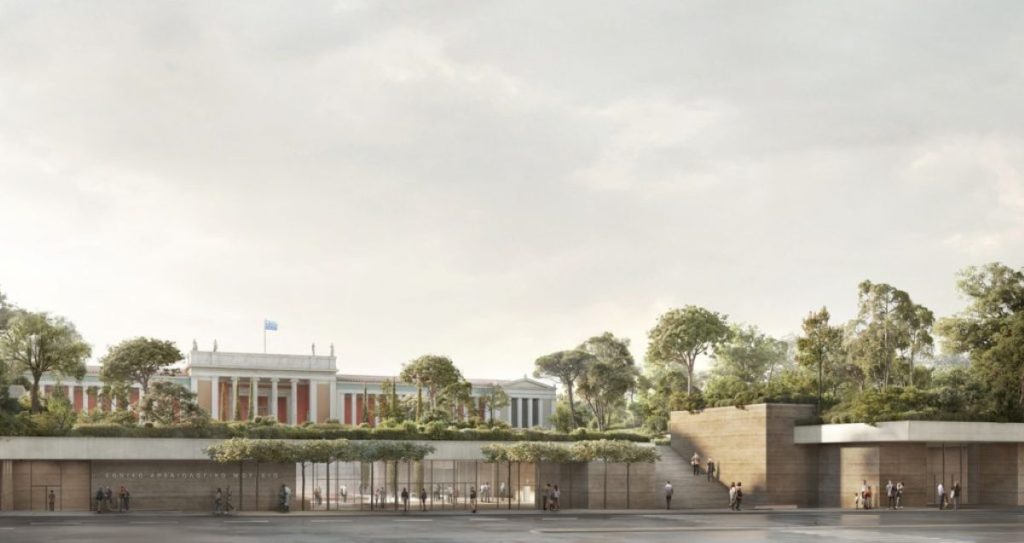
 The upgrade of the National Archaeological Museum is entering the museography phase that is, the process of translating the content into a true experience for the visitor. The Museum Council has issued a positive opinion on the museographic preliminary study for the National Archaeological Museum and the Epigraphic Museum, signalling the transition from the “where” to the detailed “how.”
According to the Ministry of Culture, the studies are progressing on schedule, confirming that the ambitious project to expand and upgrade the complex at the heart of Athens remains on track for implementation.
The museographic preliminary study is based on the full set of already approved architectural, structural, and electromechanical plans, and seeks to organise the overall visitor experience: the flow, the placement of exhibits, the levels of information, and the relationship between the historic building and the new extension.
A New Approach
It is worth noting that at the international level, major museums in recent decades are no longer judged solely by the richness of their collections, but by the way they tell their story. In keeping with this philosophy, the National Archaeological Museum is attempting to redefine its identity, shifting from a traditional presentation model to a more narrative and experiential one.
A central feature of the new approach is the creation of a “navigation axis” that will run through both the existing building and the extension. Landmark exhibits will function as “stations” or “magnets,” guiding visitors through a unified narrative. This concept aims to eliminate the fragmentation that has characterised the museum’s visitor experience for decades, transforming a visit into a coherent journey of knowledge.
Particular attention is also being given to how the exhibits are presented. Freestanding sculptures will, where possible, be viewable from all sides, allowing a 360-degree experience, while more fragile objects will be protected in specially designed display cases. Lighting, a critical factor in showcasing the works, will combine integrated solutions with targeted interventions, creating a balanced environment between functionality and aesthetics.
Significant provision is also made for the “judicious” use of multimedia. In contrast to older trends of excessive digitalisation, the new model appears to seek a balance where technology plays a supporting rather than competing role in relation to the exhibits. At the same time, the concept of autonomous exploration is reinforced, with multiple levels of information allowing visitors to choose the depth of their experience.
Equally ambitious is the reorganisation of the Epigraphic Museum, a space with particular requirements due to the nature of its exhibits. The new museographic proposal envisions the presentation of up to 650 inscriptions in a space of approximately 1,400 square metres, through a combination of chronological and thematic narrative. The introduction of “open storage”, one of the most contemporary choices, allows the public to engage with a larger portion of the collection beyond the strictly selected exhibits on display.
The organisation of the exhibition into “clusters,” combined with the presence of freestanding monuments and panoramic sections, aims to make the material more accessible and comprehensible without sacrificing scientific rigour. This is a delicate balance, as the Epigraphic Museum must maintain its research character while simultaneously opening up to a wider audience.
Accessibility: A New Pillar
At the core of the overall design is the concept of accessibility, both physical and intellectual. Provisions for different levels of reading, clear signage, a visual identity for the exhibition spaces, and ergonomic equipment together create an environment that aspires to be inclusive. The visitor experience is treated as a product of deliberate design.
As the Minister of Culture, Lina Mendoni, stated:
“The museographic preliminary study is grounded in the full set of approved studies, architectural, structural, electromechanical, for the expansion and upgrade of the National Archaeological Museum, the most significant and richest repository of ancient Greek art in the world. The museographic preliminary study focuses primarily on the general design choices, the spatial arrangement and layout of the exhibition sections, exhibits and equipment, seeking at this stage to comprehensively meet the requirements of the museological rationale while exploring the best approach to their implementation.
Key parameters of the building study have been taken into account, as well as, to a significant degree, the thematic content and the needs of the exhibition material. The collaboration between the designers across all disciplines and specialisations, and the staff of our two Museums, is ongoing and exemplary. The shared goal is to meet the deadlines as specified in the Donation Agreement between the Greek State and Spyros and Dorothy Latsis.
The comprehensive redesign of the exhibitions of both Museums, in line with the expansion and upgrade of the building complex, will deliver a modern museum of global standing.”
The preliminary studies were prepared by the architectural firm Atelier Bruckner, in collaboration with the staff of the NAM and the EM, as well as the architectural firms David Chipperfield Architects and Tombazis and Associates Architects, who are responsible for the architectural study for the upgrade and extension. Firms Kardoff Engineering, Werner Sobek, and WHP, also handle lighting, electrical and mechanical equipment, and structural studies respectively.