For his new show at the Basil & Elise Goulandris Foundation, Jannis Psychopedis has chosen not to stage a flashy retrospective of his sixty-five-year career. Instead, he has set up a “small public square” of some 70 works that are positively desperate to engage viewers in a conversation. Just like he did back in the 1960s with the “A” art group, when he would load his paintings onto the back of a truck and display them in the working-class neighborhoods of Nea Ionia and Kokkinia, determined to bring art into direct contact with the public and spark a dialogue.
The exhibition “Landscapes of Memory. The Ones I Kept” springs from a core conviction: that if these works are to escape the confines of the artist’s studio, they must fulfill some aspect of their social and political purpose.
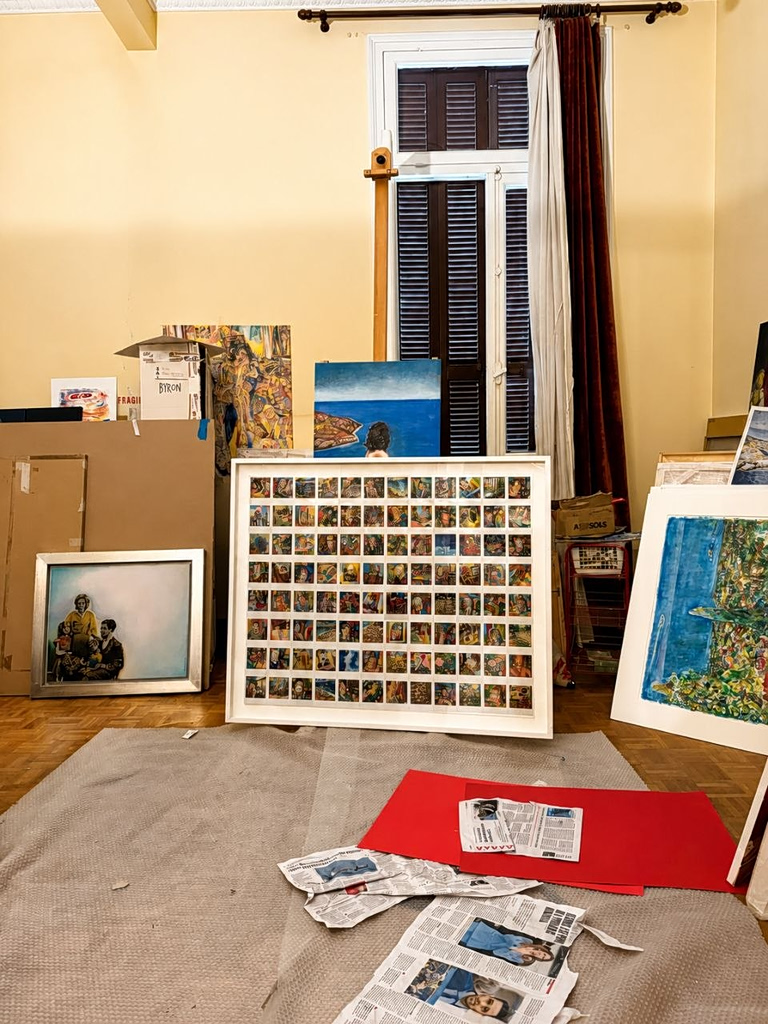
Works kept in Jannis Psychopedis’ atelier — inside cabinets, tucked into corners, covered over — works that have remained with me from 1962 to this day.
PANOS KOUGIAS/TO BHMA INTL EDITION
They may not be his “most important” paintings. They may not be the most “avant-garde” works in his oeuvre, either, as he says. But they are the ones that serve as a continuous thread; that represent a consistency in a world where everything is changing and unraveling.
The exhibition begins in 1962 and runs through to the present day, though without setting out to narrate either some linear artistic “journey” or an unchanging artistic identity. Besides, as the artist says, he did his most “Greek” works in Germany and his most “Central European” ones in Greece. The works change forms, materials and languages. From painting to collage and from constructions to mixed media—in defiance of an era in which “purity” of form was virtually an imperative. The paintings flow into one another through close to twenty scenographic sections, without claiming any single affiliation or narrative continuity.
What does remain constant along the way is Jannis Psychopedis’ chivalrous faith; his belief that whatsoever “costume” it may don, painting can always meet the contemporary world head-on. That it can pull up a chair in one of the great public forums of our times and engage the public face to face, without fear of friction or disruption. Which, more or less, is how art strikes a chord with life. And life with art.
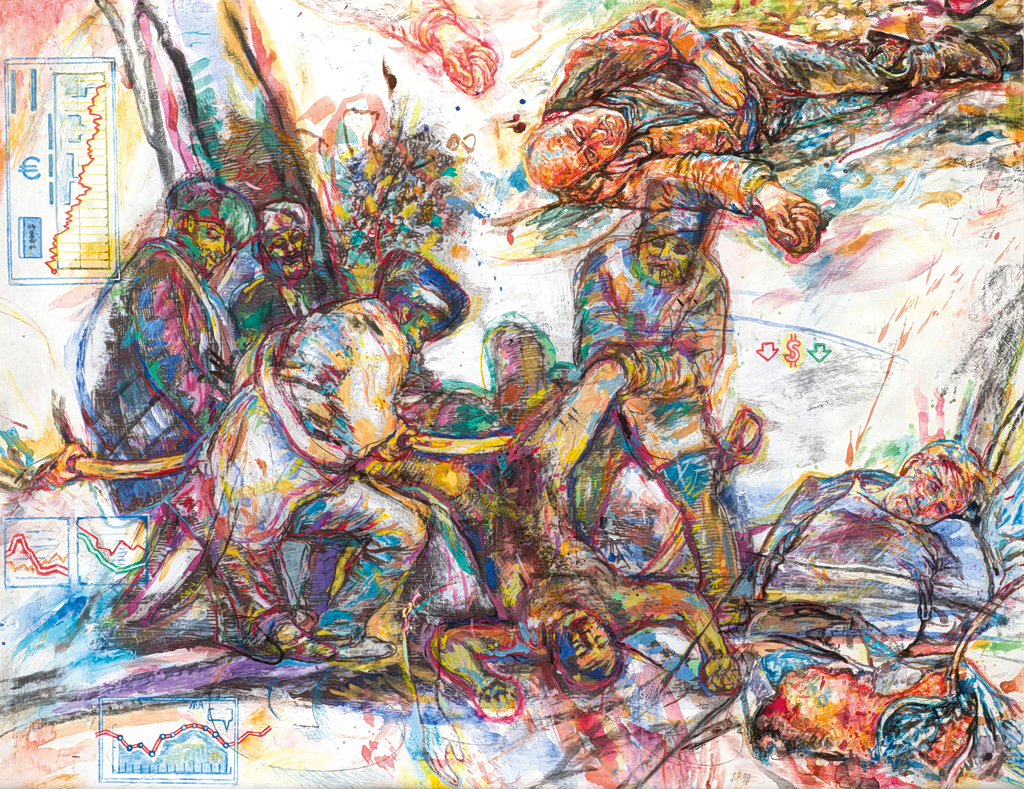
“Collateral Damage – Report to Goya”, 1999. Mixed media, 46 x 60.5 cm.
The exhibition has a very personal subtitle: “The Ones I Kept.” What does it mean for an artist to return not to the works they sold or exhibited, but to the ones they kept?
It is not exactly that these works haven’t been exhibited—though it’s a fact most of them haven’t ever been shown. The key thing is that they weren’t sold. They stayed in my personal collection, which means they acquired a singular character without my having planned it that way. In retrospect, I realized I’d kept two or three pieces from every period of my work. And because my practice has passed through many different phases, these works served as a sort of internal scaffolding for the next step forward—a thread of continuity, even when the form itself was changing radically.
Changes in terms of form, or media, too?
Both. For me, the medium has always been an ongoing quest. I’m interested in how different media can converse with one another: painting, printmaking, collage, constructions, objects. The boundaries often blur. It is profoundly liberating to express yourself in this way—it doesn’t restrict you, but rather offers a fresh stimulus, opening up new possibilities for both the imagination and our sensitivity. Objects, human relationships, our very environment become catalysts for revealing “dimensions of the gaze.” And while the core remains unchanged, it is constantly seeking out new versions of sensibility.
I believe this is what characterizes both my work and this exhibition. From my most erotic to my most political pieces, they all ultimately converge. For me, the profoundly erotic is also profoundly political, profoundly social, profoundly poetic. Together, they comprise a unified quest for sensitivity and expression. This may be what shocks us in the end: just how open we can be to a world of inexhaustible expressive possibilities.
How did the idea for this exhibition come about?
Truth be told, staging a retrospective of my work would be an enormous task. The scope of the oeuvre is huge—I’ve had 107 one-man shows in Greece and beyond, and each one was a coherent whole, not just a collection of works. I’ve always been interested in taking a subject as far as it will go, which means there’s a massive body of work behind each period. Then there’s the logistical side: the lost works, the paintings that have scattered and passed from hand to hand. You almost have to hunt them down like a detective. That the show was to be staged at the Goulandris Museum was crucial, because the space itself guided us toward something more elliptical and simultaneously more personal. Not a complete retrospective, in other words, but rather works I’ve kept in the studio, tucked away in cupboards and corners, covered up; works that have been with me from when they were made, starting in 1962.
I couldn’t agree with you more: the erotic is simultaneously political.
Yes, but not in the sweeping generic sense that “everything is political.” I mean that even the most deeply erotic work comes with its own way of seeing the world—an ideology, a stance toward reality.
If you look back at the young Psychopedis of the 1960s today, what do you see that’s remained a constant in your artistic vision?
It’s hard to speak truthfully about oneself, but I’ll share something with you that goes back even further than the 1960s. It’s a childhood drawing I did when I was five, which my mother kept safe. It was inspired by a scene from Victor Hugo’s Les Misérables—a book I still return to frequently today. The novel had moved me deeply, because it contained all the great human values: justice, poverty, solidarity, humanism.
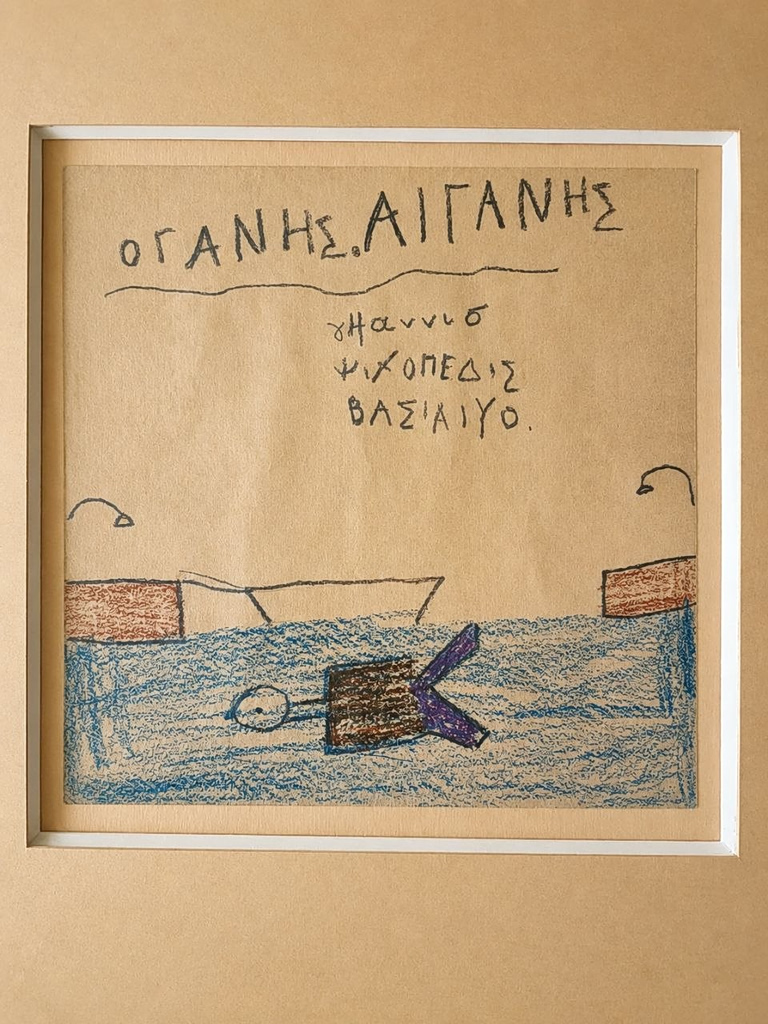
“Yannis Ayiannis” – the first drawing by Jannis Psychopedis, made at the age of five and preserved by his mother, inspired by a scene from Les Miserables.
PANOS KOUGIAS/TO BHMA INTL EDITION
The scene I had drawn was the one where Jean Valjean, has a chance to escape, but chooses to first save another convict whose life is in danger. He doesn’t leave until he’s sure the other man is safe. What moves me to this day is that moral stance. The concept of solidarity, of justice as a fundamental category of ethics. I think that stayed with me from a very early age; in a way, it still colors my view of the world and of painting.
Let’s move on to the “New Greek Realists”, a group that emerged during a profoundly political era in Greek history. Do you think art today still has the power to intervene in politics, or has it become more of an aesthetic product?
Let me tell you about one of the works in the exhibition. It’s the most unassuming, but for me it’s emblematic: a building site from ’65-’66. We’d left a neoclassical house in Kolonaki and moved downhill to an area near Michalokopoulou Street, which had very few buildings along it at that time. From my window, I drew this structure as it was going up. Looking at it now, I realize that this little work is exactly what matters. Our transition from the tenderness of neoclassicism—which I don’t want to idealize, because it had its flaws, too—to the brutality of concrete. Today, there’s a danger that everything will be concreted over—not exempting the Acropolis.
Later, this was the driving force behind the art group “A”, when we took our art out of downtown Athens in carts and trucks and into the working-class neighborhoods of Nea Ionia, Kokkinia and Piraeus. We set up the works there, like pop-up exhibitions on the street, and they sparked a raw dialogue with the public—one that was often confrontational.
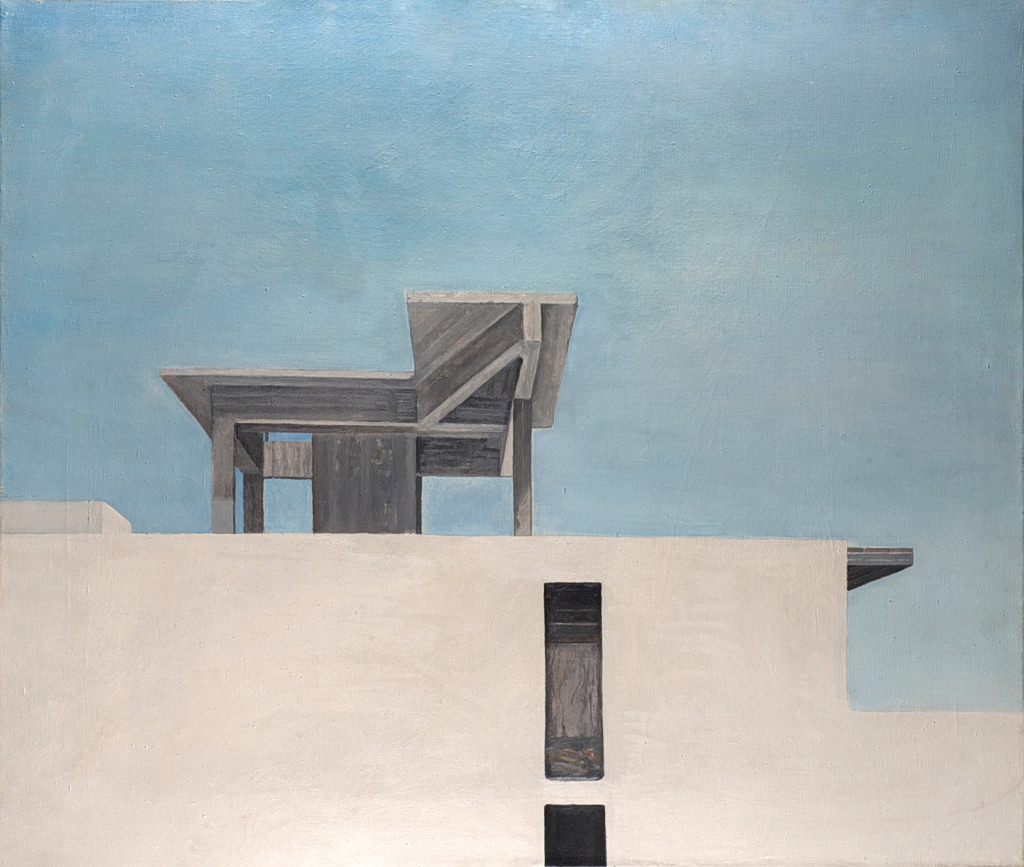
“Construction Site”, 1966. Oil on canvas, 55 x 65 cm
As the “New Greek Realists”, we worked within a realistic, critical, figurative framework. We even intended to do away with individuality completely. On certain pieces, one artist would start from one side of the canvas, another from the opposite end, and we’d meet in the middle Literally painting on the exact same work. We were trying to produce something collective, to lose the signature and replace the “ego” with a shared act.
Then came the Center for Visual Arts (KET). There were twenty of us artists there, with a very specific concept: no middlemen. No gallerists, no dealers, no institutions between us and the public. We wanted to be entirely responsible for our own space and our own work. For producing, showing, and selling it. It was a very pure, almost radical model. And it worked for a while. Years later, when I was living abroad, I was back in Athens and happened to pass by the old shop we’d converted into a gallery back then, near the Polytechnic. I found myself looked for our old sign. But instead of “KET” on the frontage, I saw “PARKET” (Parquet) in huge letters. A business had moved in that sold flooring and wood. And I said to myself: “Look how far society’s sunk. KET’s great and revolutionary ideas have ended up on the floor as PAR-KET.”
You lived and worked in Berlin and Brussels for many years. How decisive was that experience in shaping your artistic and political consciousness?
It certainly left its mark, but in a more complex way. In fact, it often works in reverse: I created my most “Greek” works in Germany and my most “Central European” in Greece. The two things intersect. Back then, Berlin was an island-city stranded in the middle of the Cold War. It was a place of charming anarchy, but also of incredible brutality. You passed through Checkpoint Charlie daily, navigating border searches and entirely surreal situations. I remember going to East Berlin once to attend a performance at the Brecht Theater. I had some Greek books in the car, and during the inspection, the guards started combing through them, looking for political texts or propaganda. That’s when they stumbled upon a book by Giannis Skarimpas. It was called “Two Buffoons’ Waterloo.” And it was there and then, at the Berlin Wall, that Skarimpas was first translated into German. Right there, caught between two worlds.
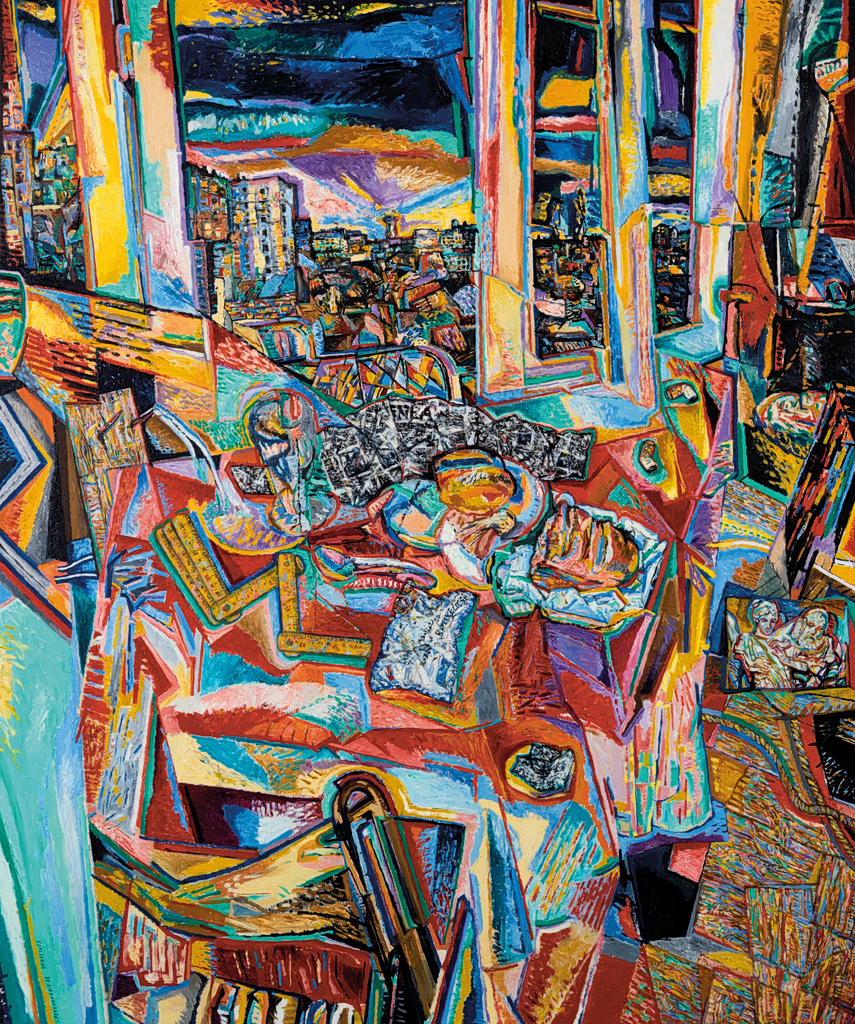
“Night in Brussels”, 1988. Oil on canvas, 120 x 100 cm.
What are your thoughts on young painters today? Do you see them returning to a different kind of conservatism?
You framed it well; this drift toward conservatism is very real. But it is a complex phenomenon. It stems, first and foremost, from the inadequacies of our academic institutions. But it goes beyond that—there is a broader deficit of critical thought across society at large. We are no longer equipped to process our lived experiences through knowledge, just as we lack a truly creative dialogue that results in healthy disagreement and debate. As a result, we no longer have cultural touchstones in society, which we need for real debate, or a vital relationship with art that simultaneously interrogates both convention and the status quo. This could be reclaimed through rigorous study in our academic institutions. Sadly, though, this isn’t happening. It seems to me we lack the time, the desire, the people and the context. As we speak, subjects such as art and sociology are being thrown off the curriculum. There could be nothing worse than that.
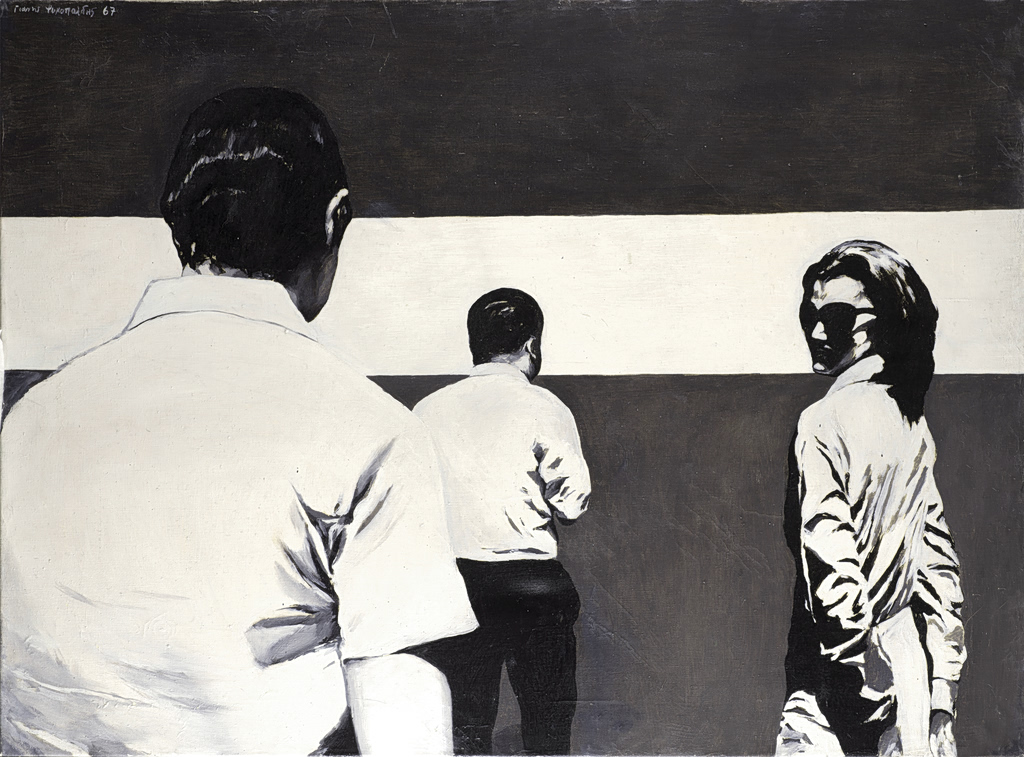
“The Encounter”, 1967. Oil on canvas, 60 x 80 cm.
In essence, we are producing people who are uneducated, socially atomized, individualistic and stripped of creative imagination. If this is what passes for progress, you can imagine what true regression looks like. Yet, perhaps the most revolutionary thing to happen to education internationally—and to arts education, in particular—is something we often overlook or undervalue: the Erasmus program. My generation missed out on that. Today, a third-year student can head to Barcelona for six months, enroll in a school, and make a life there. And it’s nothing like visiting as a tourist. They actually get to live it. They wander the streets, stay up all night, fall in love, make friends, see other ways of living, and return home a different person.
You’ve said in the past that painting is a way of “keeping human relationships alive.” Do you think that art today brings us closer together, or does it tend to operate within closed systems?
There’s no denying that our times work against the collective. If we look at it historically, in comparison with the 1960s and 1970s—and remember we’re talking about a deeply traumatized society, about a Greece ravaged by the war, Occupation and the Civil War, but simultaneously engaged in the process of rebuilding—we see that something was beginning to take shape out of the trauma. It was a phenomenon which also had deep roots in brotherhood and solidarity: a world that connected people’s struggles. And that’s why a huge social and political movement was forged back then. And that wasn’t restricted to Greece; the same thing was happening across the whole of post-war Europe. There was a sense in the air that things could get better. There were people who set an example. And that’s the crucial thing: every society relies on these paradigms. It’s not the theories you espouse that carry the most weight: it’s how you act. The way you exist in the world, without grand pronouncements, that’s what the others truly take on board—far more than any theoretical teaching. This example was set by the generation that lived through the Occupation and its aftermath. They provided the blueprint for a world where values were never abstract; where they were demanded, fought for, and won.
If you needed an alternative title, what would it be? And, in the end, what is it that we “keep” or take away with us?
“The things I don’t want to forget.” I don’t mean the artworks themselves mustn’t be forgotten; what we must never forget is who we are—and the entire constellation of experiences, people, and conditions that made you who you are. In other words, our sense of being part of a community. That is what is truly precious—to be able to feel you’re not alone in this world. And from that flows the question of how to show solidarity. For me, the concept of solidarity is the ultimate necessity—and, at the same time, contemporary society’s greatest loss. There—hold onto that.
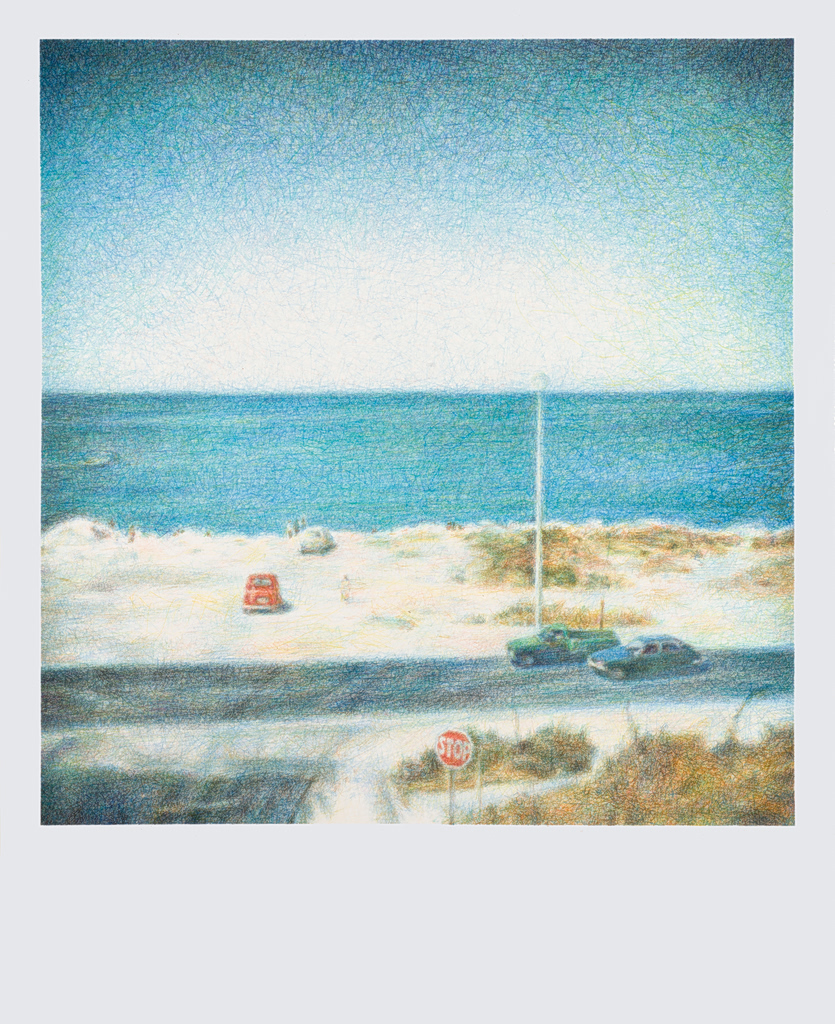
“Broken Horizon” [part of a quadriptych], 1981. Coloured pencils on paper, 58.5 × 56 cm