 Μake us preferred on Google
 “Before my diagnosis, I thought these problems happened to other people. I would hear about colleagues, friends, and relatives who were sick and feel sad. I would think, ‘I hope everything goes well…’ and I meant it. I wanted them to be well. But in reality, I couldn’t understand what they were going through. Cancer was a problem for others, far from me and my family. Until the diagnosis came.”
Eleni Georgiou, a 52-year-old teacher, remembers the day she was diagnosed with breast cancer during a routine screening. Until then, as she says, she believed problems happened to others. That day she realized that cancer makes no distinction. She also remembers what helped her the most throughout her treatment: the unexpected, abundant well-wishes from strangers—the sudden hope.
“At that time, when I first heard the news, I literally felt the ground fall from beneath my feet,” she says today. “I wasn’t calm. And I certainly wasn’t thinking positively.” While her initial reaction was panic, through the journey she discovered the strength she had inside her—her limits. A large part of that strength came from the support, the wishes, and the help of others.
“I didn’t even know how strong I was, how much power I had inside me. But with the help of my family, my doctors, acquaintances, and strangers, the battle was won. People often ask if my psychology played a role. I answer ‘yes.’ And I mean it. When a person is so fragile, you can’t imagine where they can draw strength from—an encouraging word, a successful test result, a personal story, a smile, a warm glance, a child’s drawing, or a wish on a card with Santa and the reindeer.”
Alone in the Hospital
Every year, thousands of people spend the holidays in hospitals, away from their families. They see trees decorated without imagination in white corridors, perhaps some lights blinking on a balcony across the way. They hope that next Christmas they will be home, smelling honey cookies, a turkey roasting in the oven, and gifts waiting under the tree.
People who have been hospitalized during the holidays, or who have had family members hospitalized, volunteer organizations, cultural associations, choirs, students, sports teams, and schools send toys, books, and greeting cards to patients.
Dimosthenis Konstantopoulos, representative of hospital staff at the Children’s Hospital, describes to To Vima the joy of young children in the mornings when children’s choirs visit the hospital to sing carols.
The hospital also hosts 12 children by court order. “The children here by court order eagerly await this. The other children are surprised and very happy! Even ordinary citizens bring toys and books. Of course, sweets and food are prohibited for obvious reasons, but we fill the wards with gifts and handmade cards with wishes. We have the duty to distribute them according to age. Nothing compares to the smile of a child when they receive a gift in their hands,” he adds.
This was also how the idea for the “visitation of love” began. Some people, who have fought or are fighting cancer, knew the power of words and how much strength words can give.
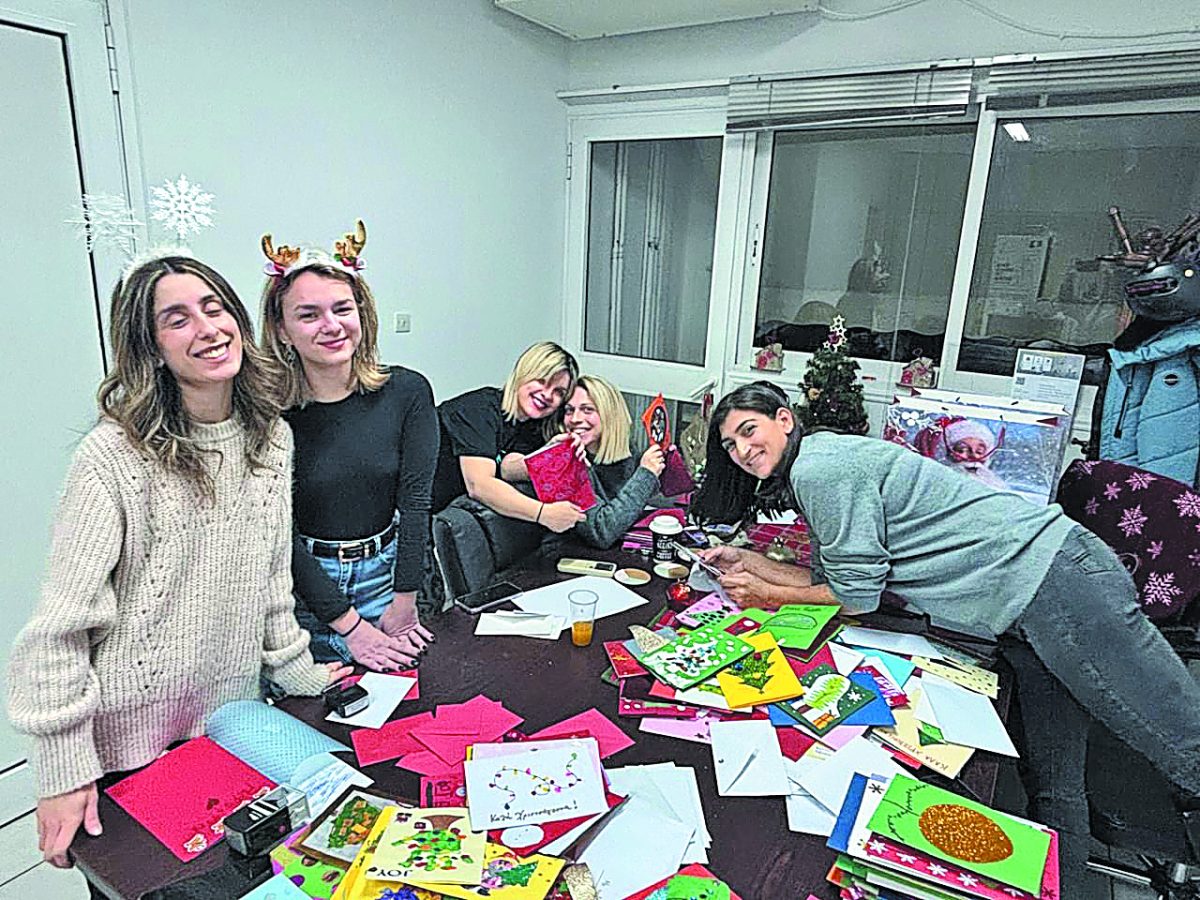
It all started during the pandemic, when the people of WinCancer, a non-profit organization, in collaboration with the Cancer Patients Guidance Center, thought of a “safe visit,” without contact, using a laminated and sterilized Christmas card. A card that, nonetheless, gives so much strength. The pandemic passed, but the initiative continues, bringing joy to people who will not sit this year at the holiday table with their loved ones.
Who is the sender of the colorful card? Everyone! A child writing a card at a school desk, a teacher making glitter stars with children, a former patient wishing to share their story, someone who lost a loved one, employees of a company, athletes, elderly people, and children at a creative activity center. A chain of love that simply says: “You are not alone!”
“I Remember Crying”
“I remember reading the cards and smiling,” says Stella, who spent last holiday season in the hospital. “The words filled me with beautiful feelings. Care. Support. Kindness. I remember crying, but they were tears of joy.”
Pisti Krystallidou, the soul of the initiative—along with Magda and Efi—remembers: “A child at a Creative Activity Center asked me, ‘Ma’am, what does what we do help?’ I replied, ‘It’s a way to show these people that we think of them.’ But in my heart, I thought… ‘Who is helping whom? Are we helping them, or are they helping us?’”
As Pisti Krystallidou explains, the initiative became an opportunity for teachers to talk to students about cancer, prevention, giving, and solidarity.
Holidays in hospitals don’t have sparkle or joyful family tables. But they do have hope. People who fight and hope. Behind every closed door, a different story of endurance and a silent wish. The gifts from “strangers”… heal, ease the loneliness.
Because the true meaning of the holidays is found in people.