

Shortly before his participation in TechFuse in Ioannina, he spoke with TO BHMA about the relationship between artificial intelligence and culture, the limits of technology, and the possibility of a more open and accessible museum for everyone.
Ask Mona was founded with the ambition to “put AI at the service of culture” and make cultural content more accessible to wider audiences. How did your own trajectory—from philosophy and political science to media and teaching—shape this initial vision, and what problem did you feel most urgently needed solving in museums and cultural institutions?
My background in philosophy and political science taught me one thing above all: that the way knowledge is transmitted matters as much as the knowledge itself. Who gets access, in what form, through what channels. These are political questions before they are technological ones. When I started working in media and then in teaching, I kept running into the same problem: cultural institutions produce extraordinary knowledge, but most of it stays locked behind walls, whether physical walls or walls of language, of codes, of social intimidation. The urgency I felt was not about technology. It was about access. AI just happened to be the most powerful lever I found to address it. Ask Mona was born from the conviction that if you can have a conversation with a work of art, you can break down most of the barriers that keep people away from culture.
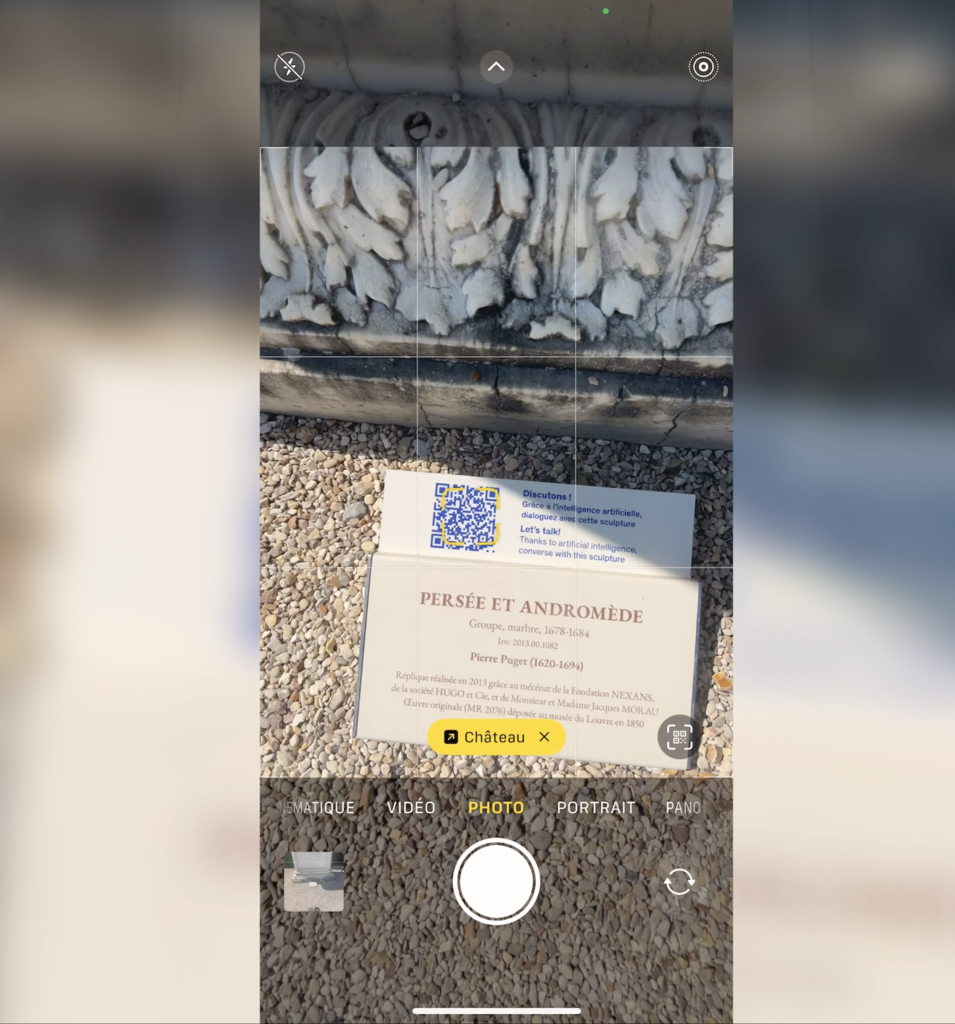
A monument plaque features a QR code for AI explanation.
You often describe AI as a tool for curiosity rather than a machine for instant answers. What does that distinction mean in practice when a museum, a monument, or a cultural institution designs an AI experience for the public?
In practice, it means designing interactions that open questions rather than close them. Most AI systems are optimized to give you the right answer as fast as possible. That is useful if you want to know the opening hours. It is much less interesting if you are standing in front of a painting. When we work with a museum, we design conversational paths that encourage the visitor to look more carefully, to notice a detail, to make a connection they would not have made on their own. The AI does not say “this painting is about X.” It might say “look at the hands, what do you think is happening here?” That is a very different experience. It is the difference between an information kiosk and a conversation partner.
In your book Propos sur ce robot qui parle, you interviewed ChatGPT. After that “conversation” do you believe AI is a mirror reflecting human culture back to us, or is it beginning to create a culture of its own?
When I wrote Propos sur ce robot qui parle, the exercise was deliberately provocative: conducting a real interview, with follow-up questions and pushback, with an AI. What struck me most was not what the AI said, but how it forced me to rethink the questions I was asking. In that sense, AI is a mirror, but not a passive one. It is a mirror that slightly distorts your reflection, and that distortion is what makes it interesting.
Now, is it creating a culture of its own? Not exactly. But it is already changing ours, and the evidence is measurable. There is a fascinating study by Kobak et al. (2024) that tracked vocabulary shifts in scientific writing after the launch of ChatGPT. The word “delve,” for instance, went from being used 349 times in PubMed abstracts in 2020 to 2,847 times in 2023.
A Finnish study (Leppänen et al., 2025) found similar patterns in student essays, with some words seeing a tenfold increase in usage. What is striking is that these are not just cases of people copying AI outputs. People have started using these words themselves, in their own writing, sometimes without even realizing where the habit came from. AI is reshaping our vocabulary, our sentence rhythms, our sense of what “sounds right.” That is not a new culture in the strong sense. But it is a cultural influence that runs deeper than most people assume.
You often discuss the “redefinition of creativity”. If a machine can compose music or paint in the style of the masters, what is the new “human’s share” in the creative process?
I understand the anxiety behind this question, and I think it deserves a serious answer rather than a quick reassurance. The fear is real: if a machine can compose music or paint in the style of the masters, what is left for us? But I think the question “what is left for humans?” assumes creativity is a fixed territory that AI is eating into. I prefer to look at it through history. When photography appeared in the 19th century, it did not kill painting. It freed painters from the obligation of faithful representation. The Impressionists exist because of the camera, not despite it. The camera forced a new generation of artists to ask a new question: if the machine can capture reality, what is it that only I can do?
I think we are at the same juncture. If a machine can compose like Bach, it does not mean human composers are useless. It means the interesting question is no longer “can you compose like Bach?” It is “what can you compose that only you could have imagined?” The human share is not technique. It is intention, it is point of view, it is the capacity to decide that something matters. No AI has that.
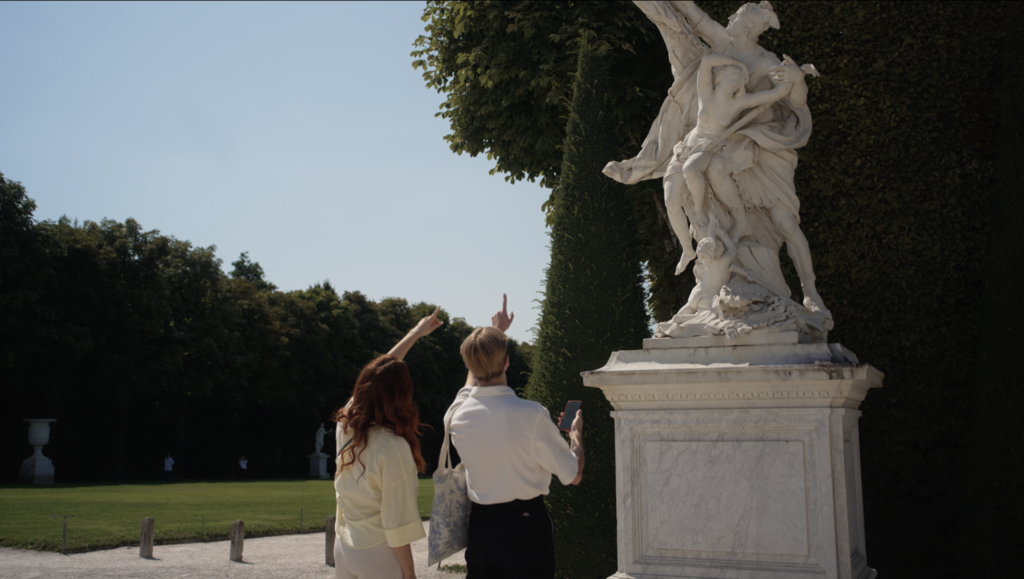
People using artificial intelligence in front of a museum exhibit.
Ask Mona aims to make culture more accessible. How does a conversational AI change the “intimidation factor” that many people feel when entering a traditional museum or art gallery?
This is one of the things I care about most, and it is both a cultural and a political issue. The intimidation factor in museums is real and it is massive. Pierre Bourdieu showed decades ago that cultural institutions reproduce social hierarchies: the people who feel welcome in museums are the people who already have the codes, the education, the references. Everyone else stays at the door, not because they are not curious, but because they fear being judged.
And this has only gotten worse in certain ways. Take mythology, for example. Two generations ago, Greek and Roman myths were a shared cultural foundation in European education. Today, that knowledge has largely faded. A visitor standing in front of an ancient sculpture of Hades may not even know who that is, and they feel embarrassed to ask. That embarrassment is the real barrier, not the price of the ticket.
A conversational AI changes the dynamic completely. You can ask a question privately, on your phone, without anyone hearing. You can ask “who is this character?” or “what am I looking at?” without shame. You can ask it ten times in a row. There is no judgement, no raised eyebrow. For someone who feels they do not belong in a museum, that privacy can be transformative. It is the difference between staying twenty minutes and staying two hours. And those two hours can change how they see culture for the rest of their life. That is not just a technological improvement. It is a democratic one.
Greece is a country defined by its vast classical heritage. How can your technology help a local museum in a city like Ioannina or a world-class site like the Acropolis move beyond the “static” audio guide?
Greece is a fascinating case because you have both world-famous sites that attract millions of visitors and smaller regional museums with extraordinary collections that very few people ever see. The challenge is different in each case.
At a site like the Acropolis, the issue is not attracting visitors. It is giving them a meaningful experience despite the crowds, the heat, the limited time. A conversational AI can offer a personalized, multilingual companion that adapts to how much time you have and what interests you.
For a museum like the Archaeological Museum of Ioannina, the challenge is visibility and depth. This museum holds 250,000 years of Epirus history, from Palaeolithic tools to the artefacts of Dodoni, one of the greatest sanctuaries of the ancient Greek world. That is an extraordinary story, but most visitors outside Epirus have never heard it. A good AI system can transform that collection into an incredibly rich experience, because the conversation does not stop at what is physically in the room. It can connect a single artefact to the broader narrative of Greek antiquity, to other collections across the country, to the visitor’s own curiosity. That is how you turn a thirty-minute visit into something unforgettable, and how you give a regional museum the voice it deserves.
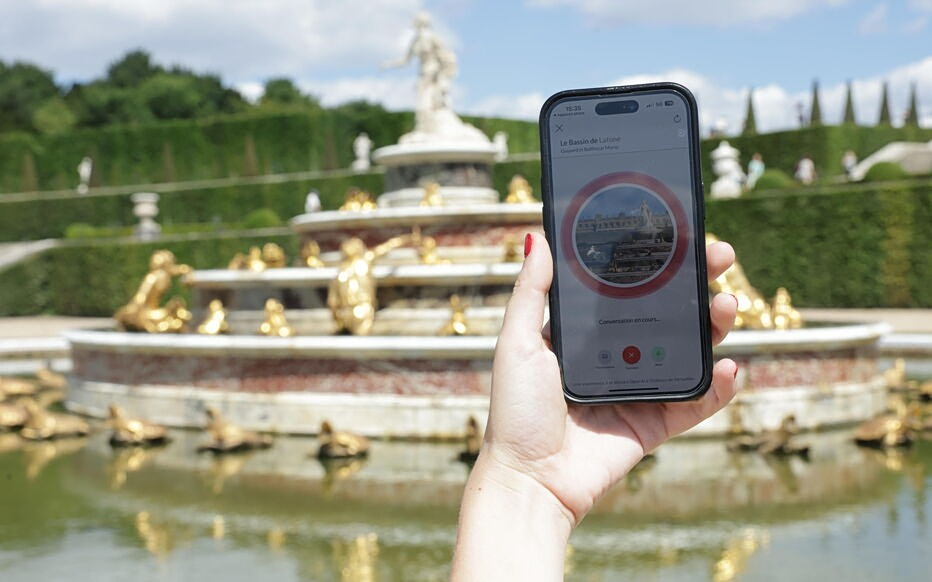
Artificial intelligence acts as a helpful guide for historical landmarks.
Some critics argue that using AI in museums might distract visitors from the actual physical artwork. How do you ensure that “Mona” enhances the gaze rather than replacing it with a screen?
This is a concern I take seriously, and it is legitimate. The last thing we want is visitors staring at their phones instead of looking at the art. The way we address it is through conversation design. Our systems are built to direct attention toward the artwork, not away from it. The AI says “look at the top left corner of this painting” or “step back and notice the scale.” It is not showing you a reproduction on a screen. It is training your eye to see what is actually in front of you. The phone becomes a tool for looking, not a substitute for looking.
And increasingly, we are also developing purely voice-based experiences. The visitor puts on earphones and simply listens and talks. There is almost no screen time at all. The AI becomes a voice in your ear, like a knowledgeable friend walking through the museum with you, pointing things out, answering your questions, but never pulling your gaze away from the work. That is a design choice, and it is one of the most important ones we make.
You’ve recently written about “Samarkand 2025” and the globalization of culture via AI. Do you fear that AI might lead to a “standardization” of culture, where every museum starts to sound the same because they use the same algorithms?
At the UNESCO General Assembly in Samarkand in 2025, I had the opportunity to address precisely this concern. And I think the fear of standardization is understandable but misguided, because it rests on a misunderstanding of how AI works, or at least how it should work.
The risk of every museum “sounding the same” would exist if everyone used the same generic AI with the same generic training data. But that is not what we do. The whole point of our approach is the opposite: personalization. Each museum, each collection, each individual artwork can have its own voice, its own knowledge base, its own way of telling its story. And beyond that, each visitor receives a different version of that story, depending on their language, their age, their interests, their level of knowledge.
AI is not a one-size-fits-all system. It is, when designed well, a system that allows the singular to exist at scale. A small museum in Epirus and a national institution in Paris should not sound the same, and with the right approach, they will not. The technology enables specificity. The risk of standardization comes not from AI itself, but from lazy implementations of it.
You have argued for ethical and trustworthy AI in culture, especially around hallucinations. What should museums and public institutions demand from AI vendors before adopting these systems?
Museums and public institutions should be extremely demanding, and I say this as an AI vendor myself. First: transparency about the data sources. The AI should only draw from validated, institution-approved knowledge bases, not from the open internet. When you are in the Louvre, the information should come from the Louvre’s curators, not from a random blog post. Second: control over hallucinations. Every AI system will sometimes produce inaccurate content. The question is what safeguards are in place. At Ask Mona, we use retrieval-augmented generation that grounds every answer in verified data, and we maintain human oversight loops. Third: the institution must retain editorial control. The AI speaks in the institution’s name. Its tone, its vocabulary, its boundaries should be defined by the institution, not by the tech company. If a vendor cannot guarantee these three things, walk away.
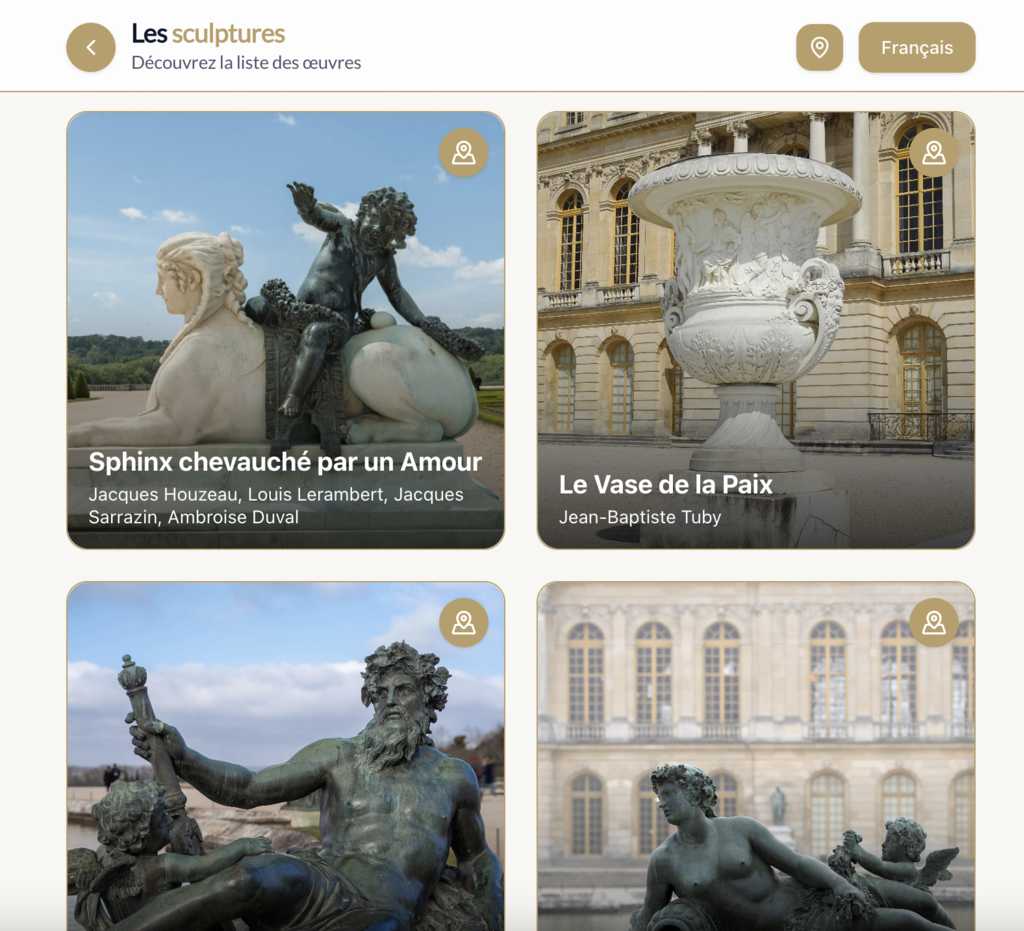
Ask Mona’s interface.
At the Techfuse conference in Ioannina, the focus is often on how technology can fuel regional growth. Can “Cultural AI” be a driver for sustainable tourism in less-visited regions of Europe?
Absolutely, and I think this is one of the most promising applications. The problem with tourism in Europe is concentration. Everyone goes to the same twenty cities and the same fifty museums. Meanwhile, extraordinary sites in less-visited regions remain almost invisible. AI can help change that in two ways. First, by making smaller institutions more discoverable, through multilingual content, through connections with larger networks, through personalized recommendations that take visitors off the beaten path. Second, by making the visit itself much richer. A small museum with fifteen objects and a well-designed AI experience can be more memorable than a crowded blockbuster exhibition. For regions like Epirus, where Ioannina is located, cultural AI can be a real tool for economic development, because it turns cultural heritage into a reason to stay longer, to explore further, to come back.