Following the recent death of the great actor Nikos Kalogeropoulos, old memories resurfaced as his films were rebroadcast. Many people recalled the series “Sto Camping” (1989), which captures the simplicity of 1980s summers in a nutshell. But is there really nostalgia for summers past, and how do we explain it?
We often see posts on social media claiming that summers “back then” lasted three months. “We were happy, we all played together.” What exactly did we lose from the Greek summers of the ’70s, ’80s, and ’90s?
Were there really conditions that made those summers more carefree, or have we constructed, after the fact, the image of an innocent era?
“I’ve noticed it’s a fairly common nostalgia pattern, that a lot of people describe summers from the ’70s and ’80s as characterized by simplicity, a simplicity that also extended to consumption,” says Dr. Panagiotis Zestanakis, a historian at Linnaeus University in Sweden specializing in everyday life, speaking to in.gr.
“It’s a common pattern, this idea that back then we were happy because we’d put a towel down at the beach, buy a soft drink from the kiosk and a couple of loukoumades from a street vendor, and spend the whole day like that, without needing a sunbed, without needing luxury, without needing all the things we see on beaches today,” he says.
Many also long for longer, less demanding vacations. “That’s another pattern, going free camping at some beach for many days, or spending long stretches of time at a house in the village, grandma and grandpa’s house, and so on,” the historian adds.

 In recent years, social media pages that evoke past decades have amassed hundreds of thousands of followers: groups like “80s Nostalgia” (440,000), “Nostalgics of the 80s-90s” (450,000), and “Old Photos of Thessaloniki” (140,000). Considering there are around 7 million active Facebook accounts in Greece, these numbers are striking to Zestanakis, who studied the nostalgia phenomenon through digital ethnography. “It means this nostalgic ‘engagement’ is extremely widespread.”
The expert believes people have a natural nostalgia for their childhood, adolescence, and youth. While he notes the phenomenon is international, he believes that in Greece, because a large segment of the population saw their day-to-day life deteriorate economically, the crisis years acted as an additional memory filter. “And this potentially creates a further idealization for people who were children in the ’90s, for example, and experienced the crisis in the early years of their working lives.”
Indeed, the economic crisis marks a clear turning point in Eurobarometer data as well: Greeks’ life satisfaction drops sharply after 2009. A harder present, after all, can make the past look better by comparison.
Blaming Today
Many nostalgic for the past criticize today’s vacation model as more expensive and more tied to a culture of “appearances.”
“That’s the classic argument nostalgic people make, that back then it was easier to go on vacation for many days,” Zestanakis says, emphasizing the economic angle. “These people believe economic conditions were better back then, and I think that connects to the high regard Greek society has for 1980s policies, which we consider redistributive, and which we believe helped create a broader middle class, and so on.”
Nostalgia Even Among the Young: The “Trauma”
While it’s understandable for people who actually lived through those decades to feel nostalgic, what’s even more interesting is that nostalgia for the past also appears among much younger people who never experienced the 1980s or 1990s at all. In memory studies, this phenomenon is called “postmemory,” according to the researcher.
“Essentially, people who lived through the ’80s, ’90s, and perhaps the 2000s, eras of greater expectations and consumer expansion, experienced the crisis as a trauma,” which was then, he adds, “carried over, in a sense, through interactions on social media, through family conversations, through conversations with friends, through various forms of discourse.”
As a result, according to the expert, this perception has, to some extent, passed on to subsequent generations as well. “That idealization that there was once an era of plenty when everything was better. As a media phenomenon, it’s real.”
We Always Idealize the Past
The loss of the company one might have kept in the past, or the evenings families and friends spent together in neighborhood courtyards, is a common topic of conversation today. It’s as if we’re nostalgic for a form of social life gradually transformed by the advance of digital technology.
But Zestanakis believes we have a tendency today to idealize forms of sociability tied to a past and to our own youth. In his 1954 book “Wanted: Hope,” novelist Antonis Samarakis, criticizing the urbanization of the 1950s, wrote that “never before have people’s roofs been so close and their hearts so far apart.” That line was included in national exam questions in the 1980s. “Essentially, examiners were asking students to reproduce a narrative about how wonderful village life was and how terrible urbanization had made things, how we’d become strangers, not even knowing our neighbors,” Zestanakis says.

“What’s remarkably interesting is the narrative itself, that students were essentially asked to idealize an earlier era, before Athens’s urbanization, the 1950s or 1960s.”
Something similar is happening today, according to the expert. “Many people who grew up either before socializing became so intertwined with digital technology, or who are millennials, say through nostalgic pages that in their era they cared about falling in love or going on vacation to live the moment, not to show the moment.”
The Contradiction
Yet even many nostalgic for the past who never adopted this culture of “appearances” themselves are, in fact, now showing off the photographic material they collected during that period.
“Which has an interesting contradiction of its own: you criticize someone for wanting to show off their happiness on social media right now, when you’re doing the same thing to show off your happiness after the fact. You post a forty-year-old photo that you kept because, for some reason, you wanted to capture that moment, and probably to show it,” he says, and asks, “why did we keep photos in a family album and show them, not on social media, since it didn’t exist, but it was quite common to have friends over and open an album to show them?”
But Was the Past Really So Innocent?
Still, what we long for from the past, the relaxed pace of vacations, trips to islands not yet as “scarred” by tourism, may not be as innocent as it seems.
“There’s a second contradiction here, that these people say that in the ’80s we lived simply and didn’t care about appearances,” Zestanakis says. However, “we’re talking about precisely the era that gave birth to all of Greece’s lifestyle and consumerism journalism, in a pre-internet era that heavily favored this flexing mentality, through magazines like Klik or Nitro.”
Here the historian identifies a key difference from the past: the lifestyle once projected as a privilege for the few can now, through digital social media, be represented by far more people. “Today people can do it through social media. Go to Mykonos for two days because you can’t afford more, take ten thousand photos, and say you’re living the lifestyle. But back then, Kostopoulos was telling you, yes, I’m opening this door, but it’s for some people, not for everyone.”
The expert doesn’t deny that a large part of the population back then genuinely didn’t care about that lifestyle. But he’s skeptical of the generalization that everything back then was “innocent.” “When you generalize and say, look, we grew up in an era of purity where appearances didn’t matter, that’s wrong,” because “if you look at it from a broader perspective, it’s the very era that created this kind of mentality in the first place.
Kostopoulos was telling you, kid, to be part of the trend-setting crowd you need expensive clothes, you need to go to Mykonos, to Paris, to London, and have a good-looking girl next to you. That’s what he was telling you. It’s the same era we’re nostalgic for as an era of ‘simplicity.'”
“All of this, of course, took hold in a society where consumer expectations kept rising year after year. That’s the point I want to make.”
Is There Optimism for Better Summers Ahead?
Eurobarometer data shows that pessimism isn’t a new trait of Greek society, though it intensified during the crisis years. In the 1990s, Greeks viewed their day-to-day life more positively, and 86% held a favorable opinion of the, as it turned out, controversial Maastricht Treaty.
“We’re not a particularly optimistic people, even in periods outside of crisis. There was always a significant share who viewed the future pessimistically. It may be higher now because the whole experience of the crisis has, in a sense, been capitalized on.”
It’s now much easier to recall images from summers past through digital media. The page “Old Mykonos,” for example, contains photos of the island from the 1970s, ’80s, and ’90s. “People upload photo material from their trips to Mykonos, mostly from the ’70s, fewer from the ’80s, some from the ’90s, and they’re nostalgic for the old Mykonos, which has been lost, altered, filled with ‘flexers,’ and so on. And this is heavily promoted through the photographic documents these people themselves have.”
It’s a nostalgia that spreads easily through media. “So I think that’s the big change, really. It’s a change in media, not that we all suddenly became extremely nostalgic.”
Digital media, then, didn’t necessarily create nostalgia, but gave it an unprecedented space for expression and circulation. What remains an open question is whether real “losses” hide behind this idealization of the past: more free time, forms of sociability, cheaper vacations, but also, more broadly, great actors, great composers, musical legends across every genre. Everything, in other words, that we remember and keep playing on repeat.
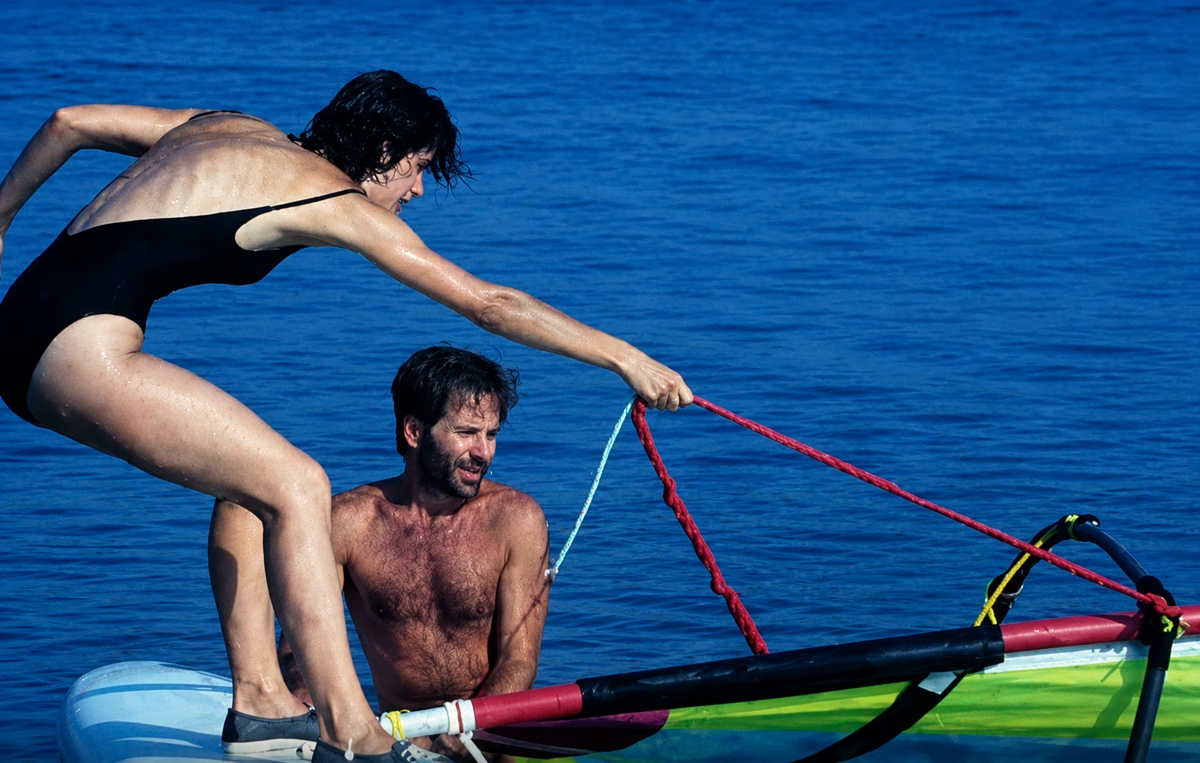
The photos are stills from the series “Camping,” which used no extras. The beachgoers appearing in the shots were people who happened to be at the beach during filming.