
As late autumn settles over Greece, the Cyclades and Dodecanese are quiet again. Hotels have shuttered for the winter, seasonal workers have gone home and owners are taking a break before preparations for the new season commence after New Year’s. It is the moment when Greece exhales and takes stock as it awaits the numbers to learn if 2025 was another record-breaking tourism season.
But the pause comes with lingering unease, as rising visitor numbers, mounting climate impacts, problematic public infrastructure, and growing resident frustration over quality of life issues remain unresolved.
In this lull, To Vima International Edition spoke with Randy Durband, CEO of the Global Sustainable Tourism Council (GSTC). With more than four decades in travel and a personal connection to Greece, he has become a prominent voice in the push for global sustainability standards in tourism and improved tourism management.

An image of a popular Greek island during the shoulder season, when tourism numbers are lower and streets “walkable”. Credit: Jimmy Teoh
A Sustainable Tourism Leadership Story Linked with Greece
Durband’s connection to Greece goes back to the start of his career. “My first trip to Europe in 1979 included Athens,” he said. “I took a student tour to the former Yugoslavia, and then I became a teaching assistant on academic programs taking Americans to the Balkans.” He later spent 25 years as an executive at U.S.-based tour operators working on all seven continents. “Professionally, I was very aware of many destinations and issues on land and sea.”
Around 15 years ago, he shifted toward sustainability. “I decided to take my knowledge of the business of travel and apply it to my passion for sustainability,” he said. He joined GSTC in 2010 as a volunteer and became CEO in 2014. What drew him to the organization was its structured approach. “I like the systematic approach of applying a common language of the standards,” he said.
Inside GSTC: Global Standards that Aim to Shape Sustainable Tourism
GSTC is known for its certification programs, but Durband stresses its broader mission. “I’d like us to be better known for our global standards that are highly inclusively created,” he said. These standards can guide destinations and businesses from the early stages of sustainability “for continuous improvement to the highest levels.” GSTC often encourages organizations and destinations interested in applying their standards to do so in a phased, five-year approach, starting with a portion of the criteria and expanding over time.
He noted that even destinations with advanced sustainability programs still struggle with one issue: “Almost everybody’s doing rather poorly on measurement and data gathering and benchmarking,” he said. Improving data, he argues, is essential for real change.
Why Greece and Europe Struggle with Overtourism
The pressures stemming from high numbers of tourists faced by Greece’s islands and in Athens closely mirror those seen across Europe. Durband argues that many of today’s problems stem from an older model of tourism governance and the legacy of DMOs (Destination Marketing Organizations), which focused solely on promoting locations.
“Good destination management is a very new concept,” he said. “The public sector always thought their job is just to promote tourism, no to develop [sustainably] and manage.”
That promotional model collided with a global surge in travel demand as global populations doubled, middle classes expanded and countries that once restricted travel opened up. “Now, everybody travels,” he said. “Global demand is off-the-chart.”

epa12178820 Activists and residents march to demand measures against mass tourism in their hometown, in Barcelona, Spain, 15 June 2025 (issued 16 June 2025). The protest in Barcelona was part of a coordinated call in different cities to raise awareness of overtourism across southern Europe’s top destinations, including Mallorca, Venice and Lisbon. EPA/MARTA PEREZ
The Challenge of Managing Visitor Flows
Durband noted that pressures on cities vary widely, and solutions must be tailored to each location. But he emphasized that managing visitor flows is now a central challenge for tourism authorities worldwide.
He pointed to Granada, Spain, as an example of how one iconic site can anchor better management. The Alhambra Palace adopted timed entry and more structured flows, which he said benefited both visitors and the wider community.
But such solutions aren’t always possible. “You can’t control flows into a city,” he said, noting that in the 21st century “there are no walls around cities.” People can arrive by train, car, ferry, bike, taxi or short-term rental, often without passing through any central control point.
Durband described how short-term rentals intensify pressures in Amsterdam. Historically, there were “very few accommodations inside the canal rings,” he said, but platforms enabling home-sharing, such as Airbnb, increased density dramatically. He argues that targeted rules- such as limiting short-term rentals within specific protected zones- can help city centers recover their balance.
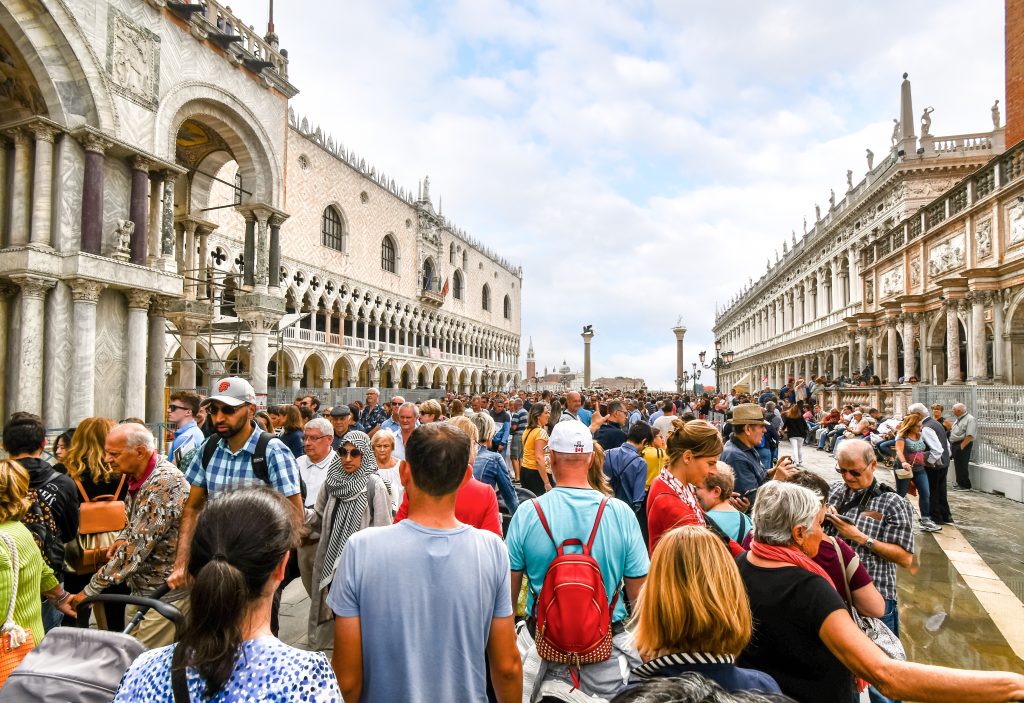
There is a long-running resident frustration in Barcelona, especially in historic neighborhoods overtaken by visitor traffic. Some situations, he said, are extraordinarily difficult: “I can’t imagine a solution” for areas where locals feel overwhelmed inside their own communities.
Durband also criticizes how slowly governments responded when ride-sharing and Airbnb apps appeared. Cities had a century to figure out how to regulate taxis, he said, but the arrival of apps “happened basically overnight,” and “no municipality in the world quickly adapted to that.”
Innovative Visitor-Flow Management: What Greece Can Learn from China
Durband emphasizes that European destinations could learn from high-density countries, especially in East Asia.
“Some of the best crowd control and visitor volume management I see is in China,” he said, noting that Westerners often overlook these cases.
He described the giant Buddha site in Leshan, where authorities use real-time data, turnstiles, and centralized command centers to track people approaching narrow stairways and viewing platforms. The system allows the destination to manage crowds dynamically rather than simply reacting after congestion builds.
Destinations sometimes need to be “creative” in dispersing visitors within a site. At Leshan, additional attractions developed within the same admission zone help distribute visitors and reduce pressure on the main viewpoint. “Kids love it, and it gives people something else to do,” he said, which prevents crowding at the primary monument.
These examples, he said, illustrate how destinations can design better visitor dispersion across time of day, seasons, and physical space.

A visitor looks at the foot of the Leshan Giant Buddha statue in Leshan in southwest China’s Sichuan province August 29, 2005. The Buddha statue, which was carved out of a hillside in the eighth century, is 71 m (233 ft) high and is the largest Buddha statue in the world. The statue, which is part of the Mount Emei area, is included in the United Nations Educational, Scientific and Cultural Organization’s world heritage list. Picture taken August 29, 2005. CHINA OUT REUTERS/China Newsphoto
How Greek Destinations Can Improve Tourism Management
“Every story anywhere in the world is localized with its own challenges,” says Durband, highlighting that this means tailor-made solutions to tourism pressures must be developed on a case-by-case basis.
That being said, there are three key approaches that work. First, destinations need internal teams with continuity, not just external consultants. Second, these teams must learn from global case studies, including in Asia. And thirdly, multi-stakeholder governance is critical for success. GSTC’s first destination criterion calls for a council to be formed that meets regularly, bringing together tourism officials, transport authorities, ports, finance, the private sector and community representatives.
Durband pointed to GSTC’s work in Greece, where assessments in several ports brought authorities together. “We brought the Port Authority together with the tourism people,” and the experience was “extremely valuable.”
Transparent, regular engagement also builds trust. The first meeting is usually just a complaint session, warns Durband, but when you develop a regular pattern, stakeholders begin to understand the issues and find solutions. “Award-winning destinations follow that formula.”

The MS Oosterdam is docked outside the town of Loutraki, Greece, 50 miles west of Athens on Monday, Nov. 3, 2003 as a fisherman stands at right. The cruise ship, with capacity of 1,848 passengers, will be hosting IOC members along with broadcasters and sponsors during the Olympic Games at the main port of Piraeus near Athens. (AP Photo/Petros Giannakouris)
Durband offers Dubrovnik, Croatia, as an example of a destination acting decisively. GSTC carried out a destination assessment there supported by the city and the cruise industry. “We’ve never done an assessment like that anywhere in the world with fewer than, say, five or six noncompliances,” he said. Yet, Dubrovnik had relatively few and was extremely transparent about their issues. Two years later, city officials contacted GSTC with details of the actions taken on each point. “It was remarkable,” he said. “They took it seriously and had the humility to say, okay, we accept that, and we’re going to go fix it.”
Aviation and Sustainable Aviation Fuels: Tourism’s Achilles’ Heel
Durband describes aviation as “the Achilles’ heel” of tourism because clean energy solutions are not yet available at scale. While tests on alternative fuels, known as sustainable aviation fuels (SAFs) are underway, “we’re a long ways away from large-scale usage of any clean fuel.”
Meanwhile, aviation’s visibility makes it a focal point for criticism. “We all fly,” so the challenges are apparent. But, his frustration lies more so with land and sea tourism, where the solutions exist for them to operate far more sustainably. “We have the technology and case studies of good practices to allow us to be much greener yesterday,” but “the green transition is going entirely too slowly, on a global level, and in all sectors.”

FILE PHOTO: Turkish Airlines (THY) aircraft are pictured on the tarmac of Istanbul Grand Airport in Istanbul, Turkey May 23, 2023. REUTERS/Yoruk Isik/File Photo
Planning Ahead: What Greece Needs Before the 2026 Season
As Greece prepares for the next tourism season, Durband believes the country has significant opportunities to strengthen governance, data collection and coordinated planning in an effort to improve tourism management.
“We need to move faster,” he said, noting that global tourism can adopt greener practices now without waiting for breakthroughs in aviation.
For Greece, he said, adopting systematic processes, building internal capacity and fostering open collaboration between the public and private sectors will help ease local pressures while keeping tourism strong.
Looking ahead, Durband sees significant opportunities for Greece to improve how it manages tourism, starting with the new scope of DMO’s as Destination Management Organizations. Adopting systematic processes, building internal capacity and fostering open collaboration between the public and private sectors will help ease local pressures while keeping tourism strong.