A few decades ago, the ferry would pull in to the Greek island of Tinos, and only a few people would get off, mostly locals, or pilgrims who wanted to visit the Church of the Evangelistria and worship the Virgin Mary the Miracle Worker.
The island’s reputation as a “religious” stop and the drab image of the Hora, the capital, with its chaos and disorderly architecture, was so unlike the charming port towns of other neighboring islands – like cosmopolitan Mykonos, stately Syros, and romantic Paros – that travelers, Greek and foreign alike, would skip Tinos altogether.
And so for decades, as most of the Cyclades islands grew and grew, attracting millions of visitors who generated millions in revenues, the island of Tinos was left behind, always due (or should I say thanks) to that unremarkable first impression.
For those of us daring enough to have visited Tinos 20 and 30 years ago, we were rewarded with a treasure trove of experiences, an untouched Greek island with dozens of traditional villages and settlements brimming with local life and ways.
This island was one of the few places in Greece, much like Crete and Naxos, producing unique food products found nowhere in the world. On Tinos you could find the tiny artichoke – a world of taste in single centimeter-size bite – pickled and preserved in extra virgin olive oil. You could find the textured dried tomato and the Tinos caper – a blast of taste which chefs come from all over the world find. At least a handful of locally-made cheeses that could easily compete with internationally celebrated varieties. A universe of sweets with the traditional “amygdalota” (macaron-like sweets) and “pastelia” sesame and honey bars leading the way. And a wealth of herbs. Tinos locals were among the first in Greece to introduce farm-to-table practices and this is where one of the first Greek-made craft beers came to life way before these became trends.
You could dance to your heart’s content in the village square during a panegyri dedicated to a patron saint. Discover exquisite marble art works made by some of Greece’s masters, including Yannoulis Chalepas. Today, Tinos’ marble craftmanship has been inscribed on the UNESCO Cultural Heritage of Humanity List. You had the chance to experience the works of one of the country’s frontrunners in contemporary art, Costas Tsoclis. You could also swim in some of the clearest waters in the Aegean and soak in the sun at one of the many pristine beaches, untouched in their true natural beauty.
Tinos Today
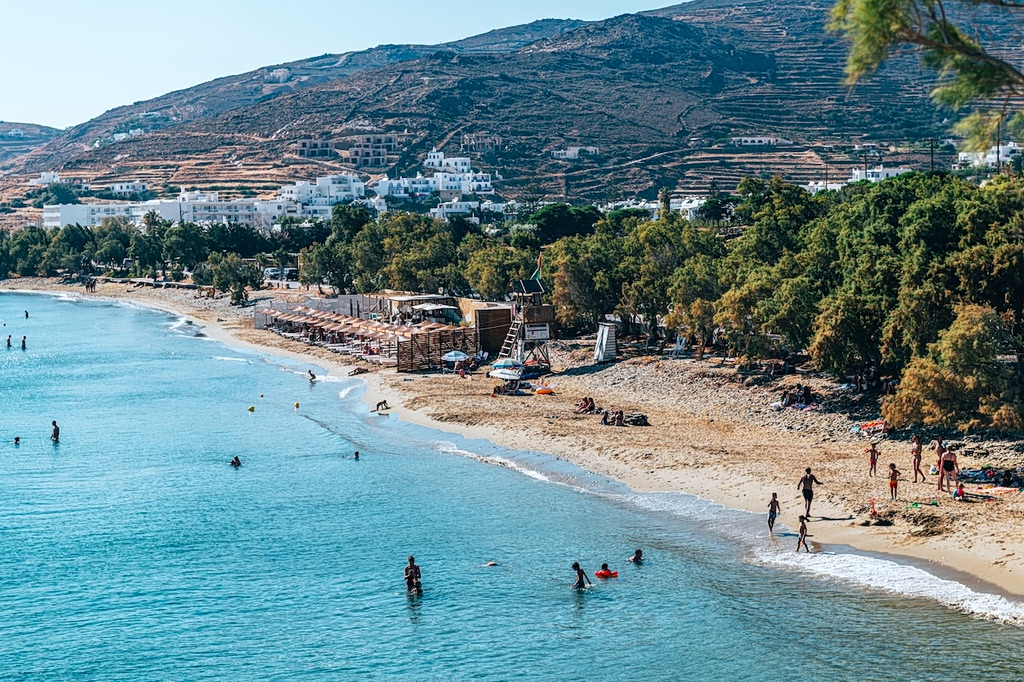
In the last decade, and more so in the last five years, the world discovered Tinos. Literally. And with the world, the trending videos, the first-hand experiences inundating social media, the torrent of traditional Tinos foods with a twist… came the irreparable loss of the very thing that set Tinos apart from all of the other “trending” Greek islands – its authenticity.
In this era of lightning-fast change and 24/7 connectivity, as we find ourselves held hostage by the very technology meant to save us time for leisure, there is a return to the word “authenticity”. We see it everywhere, on social media, and in the promises of leaders and tourism stakeholders. Younger generations, deprived of anything real, are trying hard to find something that has meaning. And yet, the authentic character of the island can no longer be found. Instead, it’s pretending to be authentic.
There’s been lots of talk in Europe particularly, about the impact of overtourism and the gentrification of cities. Sadly, this is now the case not only in many central Athens’ neighborhoods, but also on many Greek islands, including Tinos.
Visiting Tinos for the third time in a period of 30 years, this change was more than evident. And it was painful.
Lifeless Villages
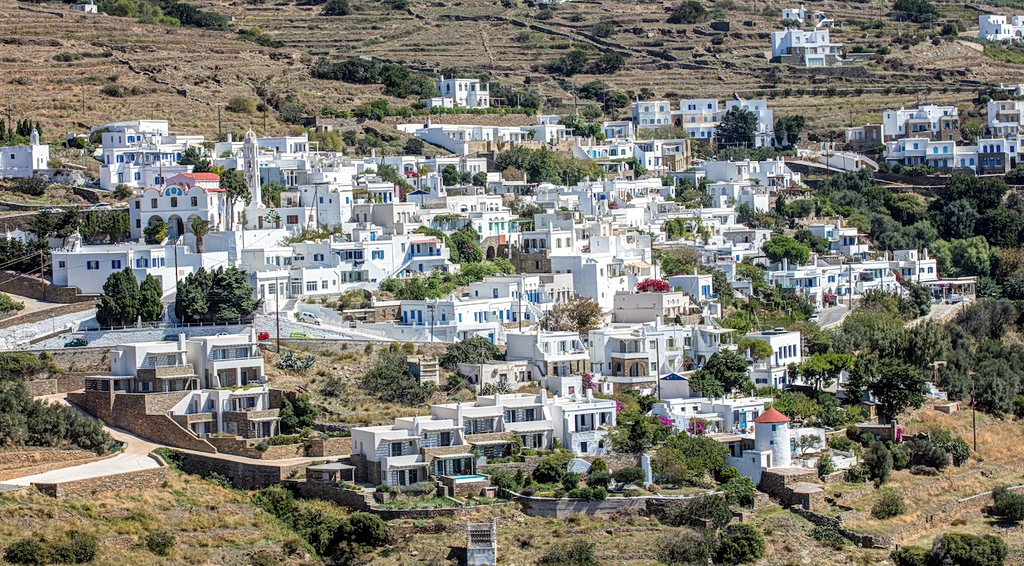
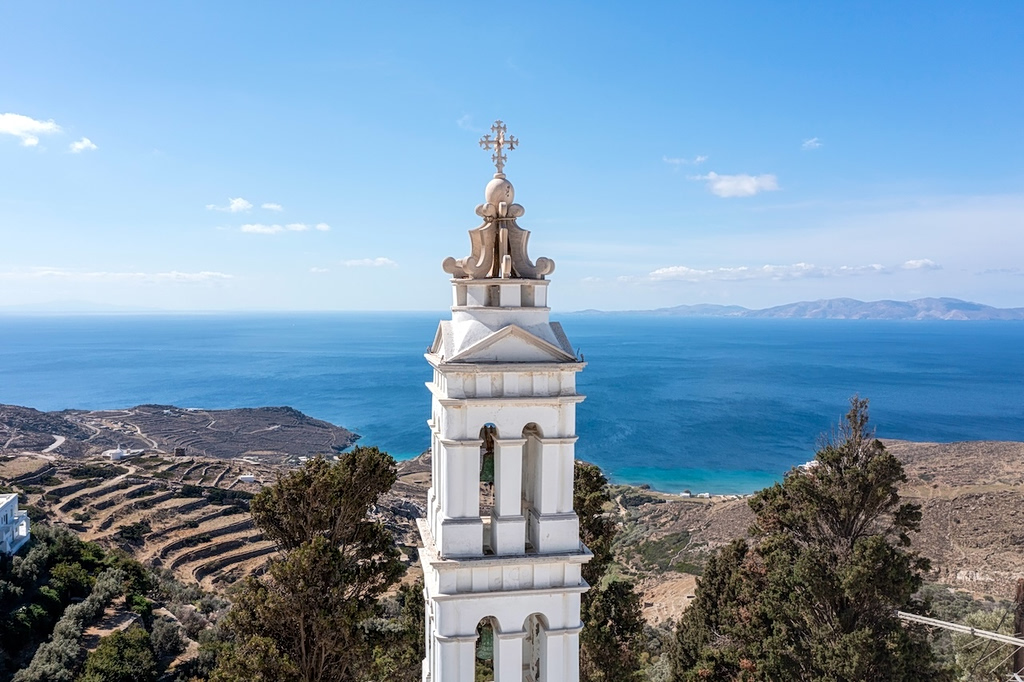
The island’s beautiful villages are even more beautiful today, many homes renovated, old abandoned buildings repaired, squares maintained, stone walkways white washed. And yet this post-card perfect setting, comes to life like a stage set only three months of the year, in the summer, when the tourists arrive.
The very essence of what made Greece appealing to foreigners, the simple way of life in the island village, no longer exists.
Travelers from across the world started visiting Greece and the Greek islands in the early 1970s intrigued by the locals baking bread, fishing, collecting herbs, making cheese, honoring their saints, celebrating life’s special moments; a baptism, a wedding, an engagement, a harvest, a national holiday.
No more. Only a handful of people still live in the villages today. With the exception of two or three towns on the island and the port, the rest of Tinos falls silent on September 30, the last day of the tourist season.
Don’t get me wrong, tourism is a very good thing. It helped thousands of Greek families survive, especially during the debt crisis and after COVID-19. Before that, it brought many Greek islanders out of poverty. It generated revenue for a poor country. It also helped spread the word about Greece’s singular cuisine, music, and arts.
But it has and continues to be unregulated, serving the interests of foreign funds, billionaires, investors, and locals who care very little of their precious and priceless inheritance. And Tinos is one clear example of this.
Its hillsides, once covered in thistle, thyme, oregano and rosemary, glittering gold in the wind, are now choked with small, big and gigantic white villas and stone holiday homes. More swimming pools, more driveways, more lights, more and more buildings to house more and more tourists, not locals.
At the same time, the roads, some of them still single-lane, are much as they were decades ago. Imagine dozens of tourist buses, hundreds of rental cars, locals trying to get to work, and tourists scrambling in search of the perfect beach. Where will all these people park? Most of the island’s villages are built on steep inclines, and in the past, access was possible only by mule—for a reason.
The Mykonos Effect
And so in 2026, Tinos, the island that was among the few still holding tightly to its authentic ways, has succumbed to the “Mykonos effect”.
What is the Mykonos effect? Visitors to the iconic island find themselves in rented cars or on rented motorcycles, meandering along snakelike roads hemmed in by towering stone walls, unable to catch even the slightest glimpse of the sea.
The beach of their dreams comes into sight only when they are a few meters away. And once there, the choice is one: pick one of the (too) many beach bars to park your vehicle and gain access to the otherwise public beach. If you want to simply find a spot to lay your towel, no umbrellas, fees, coffees, and VIPS… look elsewhere.
A few decades ago, you could see (and smell) the sea from any point on the island. As the rattle-trap bus made its way along the narrow roads, the mesmerizing Aegean blue merged with the crisp blue sky and piqued your curiosity. You could feel the excitement as your heart beat faster, eager to set foot in paradise. Today, instead of this invigorating view of the Aegean, you see only walls, villas and restricted access.
This too is sadly happening at a very fast pace on Tinos. Futuristic villas and opulent holiday homes are mushrooming in every available space. And Tinos is not flat like Mykonos. Its steep inclines make building and access difficult, and reaching the beach is no easy matter.
The Dream and the Reality
Today, there are approximately 8,900 permanent residents on Tinos with the majority -around 5,000- living in the port and the rest spread out among six villages of the island’s 40, according to ELSTAT 2021 data. In the three summer months this figure skyrockets to 40,000 people. One can only imagine the considerable demand for water, power and waste management, not to mention the traffic and the impact on the environment.
In 2025, Greece welcomed nearly 38 million travelers, who generated 23.6 billion euros in revenues. From the minor impact tourism had on the country’s economy in the past decades, today the sector is a major contributor accounting for 13% of total GDP. Its wider economic and social footprint is even more significant supporting more than 450,000 jobs and generating up to 85.9 billion euros, indirect activity included.
And yet, with more than half a century of tourism experience under our belts, everyone in Greece is still missing the point: travelers, both young and old, dreaming of vacationing on the Greek islands rarely conjure images of struggling to find a spot to lay their towels on overcrowded beaches, paying outrageous prices to use an umbrella and lie on one of the hundreds of sunbeds packed almost on top of each other, amid the cacophony of blaring music from at least three beach bars, while water-sports enthusiasts roar through the waves on jet skis and speedboats.
They don’t dream of eating waffles and Croque Madames, cinnamon rolls and cheesecakes. They don’t anticipate spending hours waiting in line to park, get a seat or order a drink. They dream of an unspoiled beach, with an unpretentious bar playing cool vibes as people mingle and chill.
In 2026, the same port that once put people off with its plainness and lack of polish may be the most authentic part of Tinos, where real people live real lives, and where the island’s story continues long after the summer crowds have gone… pretense-free.
Write to Maria Paravantes at mparavantes@tovima.com