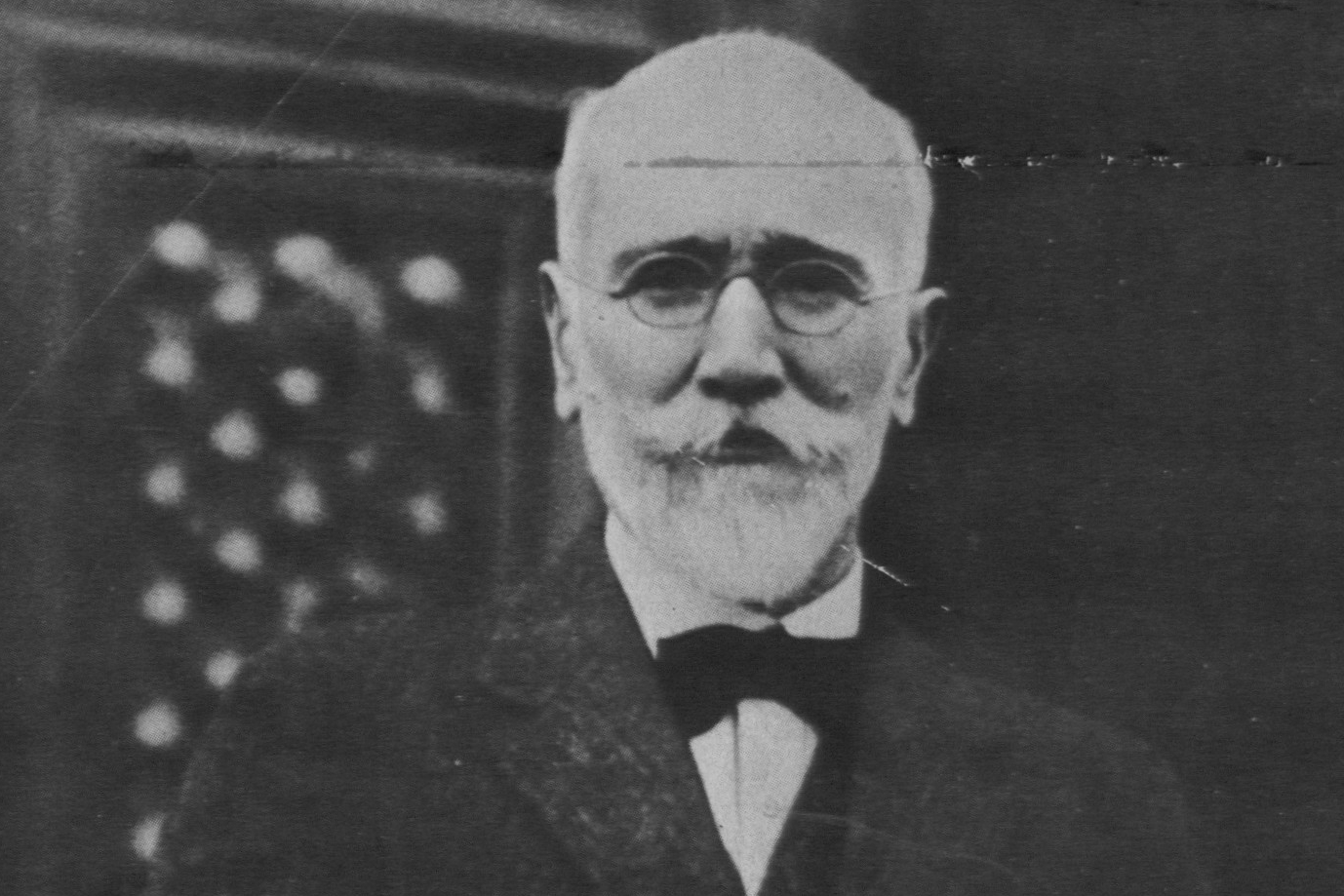
It was July 30, 1920, when at the Gare de Lyon in Paris, Greek Prime Minister Eleftherios Venizelos was the target of an assassination attempt—by fellow Greeks.
Venizelos was preparing to board the return train to Greece, triumphant after signing the Treaty of Sèvres, which laid the foundation for the envisioned “Greater Greece of two continents and five seas.”
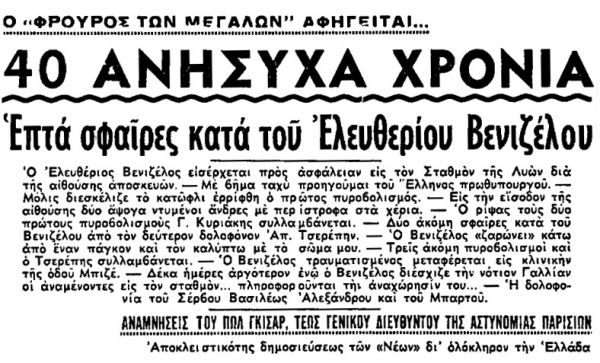
From “TA NEA”, 13.12.1954 – Historical Archive of “TO VIMA” & “TA NEA”
In its December 13, 1954 edition, TA NEA published excerpts from the memoirs of former Paris Police Chief Paul Guichard, who stood beside Venizelos at the time of the attempted assassination.
Testimony of the Police Chief
“One of the most shocking assassination attempts during my 40-year tenure as Chief of Police in Paris was the one against Eleftherios Venizelos.
Venizelos, then Prime Minister of Greece, was scheduled to leave Paris on the 8:30 p.m. train from Gare de Lyon.
The most reckless decision was allowing members of the Greek community to come bid farewell at the station.
Following my intervention, it was decided that Prime Minister Venizelos would enter the station through the baggage hall to avoid mingling with the crowd of travelers.
Venizelos appeared at the entrance to the baggage hall at 8:20 p.m. (…) Just as he crossed the threshold and I walked a few steps ahead of him, a gunshot rang out.

I turned immediately and saw two impeccably dressed men in black at the entrance, each holding a revolver and aiming at the Prime Minister.
One of them, named G. Kyriakis, had fired the first shot. He managed to fire a second round before fleeing into a nearby luggage storage room.
He leapt over a counter and reached the station courtyard, where he was apprehended by police.
Meanwhile, the second attacker, Apostolos Tserepis, fired two shots in Venizelos’s direction.
Seeking cover, Venizelos ducked and crouched behind a bench typically used for storing packages.
Tserepis (…) fired three more shots toward the ground, almost at Venizelos’s feet. He didn’t manage to fire a sixth—police officers had already seized him.”
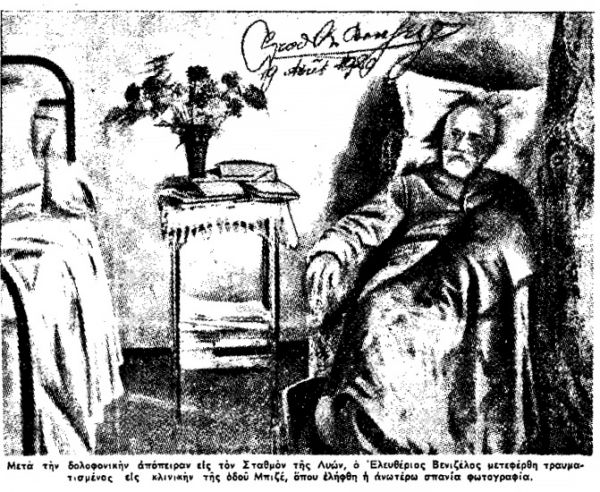
An image of Venizelos recovering after the attempt, from ‘TA NEA” on 13.12.1954, from “TA NEA” and TO VIMA’s” historical archives
“Venizelos was wounded. He was laid out on a bench. (…) Greece’s ambassador, Mr. Romanos, arrived shortly after and arranged for his transfer to a clinic on Rue Georges Bizet.
About ten days later, President Venizelos had recovered.”
The Would-Be Assassins
Venizelos was shot in the arm. The attackers were identified as former Greek military officers: Apostolos Tserepis, a dismissed navy lieutenant from Aetoliko, and Georgios Kyriakis, a dismissed army lieutenant from Corinth.
The news caused major upheaval in Greece, especially as early (and incorrect) reports claimed the prime minister had died from his wounds.
The attempt sparked a furious response from Venizelos’s supporters against royalist and anti-Venizelist factions.
The Aftermath in Greece
As TO VIMA reported on August 30, 2003:
“Immediately following the failed assassination attempt, panic and uncertainty gripped Athens.
Information was scarce and conflicting. Many feared Venizelos had not survived. Thousands of Venizelist supporters flooded the streets, shouting in outrage, ‘Death to the assassins,’ ‘Death to the masterminds.’”
The following day, July 31, Venizelist military officers arrested and executed politician Ion Dragoumis, a prominent figure of the anti-Venizelist movement.
“That same evening, in an attempt to calm public outrage, a thanksgiving service was held at the Athens Metropolitan Cathedral to celebrate the survival of Eleftherios Venizelos.”
Yet Greece remained trapped in the throes of the National Schism, whose divisive shadow would soon—and disastrously—extend over Asia Mi