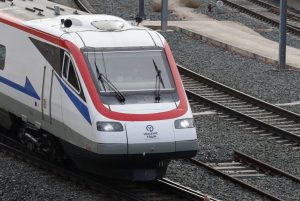
The United States has the largest economic and technological ecosystem in the world, yet it remains strikingly behind Europe and Asia when it comes to high-speed rail travel. While France, Spain, Italy, Germany, China, and Japan have connected their major cities with fast trains, Americans still rely mainly on cars and airplanes.
That picture may start to shift in the coming years. At the forefront of America’s new rail ambitions is the Transcontinental Chief, a project from AmeriStarRail aiming to link New York directly with Los Angeles. The roughly 4,500-kilometer route would connect the Atlantic to the Pacific, crossing the entire country in about 72 hours.
Eight main stations are planned: Los Angeles, Albuquerque, Kansas City, Chicago, Cleveland, Pittsburgh, Harrisburg, and New York. The train is designed to run at speeds of up to 160 kilometers per hour, relying mainly on the existing rail network. That reduces the need to build new lines, but creates serious operational challenges, since much of America’s rail infrastructure is used by freight trains.
The plan isn’t just about passengers. AmeriStarRail also wants to transport private cars and even trucks, offering an alternative to long-distance road travel. It’s precisely this complexity that has drawn objections from Amtrak, which has argued that the proposal still lacks sufficient financial and operational documentation.
Launch had originally been targeted for 2026. But the disagreements have delayed the project, and AmeriStarRail is now turning to Congress and the U.S. Department of Transportation for support. The new symbolic target is 2028, the year Los Angeles will host the Olympic Games.
Considered more advanced is Brightline West, the new line that will connect Las Vegas with the Los Angeles area. The train will cover more than 400 kilometers in about two hours, reaching speeds of 320 kilometers per hour on certain stretches. Its launch is also planned for 2028, and it’s expected to relieve congestion on one of the busiest road corridors in the country.
Meanwhile, the California High-Speed Rail project continues to move forward, though slowed by delays and major cost overruns. The first phase calls for connecting San Francisco with Anaheim through the Central Valley, with future extensions reaching Sacramento and San Diego. The first operational segment, from Merced to Bakersfield, is expected in 2032 or 2033.
America’s return to the rails will be neither quick nor cheap. But it does reveal a strategic shift: in a country built around the car and the airplane, the train is once again staking its claim to a place in the future of transportation.