 Μake us preferred on Google
 Greece has formally responded to Libya’s recent diplomatic protest regarding the publication of maritime concession maps southwest of Crete. The Greek Permanent Mission to the United Nations submitted an official reply, clarifying the legal basis for the country’s maritime boundaries and resource exploration activities.
Greek Position Based on International Law
The response outlines the boundaries of Greece’s territorial waters, continental shelf, and Exclusive Economic Zone (EEZ), all defined in accordance with international law and the United Nations Convention on the Law of the Sea (UNCLOS). According to Greece, its territorial waters in the Ionian Sea and up to Cape Tainaron extend to 12 nautical miles. The statement also references agreements Greece has signed with Egypt (partial EEZ delimitation) and Italy.
Libya’s Objection and the Turkey-Libya Agreement
Libya’s transitional government had earlier lodged a formal complaint after Greece shared concession maps for two offshore blocks—intended for exploration by U.S. company Chevron—with relevant European authorities. In its diplomatic note, Libya argued that the Greek maritime spatial plan, presented in April 2025 by the Ministries of Foreign Affairs and Environment & Energy, infringes on Libya’s continental shelf.
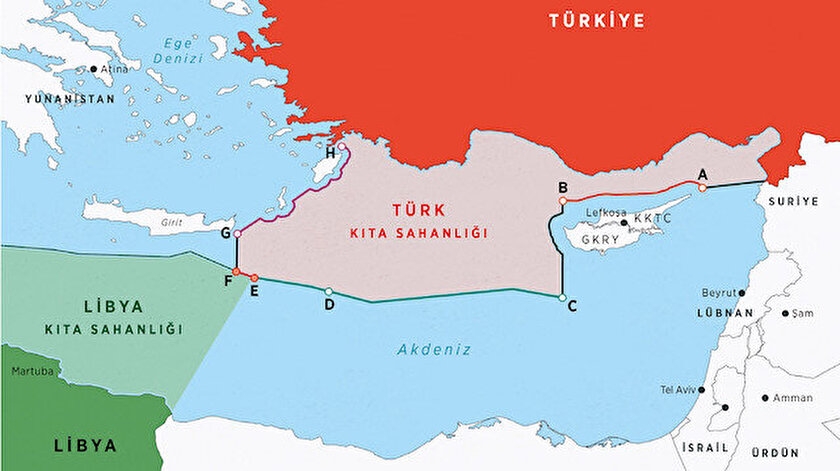
Libya maintains that some southern sections of the Greek plan overlap with areas in which it claims sovereign rights “ipso facto and ab initio,” based on international law. It further states that the Greek maritime plan has no legal validity with respect to Libya.
This protest is seen as an attempt to reinforce the controversial 2019 maritime deal between Libya and Turkey—a memorandum considered unlawful by Greece and several other states. The agreement, which outlines maritime boundaries between Libya and Turkey, has been a longstanding source of tension in the Eastern Mediterranean.
Additional Libyan Claims
Libya also objects to Greece’s April 17, 2025 declaration of an EEZ in the Ionian Sea, published under official government decree (No. 59). According to Libya, the southern boundary of this zone is not equidistant between the Libyan and Greek coasts, thereby violating Libya’s continental shelf rights.
The Libyan side asserts that such unilateral actions contradict key principles of the international law of the sea, which encourage states to seek temporary practical arrangements and avoid hindering the conclusion of final agreements.