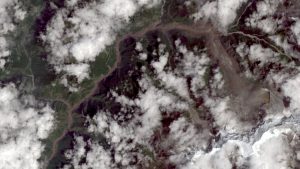
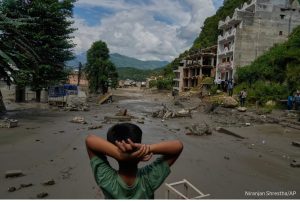
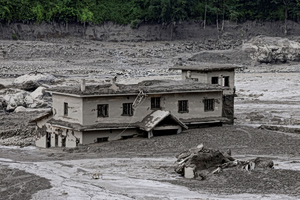
Rescue teams in Nepal have recovered more than 350 bodies as of now, after a devastating flood sweeped across the Nepal-Tibet border, according to local media. Police warn that the death toll will keep rising as more bodies are found in lowland areas well away from the original disaster site. China has separately confirmed 3 deaths, along with 103 bodies recovered from a river near Chitwan province, about 100 kilometers from the epicenter.
A Broader Missing List
In China’s Gyirong region alone, 558 people remain missing, including 260 foreign nationals. Across both countries, those unaccounted for come from more than 24 countries: 288 Indians, 63 Americans, 51 Malaysians, 34 Australians, 33 Britons, and 25 Canadians are among those on the list.
Rescue crews have had some success: 100 Indian visitors, mostly pilgrims, and 25 Chinese workers were pulled to safety in the hard-hit Trishuli area. More than 5,000 rescue personnel are now involved in the operation, having saved 125 people on Thursday alone, including 20 foreign nationals.
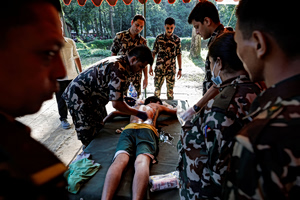
A man, who was airlifted from Rasuwa district, receives first-aid at a mobile hospital inside the Maithali Barrack, an army training centre, which also serves as a primary base to airlift survivors following flash floods and mudslide at Trishuli in Nuwakot district, Nepal, August 27, 2026. REUTERS/Navesh Chitrakar
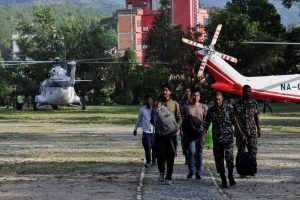
People rescued and airlifted from flood-affected areas arrive at Maithali Barrack, an army training centre, which serves as a primary base to airlift survivors following flash floods and mudslide at Trishuli in Nuwakot district, Nepal, August 27, 2026. REUTERS/Navesh Chitrakar
A New Flood Risk
Chinese authorities have identified a fresh danger: a lake formed by debris in the Gyirong area, which is already overflowing and threatens a second flood, especially with rain forecast in the coming days. As of Thursday morning, the lake held roughly 2 million cubic meters of water and is expected to take on another 3 million cubic meters over the next three days, raising the risk of a breach. A similar event last year, a sudden glacial lake drainage on Tibet’s Purep Glacier, triggered deadly flooding in Nepal.
Many of this year’s victims were pilgrims traveling to Mount Kailash, a site of major significance for Hindus and Buddhists. A tourism industry representative described the scene starkly: the area was leveled, and anyone caught in a hotel, restaurant, or car was likely lost.
Political Response
Chinese Premier Li Qiang made a surprise visit to the disaster site, underscoring how seriously Beijing is treating the incident. Nepal’s Prime Minister Balendra Shah traveled by road to one of the worst-hit areas to assess the situation firsthand. His government, in office for just five months, is facing a major test, though officials point to the country’s experience managing the 2015 earthquake as reason for confidence.
Overwhelmed Facilities
Local hospitals are unable to hold all of the bodies recovered, so authorities are setting up tents to prepare for families arriving to identify victims. Bodies that can’t be identified will undergo DNA testing.
The Gyirong border crossing, a key node in China’s Belt and Road network, has seen rapid development in recent years. India, the United States, Canada, and the United Nations have all sent aid or pledged support for the affected communities.