 Μake us preferred on Google
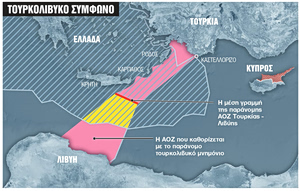
In 2019, US diplomacy was called on to manage the crisis that the Turkey-Libya memorandum triggered in the Eastern Mediterranean. Comparing its reactions back then with the strictly neutral response it gave after the eastern Libyan House of Representatives decided to ratify the memorandum is revealing. The Turkey-Libya memorandum stayed the same. The State Department, however, changed.
In its response to ERT on Wednesday afternoon, the US department’s spokesperson once again put the doctrine of economic diplomacy ahead of international law. Resolving maritime issues, the spokesperson said, “opens the way for commercial investment and exploration that will benefit the entire Mediterranean region.”
The response contained no reference to international law or to the rights of islands. Greece and Turkey were simply called on to work things out through “good faith negotiations.”
What Washington Said During Trump’s First Term
The picture is far from that of the period that began with the signing of the memorandum in 2019 and peaked with the Greek-Turkish crisis in the summer of 2020. At that time, during Trump’s first term, the State Department openly challenged specific Turkish claims.
On January 15, 2020, responding to the Athens-Macedonian News Agency (AMNA), the US State Department invoked the Convention on the Law of the Sea for the first time, even though the US is not a party to it.
“Contrary to what Turkey suggests, under international law as reflected in the Convention on the Law of the Sea, islands are generally entitled to an EEZ and continental shelf to the same extent as any other land territory,” it said at the time.
A barrage of other statements followed that made clear reference to international law, bluntly described the Turkey-Libya memorandum as unconstructive and provocative, and stressed “that this memorandum of understanding cannot, from a legal standpoint, affect the rights or obligations of third states, such as Greece.”
Behind this stance was a strategic view that Wess Mitchell, then in charge of Europe and Eurasia at the State Department, had already expressed in 2018. At a closed briefing held in Washington at the time, he linked the US response to Turkish actions in the Eastern Mediterranean with the challenges the US faced in the South China Sea. US diplomacy could not overlook Turkey’s behavior while at the same time demanding that China respect international rules.
In “The Unquiet Frontier,” which he co-wrote with Jakub Grygiel, Mitchell had developed the idea that US rivals test Washington’s resolve by pressuring its smaller allies. US inaction encourages new claims and erodes the trust of its partners.
In the Eastern Mediterranean, this reasoning gave strategic substance to the defense of international law. Tolerating challenges to the rights of Greece and Cyprus could undermine US credibility on other fronts as well. From this perspective, maintaining relations with Ankara did not require treating conflicting positions as equally valid.
Mitchell left in February 2019, before the Turkey-Libya memorandum was signed. However, the clear distancing from Turkish positions continued after his departure.
In July 2020, Matthew Palmer told Greek correspondents that “Turkey’s understanding of the legal framework is different from ours.” He added that it differed from it and explained that US diplomacy had conveyed its concerns to Ankara both publicly and privately.
The Turkish Ambassador’s “Complaint”
Ankara’s annoyance at this change in Washington’s public tone was also recorded during Turkish diplomat Çağatay Erciyes’s visit to the US capital in February 2020. Erciyes, who later became especially well known in Greece as he served as Turkey’s ambassador in Athens, had then “complained” that the US had recently given the impression that it had moved away from its longstanding policy of equal distance.
As he stated, Turkey was not seeking US intervention in favor of its rights, but was asking Washington to do what it had always done. That is, to remain strictly neutral, without intervening or taking a position on the substance of its disputes with Greece.
Who Shapes Policy at the State Department Today
Donald Trump’s personal relationship with Tayyip Erdogan also existed in his first term. It is therefore not enough to explain today’s shift. What has changed is the room that other players in the US administration have to shape policy.
In the first term, a White House absorbed by successive domestic crises left room for officials with specific ideas and political weight. Especially under Mike Pompeo, State Department officials could promote a regional strategy and publicly defend its choices. Mitchell was a typical example of someone who knew what he wanted to do with his portfolio.
Today, diplomatic conversations in Washington paint a different picture. Embassies continue to talk to the State Department as usual. However, they do not have the same certainty that the positions they hear have the necessary political backing and would hold up if the White House took a different direction.
Experienced officials have left and the willingness to take initiative has declined. Avoiding exposure to the president affects how the system works. A general call for dialogue is safer than a statement that directly challenges the positions of a leader whom Trump consistently praises.
Moreover, the demand for loyal alignment has also been formalized. The executive order “One Voice for America’s Foreign Relations,” dated February 12, 2025, states that failing to faithfully implement the president’s policy may lead to disciplinary action, including removal.
The gap between the two terms concerns both the White House’s priorities and the State Department’s ability to influence them. In 2020, Washington explained to Ankara what international law provides. Today, it explains to Athens and Ankara how much they can gain if they reach an agreement.
From international law to business deals, then, is the distance between two terms of the same president.