 Μake us preferred on Google
 The Bode Museum, built in the Neo-Baroque style, dominates Berlin’s Museum Island, or Museumsinsel, in the heart of the German capital. In its imposing entrance hall, I walk past the equestrian statue of Frederick William of Brandenburg and climb the broad marble staircase leading to the first floor.
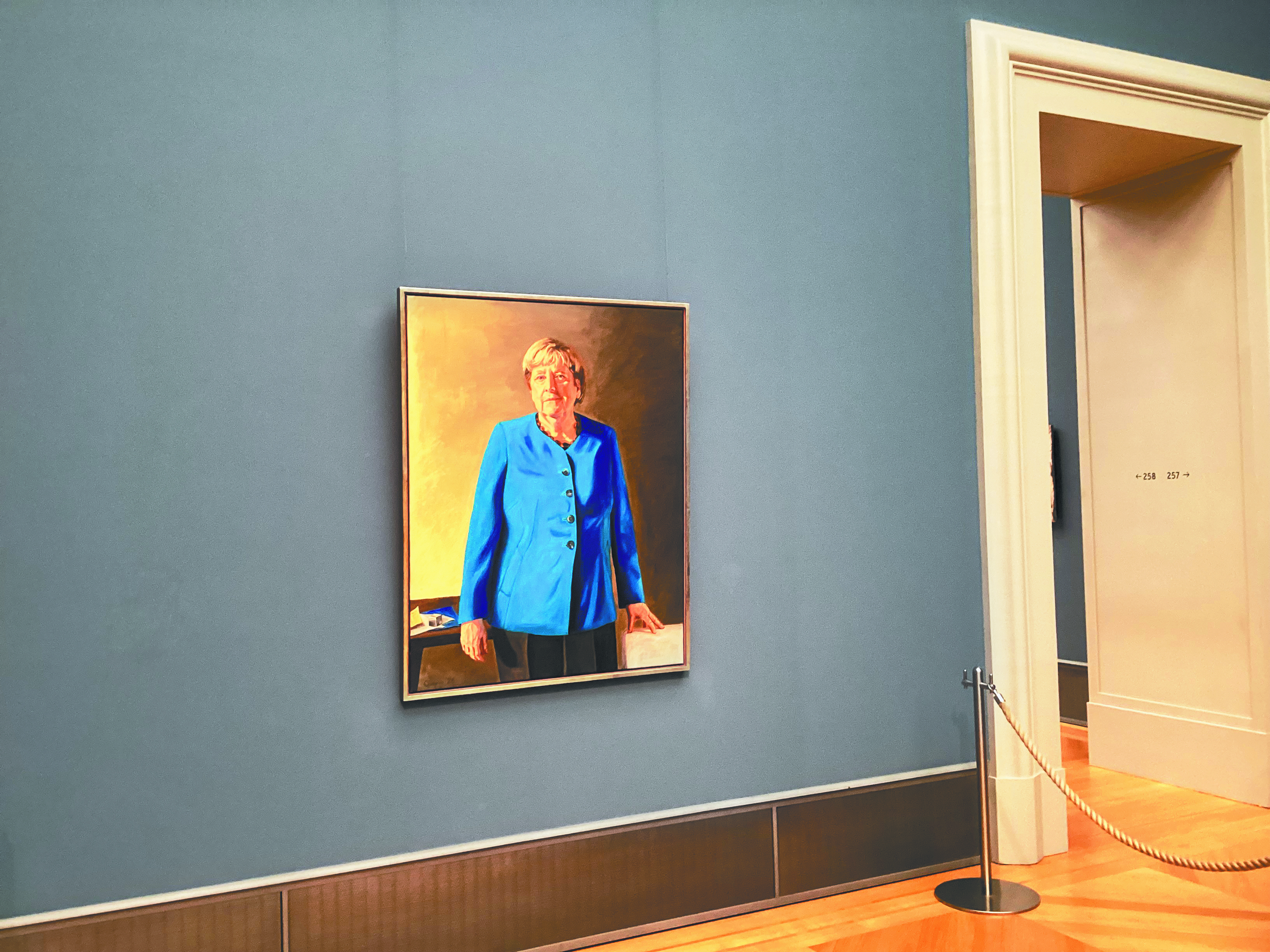
“You can also see Merkel’s portrait,” an attendant is quick to tell me as I make my way toward the so-called French Room, which houses sculptures and works of art by 18th-century French artists. The room is packed. As I enter, I notice that everyone is facing the same portrait: Angela Merkel.
An entire wall had to be cleared to make room for the painting. Temporarily, of course. In October, the portrait of Germany’s first female chancellor, who grew up in East Germany, will “move” to its final destination: the first floor of the Federal Chancellery, where portraits of former German chancellors dating back to 1949 are displayed, following a tradition started by Helmut Schmidt.
The Painter
A portrait of Merkel for posterity? Which artist would dare paint it? As soon as she left politics, speculation ran rampant. Some suggested famous artists from Leipzig, others female artists from cities across the former East Germany. But Merkel has never been predictable. And she had no reason to rush.
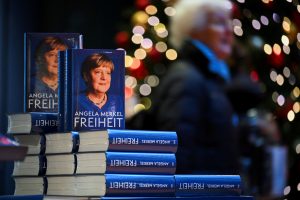
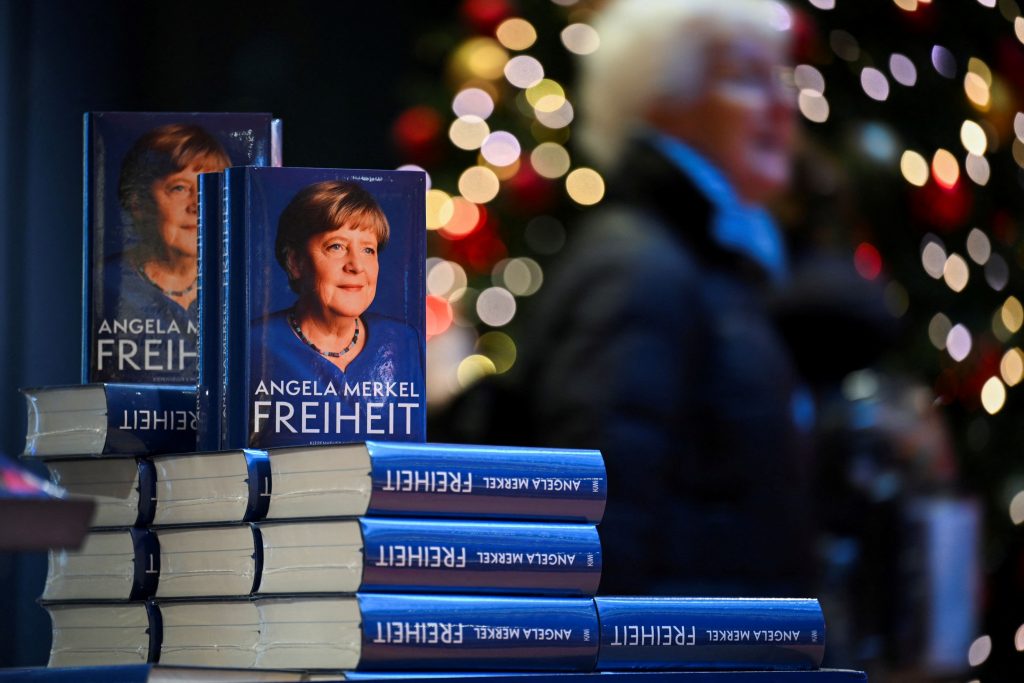
First, she wanted to finish her autobiography, “Freedom: Memoirs 1954-2021,” which she co-wrote with her closest confidante and longtime aide, Beate Baumann.
Only then would she embark on this other “journey,” the portrait. For Merkel, of course, this was not simply another painting by another artist. It was something much more.
It was a visual expression of the understanding of power she embodied for 16 years. But it was also an adventure into the world of fine art for the unknown painter Jérémie Queyras who listened to that other, persistent voice inside him and, in 2022, at the age of 24, wrote Merkel a handwritten letter.
“You can perhaps guess why I am writing to you. I am a young German-French painter of abstract art, but often of classical painting as well,” he wrote.
He enclosed several reproductions of his work and mailed the envelope. But he had no expectations. Why would Merkel choose an unknown young painter to create her portrait?
The answer came three years later, in April 2025. Coruld he come by the former chancellor’s office on Unter den Linden, the grand boulevard in central Berlin?
He remembers being extremely nervous because he did not know whether there were other candidates. He put on a suit and tie. But when the door opened and he saw her walking toward him, his nervousness disappeared. The feeling of warmth was mutual.
Merkel consulted people she trusted without ever seeing any of his original works. As she told the German newspaper Die Zeit, she was driven by curiosity about the young painter and his outlook on life. She wanted to see how someone 40 years younger than her would portray, through art, a politician over the age of 70 with three decades of active political life behind her.
She knew, of course, that the young painter’s life was about to change. And she gave him the opportunity to consider whether he could truly handle the envy of fellow artists and hostile comments from parties on the political extremes.
They began by spending a great deal of time together. Would she pose standing or sitting, like her predecessors? Standing, of course. They immediately agreed that the pose conveyed dynamism.
What color blazer would she wear? Merkel chose a bright blue. She felt it gave her the necessary combination of relaxed composure and seriousness.
And around her neck? Necklaces had become something of a trademark of her appearance; some even considered them a kind of talisman. She chose her familiar amber necklace, which shimmers slightly in the light.
The Diamond and the Folder
But she did not adopt the classic diamond-shaped hand gesture known as the Merkel-Raute, formed by her fingers when she did not know what else to do with them. Instead, her hands rest loosely on the arm of a chair, as though ready to spring into action.
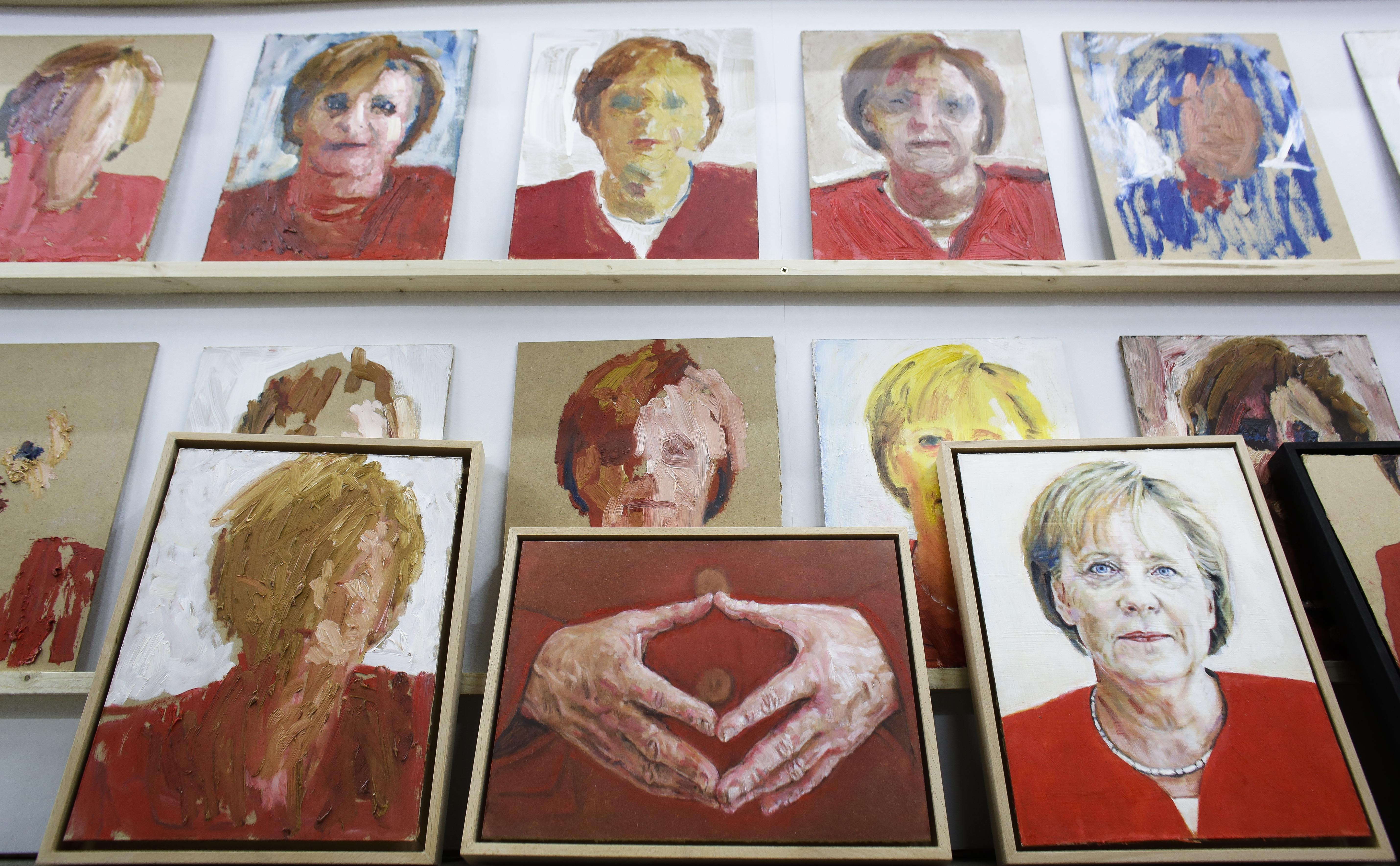
Paintings or portrait studies of the series ’60 Merkels 2012′ of German Chancellor Angela Merkel by Canadian artist Peter Wilde are on display at stand of the Berlin List, an art fair as a part of the Berlin Art Week, in Berlin, Thursday, Sept. 19, 2013. The stand with only art works with German Chancellor Angela Merkel in focus by 13 different artists is the conceptual design of curator and artist Konstantin Schneider. Schneider designed this exhibition specially due to the upcoming national elections on Sunday, Sept, 22, to show Merkel in contemporary art works. (AP Photo/Markus Schreiber)
Like during the refugee crisis, when she confidently declared: “We can do this.”
The portrait could not omit the silver diamond that a former editor-in-chief of Bild gave Merkel as a gift when she became chancellor. She always kept it on her desk. A symbol of good luck.
Each of its six sides bears a word: In. Der. Ruhe. Liegt. Die. Kraft. — “In calmness lies strength.”
How many unforeseen crises unfolded during her 16 years in power, and yet she maintained the strength and composure to confront them…
Beside the diamond sits a yellowish government-issue file folder. Perhaps it symbolizes her belief that sound decisions require a thorough knowledge of the files rather than hasty judgments. Or perhaps it is a touch of self-deprecating humor about her attachment to paper in the age of digitalization.
The greatest mystery in the painting, however, lies in her blue eyes, which the young artist deliberately painted larger than life. Visitors to the Bode Museum sit for hours trying to decipher her gaze. They feel as though she is looking directly at them.
What does that gaze express? Patience? Surprise? Melancholy? Doubt? Perhaps self-criticism?
“Mona Merkel” was the title Stefan Trinks gave his article on the portrait in the Frankfurter Allgemeine Zeitung.
Nostalgia for the Former Chancellor?
“It’s strange when you slowly become history,” Merkel said when asked how she felt about having her portrait hang alongside those of her predecessors.
“That’s simply where I’ll be hanging,” she added matter-of-factly.
The portrait belongs to Merkel herself.
Unlike her predecessors — with the exception of Helmut Kohl — she covered the cost personally, from the paints to the artist’s fee. The amount has not been made public.
And when Oct. 3 arrives, German Unity Day, she will “loan” the portrait to the Chancellery. And if, God forbid, the far right should one day come to power, she will take it back and return it to the Bode Museum, just 300 meters from her home.
Since Merkel’s portrait went on display, people have been lining up to see it — an unprecedented phenomenon for the museum, which has recorded an 85% increase in visitors thanks to the former chancellor’s portrait.
Since July 1, when the painting went on display at the Bode, an average of 900 people a day have visited the museum.
Could it be a wave of nostalgia for Merkel at a time when Germany’s current chancellor, Friedrich Merz, is being challenged from within his own party to a degree unlike any of his predecessors?