Behind appeals to “religious freedom” and claims of “persecution” in Ukraine, U.S. officials and analysts see a coordinated effort to influence American policy toward Kyiv and to insert church affairs into any future peace negotiations.
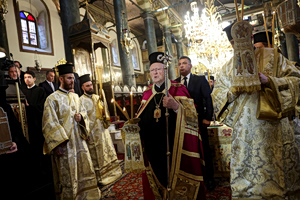
At the center of the dispute is the Ecumenical Patriarchate of Constantinople, the historic seat of Eastern Orthodoxy, whose authority has increasingly come under pressure from Moscow.
In 2018, Ecumenical Patriarch Bartholomew granted canonical independence to the Orthodox Church of Ukraine, reshaping the country’s religious landscape and triggering the most serious rupture within Orthodoxy in modern times.
The decision formalized the existence of two parallel Orthodox structures in Ukraine: The Orthodox Church of Ukraine, recognized by Constantinople and several other churches, and a separate body historically aligned with the Moscow Patriarchate.
The schism has since become deeply intertwined with the broader geopolitical confrontation between Russia and the West.
The lobbying campaign was first detailed by The Hill, which reported that clergy members and political operatives linked to Moscow have been systematically contacting government officials and members of Congress. Their message has been consistent: that Ukraine is violating religious freedom and that U.S. military and financial assistance should be reconsidered.
The effort seeks to portray Ukrainian authorities as persecutors of believers who remain loyal to the Moscow aligned church, while casting doubt on the legitimacy of the Orthodox Church of Ukraine recognized by Constantinople.
At the center of the campaign is Robert Amsterdam, a Canadian American lawyer and veteran lobbyist, who has promoted the narrative that Ukraine is becoming an “anti-Christian state.” He has argued that Kyiv’s policies amount to religious repression, despite the existence of a recognized independent Orthodox church.
According to The Washington Post, Mr. Amsterdam’s work has been financed by Vadim Novinsky, a Russian Ukrainian businessman and a deacon in the Russian Orthodox Church. Mr. Novinsky has funded a network of former lawmakers, law firms, and political consultants engaged in advocacy in Washington.
Over the past two years, the campaign has found a receptive audience in parts of the American conservative movement. As a senator, J.D. Vance linked military aid to Ukraine to what he described as the need to protect religious freedom. Tucker Carlson, the influential conservative commentator, has repeatedly given Mr. Amsterdam airtime, amplifying his claims to millions of viewers.
The growing visibility of the effort has raised concerns on Capitol Hill. Representative Joe Wilson, Republican of South Carolina, has urged the Justice Department to investigate possible foreign influence operations conducted through religious organizations, warning that the Kremlin may be using faith as a political instrument.
Targeting Constantinople: A Long Running Rivalry
The confrontation between Moscow and Constantinople did not begin in 2018.
For decades, Russian church leaders have sought to expand their influence within global Orthodoxy, challenge the Ecumenical Patriarchate’s traditional role as “first among equals,” and strengthen Moscow’s authority over former Soviet and diaspora communities.
After the collapse of the Soviet Union, the Russian Orthodox Church reemerged as a powerful institutional and political actor closely aligned with the Kremlin. As its influence grew, so did tensions with Constantinople over jurisdiction, leadership, and legitimacy.
When Ecumenical Patriarch Bartholomew granted independence to the Orthodox Church of Ukraine in 2018, those long simmering disputes escalated into an open campaign to undermine his standing.
Russian church officials and their allies began questioning his canonical authority and promoting conspiracy theories, stepping up political pressure in Western capitals.
That campaign has since taken on a sharper and more explicitly political tone.
In January 2026, Russia’s Foreign Intelligence Service issued an unusually public and inflammatory statement targeting Patriarch Bartholomew. It branded him an “Antichrist in cassock” and a “devil incarnate,” accusing him of serving Western intelligence and of “dismembering Orthodox Ukraine.”
The communiqué sought to recast the Patriarch’s religious authority as a geopolitical threat and to rally opposition in Orthodox communities from Eastern Europe to North America.
Long before the dispute entered mainstream political debate in Washington, Aykan Erdemir, a former analyst at the Foundation for Defense of Democracies, warned that Moscow was systematically targeting the Ecumenical Patriarchate as part of a broader geopolitical strategy. He was among the first policy analyst in the United States to argue that Russia viewed control over Orthodoxy as a tool of influence rather than a purely theological matter.
Strains in the American Diaspora
The effects of that campaign have not been confined to church leadership in Istanbul or political circles in Washington. They have increasingly been felt within the Orthodox community in the United States, where rival jurisdictions and outside pressures have begun to strain long standing institutional relationships.
Recent tensions within the Greek Orthodox community in the United States have underscored the risks of that strategy.
Last year, the Archon Order of the Ecumenical Patriarchate in the United States, which represents senior lay supporters of the Patriarchate, issued a statement condemning the White House meeting with Russian clerics. The statement was released without consultation with the Greek Orthodox Archdiocese of America, prompting concern among clergy and lay leaders.
Some warned that the move threatened to destabilize the Assembly of Canonical Orthodox Bishops of the United States, the main coordinating body for Orthodox jurisdictions in the country and one of Constantinople’s most important institutional footholds in America. The assembly, chaired by Archbishop Elpidophoros, includes bishops with close ties to Moscow.
Church officials said privately that any weakening or fragmentation of the body would serve Russian interests. Several described the episode as an unintended own goal, arguing that the Archons’ intervention risked advancing precisely the outcome Moscow has long sought.
Facing mounting pressure, Archbishop Elpidophoros publicly distanced himself from the statement in an effort to preserve unity.
A Strategic Contest
In Washington, policymakers and analysts are increasingly viewing Orthodox church disputes through a geopolitical lens.
During the Biden administration, officials were generally reluctant to intervene in religious affairs, avoiding sanctions against the Moscow Patriarchate and its leader, Patriarch Kirill, who openly supported Russia’s invasion of Ukraine.
The United States also declined to respond forcefully as the Russian Orthodox Church established parallel structures in Africa, challenging the authority of the Patriarchate of Alexandria and expanding Moscow’s influence.
According to people familiar with the matter, detailed briefings, including lists of individuals accused of assisting Russian efforts to undermine the Alexandrian Patriarchate, were submitted to senior officials at the National Security Council. Despite the documentation, no meaningful policy response followed.
Today, there is growing recognition in Washington that the conflict is not primarily theological.
It is political, shaped by competing claims to authority and influence at a moment when Ukraine’s future remains uncertain and any peace settlement could reshape the region.
By framing church disputes as human rights violations, Moscow’s allies in Washington are seeking to turn Orthodoxy into a bargaining chip in international negotiations.
For the Ecumenical Patriarchate, and for the Greek Orthodox world more broadly, the outcome of this quiet struggle may prove decisive.
It is unfolding largely out of public view. But its consequences extend well beyond church diplomacy, reaching into the core of U.S. foreign policy and the future of Eastern Europe.