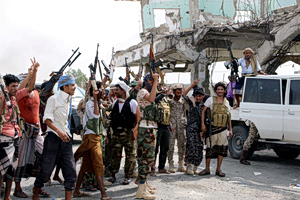
The turbulent December opened a new round of confrontation in Yemen, a country tested by civil war for over twelve years. Secessionist forces in the South turned against the leadership of the Saudi-led coalition, which is fighting the Shiite Houthi fighters—essentially, a small civil war erupted within the larger civil war.
Despite the Saudi-led coalition’s victory, the situation in the southern part of the country remains fragile. At the same time, the ambitions of the Arab Peninsula monarchies—particularly Saudi Arabia and the UAE—clash with the entrenched power of the Houthis, undermining prospects for peace. The Houthis continue to maintain control of the northern part of the country.
In this context, Vima spoke with Thanos Petouris, a researcher at the European Institute of Peace with deep knowledge of Yemen’s political situation, in an effort to decode the developments.
Until recently, the Southern Transitional Council (STC) was part of a unified authority supported by the Saudi kingdom. What explains the change in stance and how did the conflict arise?
It was a risk taken by the Southern secessionists, supported by the United Arab Emirates (UAE), who believed it was the right moment to leave the unified coalition and establish themselves as the dominant political power in the South. In my opinion, this was the Council’s mistake: it gained arrogance due to the constant support it received from the Emirates, which never allowed it to negotiate with other political forces. Their program was limited to the secession of the South, and they were unwilling to talk to anyone who wanted to maintain a unified Yemen, even in a confederal form. This reasoning led them to take initiatives in December.
What is the current situation of the Transitional Council?
The Transitional Council is in a state of disintegration. Our information indicates that the hard core of power is based in the Emirates. It visits Aden periodically, but Al-Zubeidi, its leader, fled to Abu Dhabi. The Saudis, on the other hand, have brought 80% of the Council to Riyadh and control it, with the ultimate aim of reaching an understanding with the more moderate southern forces. Today, the Council is weakened; news of Zubeidi’s departure has led provincial governors to ban gatherings and close the Council’s offices.
Saudi Arabia has chosen direct confrontation with the Houthis. Wouldn’t a negotiation with them be more fruitful?
Saudi Arabia does not want a unified Yemen in the hands of the Houthis, for reasons of national security and because it considers the Houthi movement a threat due to its good relations with Tehran. For this reason, it aimed to unify different forces and organizations to create a counterweight to the Houthi regime in Sana’a, which might eventually reintegrate the northern part of the country. This plan failed because the southern secessionists had accepted the logic of two states. Riyadh saw its “investment” turning into a risk and therefore decided to intervene, precisely because the developments of December disrupted its planning.
What is the role of the UAE and how is their support for the secessionists explained?
The reason the UAE supported the Transitional Council is that they aim to control the Red Sea coast as part of a broader rivalry with Saudi Arabia over trade routes. Hence Zubeidi’s flight included a stop in Somaliland, with which the UAE maintains good relations, attempting to create a counterbalance to Riyadh on the other side of the Red Sea.
The Houthis dominate the North but cannot consolidate their presence in the South. Why is this?
They managed to capture Aden in 2015, which triggered the Saudi-led coalition’s intervention. However, they failed to find alliances that would keep them in power. Additionally, southern forces had already fought in the 1990s against the central government based in the North, so they perceive the Houthis more as part of the problem.
There is also a division between North and South Yemen that was never overcome during the years of unification since 1990.
People from South Yemen carry the idea of a broader cosmopolitanism; one often hears the argument: “We are more secular, Aden is a key port for global trade, we were a British colony and a strategic ally of the Soviets. Why should we be accountable to a regime representing other traditions?” In short, we are talking about a state with two souls. This reality, combined of course with the involvement of external actors, explains why it is so difficult to have a unified Yemen at peace.
What keeps the Houthis in power in the North?
Primarily their ability to provide basic services to citizens. They have managed to turn the North into a state entity, establishing a power mechanism that allows them to collect taxes and provide policing—basic functions of a state. Sana’a, even after airstrikes by the US and Israeli forces, was re-electrified within a few days. In contrast, Aden, under 45°C heat, gets only two hours of electricity a day.
Then there is the capability of Houthi forces. From 2004 to 2010, they fought in six different war cycles against the Saleh regime, which had air superiority, bombed their villages, and generally tried to impose its authority in the North while keeping an ambitious portion of the army away from power. This valuable combat experience, in rugged mountainous terrain, shows a martial culture that is not easily eroded. The role of the warrior is highly esteemed in northern Yemen, where the Houthis dominate.
How do you interpret that the war does not have Sunni-Shiite characteristics, unlike other Middle Eastern states?
In northern Yemen, Zaydi Shiites predominate, although their ritual practices resemble Sunni Islam more closely. Yemen managed for years to balance between the two doctrines and hosted a significant number of Bahá’ís. This kind of syncretism explains why the war in Yemen never took on a religious character. Saleh used the “Iran bogeyman” to seek funding and military support from the West and Saudis, but the confrontation never turned sectarian.
What is the role of Oman in Yemen’s developments?
Oman does not want changes to its borders. The Mahra region shares extensive borders with Oman, and Muscat would not welcome a state controlled by the UAE on its border. For this reason, Oman aligned with Saudi Arabia and politically supported the Saudi intervention. At the same time, it maintains excellent relations with Mahra’s governor and business elite to retain some influence in its immediate area of interest.