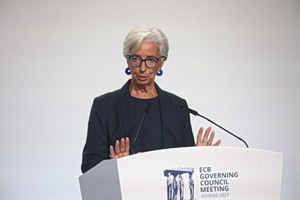
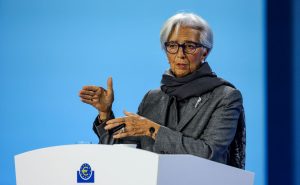
Christine Lagarde said she expects completing her mission as president of the European Central Bank will take until the end of her term, amid speculation that she will resign early to allow the French government to help pick her successor before next year’s election.
“When I look back at all these years, I think that we have accomplished a lot, that I have accomplished a lot,” she said in an interview with The Wall Street Journal on Thursday. “We need to consolidate and make sure that this is really solid and reliable. So my baseline is that it will take until the end of my term.”
Lagarde said she views her mission as price and financial stability, as well as “protecting the euro, making sure that it is solid and strong and fit for the future of Europe.”
She declined to comment on a report, published in the Financial Times earlier in the week, that she would step down before her term is set to end in October 2027. The ECB said in a written statement that Lagarde hadn’t made a decision about the end of her term, but stopped short of denying the report.
An early departure by Lagarde would give French President Emmanuel Macron a say in filling one of Europe’s most powerful jobs before the April 2027 French presidential election, which could see Marine Le Pen’s far-right National Rally party gain power.
While all 27 EU leaders officially select the ECB president, larger countries such as France and Germany have an outsize role in the negotiations, which often come alongside horse-trading for other European posts. Lagarde’s appointment in 2019 was part of a package that saw German Ursula von der Leyen elevated to European Commission president.
Lagarde has dismissed speculation about an early resignation in the past, saying last year she was determined to serve out her term after reports she had discussed leaving early to run the World Economic Forum.
On Thursday, Lagarde said the WEF is “one of the many options” she is considering once she leaves the central bank.
Rumors started to circulate again this month about an early departure, after the head of the French central bank, François Villeroy de Galhau , unexpectedly said he would step down in June . Villeroy said he was leaving to lead a Catholic charitable foundation, but it was seen as potentially laying the groundwork for a broader shuffling of ECB roles ahead of the French election.
Two other seats on the ECB’s executive board—those of Chief Economist Philip Lane and Isabel Schnabel —are set to free up next year.
Filling the roles early would ensure stability at the central bank. But it is likely to fuel hostility on the far-right. Jordan Bardella , the National Rally president who could succeed Macron after the election, described the rush to secure positions including Lagarde’s as antidemocratic in a video posted on X Wednesday.
“It does look like a risky move which could fuel more criticism from populist parties,” said Frederik Ducrozet , head of macroeconomic research at Pictet Wealth Management. “Using such tricks to protect the ECB from populist pressure is not a good look, and may well backfire.”
Asked about whether an early departure could raise questions about the ECB’s political independence, Lagarde said: “I think the ECB is a very respected and credible institution, and I hope that I’ve participated in that.”
Write to Chelsey Dulaney at chelsey.dulaney@wsj.com