International businesses are abandoning Cuba, delivering another blow to the island’s collapsing economy as the Trump administration ratchets up pressure on Havana.
Mastercard and Visa transactions by non-U.S. foreign visitors will be suspended on the island starting Saturday, according to Cuba’s central bank. Americans were already prohibited from using their cards in Cuba.
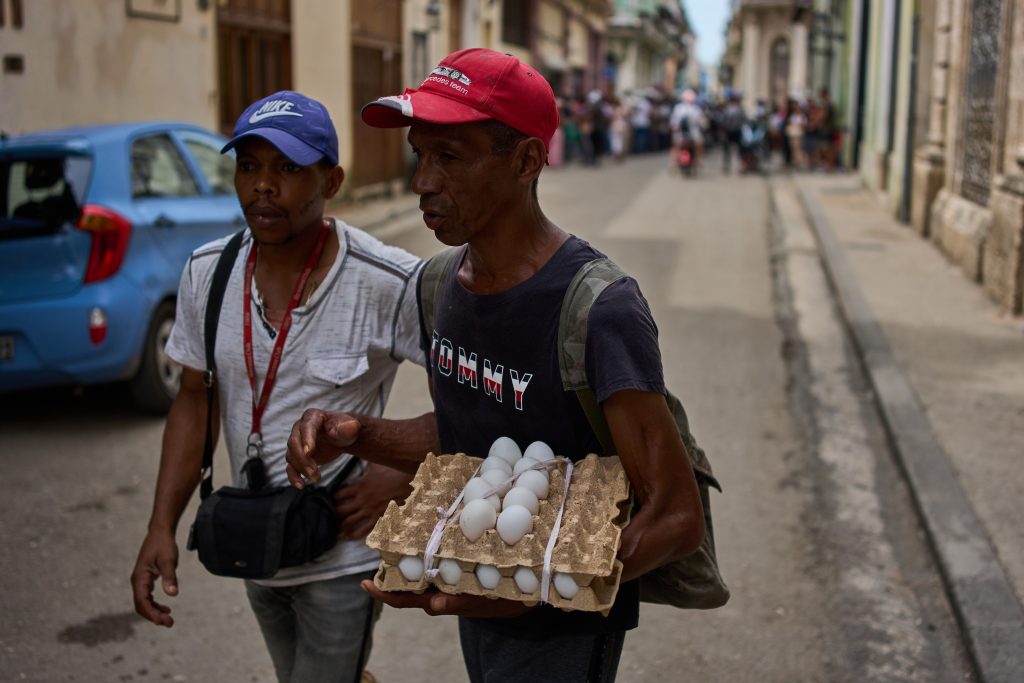
People walk and chat in Havana, Wednesday, June 3, 2026. (AP Photo/Ramon Espinosa)
Spanish hotel giants Iberostar and Meliá have said they are giving up management of at least a dozen Cuban hotels each. Royalton Hotels & Resorts, a Canadian operator, ceased operations after grappling with a collapse in tourism.
There is also uncertainty over the future of Sherritt International, a Canadian mining company that’s one of Cuba’s most important foreign investors. Its former chief executive was once nicknamed Fidel Castro’s “favorite capitalist.” Last month, Sherritt said it was suspending operations and repatriating staff.
The exodus followed several major airlines’ canceling flights into Cuba because of jet-fuel shortages there.
For decades, foreign corporations accepted the risks of operating in Cuba, seeking a foothold in the island’s tourism and mining sectors despite a long-running U.S. embargo. They were among the last vestiges of foreign investment in an economy dominated by the communist state.
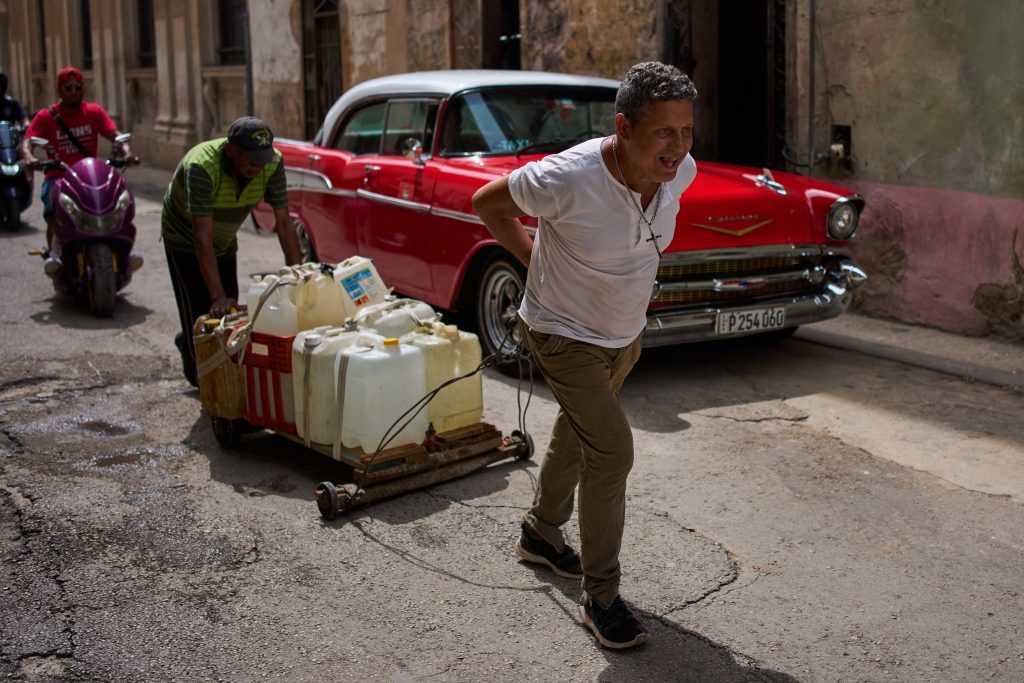
People transport containers of water in Havana, Wednesday, June 3, 2026. (AP Photo/Ramon Espinosa)
The companies supplied Cuba with badly needed hard currency and business expertise. Now, many have concluded that the risks outweigh the rewards as they confront both a deepening economic collapse and a Trump administration determined to increase pressure on Havana.
“This is an inflection point,” said Ricardo Torres, a Cuban economist at American University in Washington. “It’s a major blow to an already weakened economy.”
The departure of Sherritt would be particularly significant.
For more than three decades, the company extracted tens of thousands of tons of nickel and cobalt each year from the Moa mine in eastern Cuba, helping sustain one of the island’s most important export industries.
Mark Entwistle, Canada’s ambassador to Cuba during the 1990s when Sherritt was establishing itself on the island, said the company did far more than operate a mine.
“It effectively trained a whole series of Cuban business executives on how modern companies work,” Entwistle said, helping create “an embryonic business class that was very, very revolutionary in Cuba at the time.”
Just months ago, Sherritt was discussing expansion projects to improve production after output fell because of fuel shortages and Hurricane Melissa.
“Navigating uncertainty is nothing new for Sherritt,” interim Chief Executive Peter Hancock said during a February earnings call.
The company now says that uncertainty has become too great.
While Sherritt wasn’t formally designated under a Trump administration executive order targeting Cuba’s military-controlled economy, it said the order’s “mere issuance” had created conditions that materially altered its ability to operate.
Its chief financial officer, external auditor and several board members resigned. The company later said it was dissolving its joint ventures in Cuba, before reversing course and announcing that it had signed a nonbinding preliminary agreement to sell a controlling stake to Gillon Capital, a private family office linked to Ray Washburne , a Republican financier who served in Trump’s first administration.
Shares of Sherritt have fallen more than 50% amid the turmoil. Sherritt didn’t respond to a request for comment.
Meliá said its decision to close 15 hotels was driven by circumstances beyond the firm’s control, noting that most were already closed “due to the energy challenges and the decline in demand” affecting the island. Iberostar said it would cease operating 12 hotels in Cuba “as part of an effort to adapt to the international regulatory environment.”
Mastercard said its cards can’t be used in Cuba because a foreign partner that connects merchants to its network has curtailed operations in the market. Visa didn’t respond to a request for comment.
The corporate retreat comes as Washington intensifies pressure on Cuba’s communist government.
In May, Trump signed an executive order targeting Cuba’s military-owned conglomerate GAESA, which Secretary of State Marco Rubio called “the heart of Cuba’s kleptocratic communist system.”
The U.S. says GAESA controls at least 40% of Cuba’s economy, including many hotels operated through partnerships with foreign companies such as chains that are now leaving or scaling back their presence on the island.
Moa Nickel, the joint venture between Sherritt and Cuba’s state-owned nickel company, was also sanctioned. The U.S. says the project helps sustain a repressive government.
The executive order effectively forced foreign investors to choose whether to continue doing business with entities tied to Cuba’s military or risk secondary sanctions.
“The Trump administration is focused like a laser on the military, intelligence and state security services and any dealings they have with foreign companies,” said Ricardo Herrero, executive director of the Cuba Study Group. “That is where the power is.”
The measures are part of a wider campaign by Washington to extract political and economic concessions from Havana.
Last month, U.S. prosecutors charged Raúl Castro , Cuba’s aging former president, with murder over the military’s shootdown of civilian aircraft in the 1990s. On Thursday, Washington sanctioned current President Miguel Díaz-Canel , members of his family, Castro’s son and grandson, and several Cuban entities.
Cuba’s economy began unraveling after years of mismanagement, corruption and a comprehensive set of American sanctions. The situation deteriorated further after the Trump administration imposed an oil blockade following the January capture of Venezuelan leader Nicolás Maduro, whose government had long supplied subsidized oil to Havana.
Without that lifeline, public transportation has been curtailed, farmers struggle to get produce to market and residents endure hourslong blackouts . Cuba’s peso currency has fallen to around 620 to the dollar on the informal market, according El Toque, an independent Cuban news site that tracks the currency market.
Cubans have protested by banging pots and burning garbage. Hundreds of thousands have left the island.
Now many of the foreign companies that remained are leaving as well, creating a void that few investors appear willing to fill.
“You can call it a one-two punch,” said Ted Henken, a Cuba expert at Baruch College. “It’s just been a gradual but consistent strangulation coming from the Trump administration.”
Write to Ryan Dubé at ryan.dube@wsj.com , Amanda Coletta at amanda.coletta@wsj.com and Deborah Acosta at deborah.acosta@wsj.com