

 Μake us preferred on Google
 Tourism was booming when Sarah Foda began working at Caribbean Tours’ operations in Cuba a decade ago, with 84 employees shepherding thousands of foreign visitors each month to the island’s faded Spanish-colonial cities and turquoise beaches.
With the Trump administration intensifying its squeeze on Cuba’s communist regime, the Swiss-owned company’s visitor numbers have plunged to about a dozen travelers a month. Caribbean Tours still employs 22 people on a reduced payroll to keep them afloat until the business can snap back—if it ever does.
Foda’s business is among the casualties of a U.S. campaign to pressure Cuban President Miguel Díaz-Canel’s government into broad political and economic change. A pillar of the economy, tourism has cratered since the U.S. ousted Venezuelan strongman Nicolás Maduro in January while warning Havana it could face the same fate. The U.S. has cut off essential oil shipments to Cuba.
“I didn’t think it would fall so hard and so fast,” Foda, the company’s destination manager for Cuba, said of tourism. “But worsening infrastructure problems combined with negative international press coverage about blackouts and garbage piling up hurt demand.”
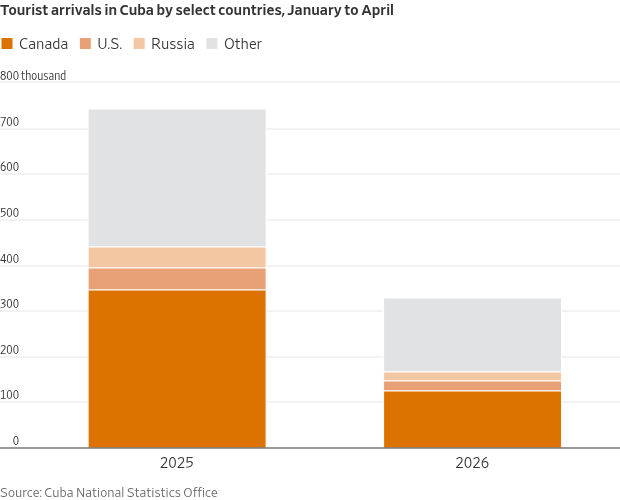
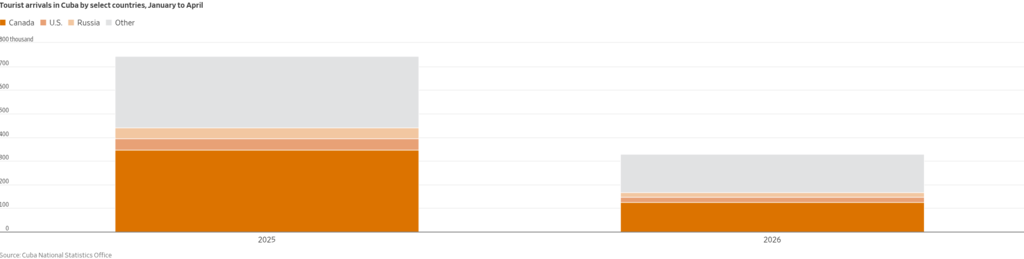
Cuban statistics show around 298,000 international visitors in the first quarter, down 48% from the depressed levels in the same period last year. In March, traditionally high-season, fewer than 36,000 visitors arrived from abroad. Back in 2017 and 2018, when tourism was thriving, nearly 400,000 international tourists visited Cuba on average a month. In those better times, tourism accounted for about 8% of Cuba’s roughly $30 billion economy, employed hundreds of thousands and was a key source of foreign currency, said Pavel Vidal Alejandro, a Cuban economist.
Before the 1959 revolution, Cuba was a tourist destination for Americans drawn by beaches, nightlife, prostitution and casinos, many run by mobsters. Fidel Castro saw tourism as a conduit for corruption and U.S. influence. His government nationalized hotels, closed casinos and turned to sugar exports for revenue, sidelining tourism for decades.
Desperate for hard currency after the Soviet Union collapsed in 1991, Castro reluctantly embraced tourism as a lifeline. Cuba invested heavily in resorts and hotels through partnerships with Spanish and Canadian chains, making tourism a top revenue source.
Prostitution resurfaced, and tourism created inequalities between Cuban hotel workers with access to dollars and those without. Still, by the 2000s, tourism was central to state policy, run by Cuban military-linked companies. Under a short-lived Obama-era rapprochement that began in 2014, private guesthouses and restaurants expanded and visits by Americans surged. Then President Trump reversed the policy in his first term, tightening sanctions.
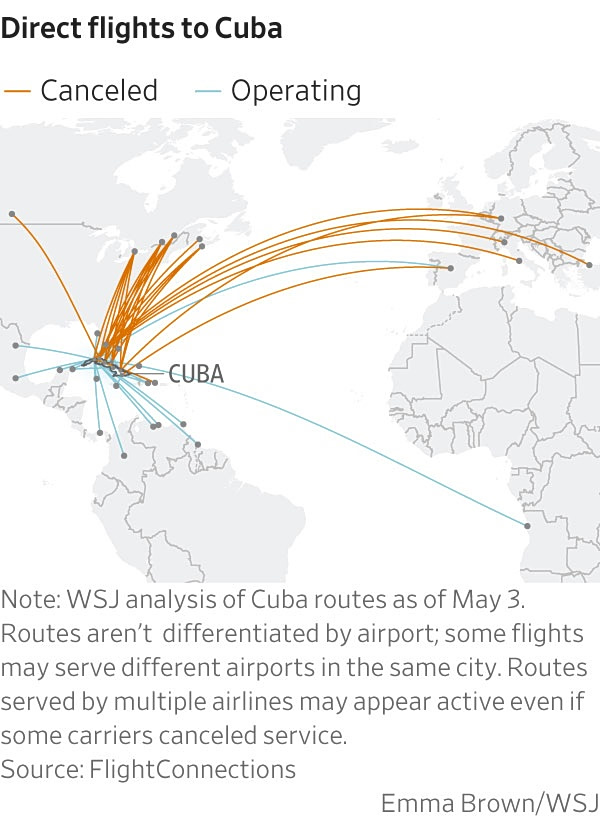
The deepening economic crisis and lack of fuel recently forced several airlines—among them Air France and Air Canada —to suspend service to Cuba because they could no longer reliably refuel return flights. That has made traveling to Cuba complicated and expensive, requiring flights to go through Mexico and other countries. The charter carrier World2Fly became the latest to pull out, ending its Madrid-Havana route with a final flight earlier this month.
Mounting piles of garbage, stagnant water and a crumbling health system fueled outbreaks of mosquito-borne illnesses, further scaring away tourists.
“Tourism has fallen off a cliff,” said Christopher Baker, a British author and tour guide who lives part time in Cuba. Baker, who for years led American visitors across Cuba on motorcycle and photography tours, said most customers canceled recent tours despite his assurances they would have fuel, electricity, food, water and safety.
Andrea Gallina , an Italian entrepreneur, turned an 18th-century Spanish-colonial mansion in Old Havana into a hotel last year, modeling it after the boutique luxury property he opened with his Cuban wife a decade before.
He closed it on April 1. And his first hotel, which in better times had high-season occupancy rates of 80%, now only serves a handful of diplomats and corporate clients with a skeletal staff.
“We dropped to 20% occupancy, and then 10, then 5,” Gallina said, as the fuel crisis deepened and blackouts worsened, compounded by relentless news coverage of Cuba’s woes. “It’s like a pandemic situation, but even worse. Old Havana is a desert. No tourists.”
Alejandro Herrera, who owns a seafood restaurant on the Havana waterfront, said he has considered closing as revenue has fallen 90%. But he keeps it open to provide at least some income for his employees.
“Many people don’t feel very festive these days because of the economic situation,” he said. “They are holding back spending except for very special occasions.”
A tour guide who specializes in Americans hosted visitors until April but canceled his last four tours of the season after conditions worsened and travelers grew concerned. He said he hoped he could start up again in September, the next high season. He and others involved in Cuban tourism asked not to be identified for fear of repercussions from the Cuban or U.S. governments.
A Cuban tour guide at Havana’s historic Colón Cemetery, a popular visitor draw because of its elaborate monuments and mausoleums, said she lost her job this spring as tourism collapsed.
After widespread blackouts beginning in 2024 battered the island, Foda of Caribbean Tours turned to solar panels, batteries and electric vehicles, helping them serve the dwindling number of tourists.
“We had figured it out,” she said, describing how she was “low-key” optimistic.
Geopolitics has proved hard to overcome, though a few hardcore tourists still make the trip and leave deeply moved by Cubans’ warmth and resilience, Foda said.
“They were petrified before arriving,” she said, “but they still came and had an incredible time.”