RANGPO FOREST VILLAGE, India—Far from human eyes, nestled in the Himalayas at 17,000 feet, the South Lhonak Lake was growing. Late one night in October 2023, part of the shelf of rocks and ice that dammed the lake in northeast India collapsed.
What followed was part-tsunami, part-landslide.
The water that poured out of the lake picked up stones, sand and other sediment as it flowed through the rocky mountain channels, triggering a series of landslides along the way. In one town, the slurry knocked out a hydropower project, adding even more water to the deluge as it joined the Teesta, a Himalayan river known for its sinewy twists and turns.
Sometime after 2 a.m., Dharmendra Prasad, a 37-year-old taxi driver living far below the lake in the town of Rangpo Forest, awoke to a commotion, as townspeople desperately scrambled to get to higher ground.
Prasad bundled his 23-year-old wife, Priyanka Devi, who was due to deliver their second child, and his 5-year-old son, into his SUV. He then went to get his father, but couldn’t find him. He ran back to the car, but as he was about to jump in a wave of water hit him and he fell.
“When I looked around, neither my car nor my wife and child were there,” he said. “Somehow I managed to get out of the water and was shouting, ‘Save us, save us.’ But at the time, everyone was busy trying to save their own families.”
Shanti Rai, 45, runs a volunteer rescue group that helped save people stuck on rooftops and clinging to trees, and pulled bodies from the Teesta.
“I used to wonder where tears come from endlessly when we are sad,” said Rai, sitting at the riverside restaurant she built on the highway to Rangpo. “Looking at the river, I wondered: ‘Where is so much water coming from? Where in the mountains is there so much water?’ ”
As warmer global temperatures melt polar ice, ocean waters are rising, posing a threat to island nations and coastal communities. A parallel danger lurks in the Himalayas and other high mountain areas like the Andes, where melting glaciers have created thousands of new lakes.
Between 1990 and 2018, the volume of the world’s glacial lakes expanded by nearly 50%, according to the first global survey of these lakes. It was led by Daniel Shugar, a geomorphologist at the University of Calgary in Canada, and is based on an analysis of a quarter of a million NASA satellite images. It showed that the amount of water the lakes have added was about double the volume of Italy’s Lake Como.
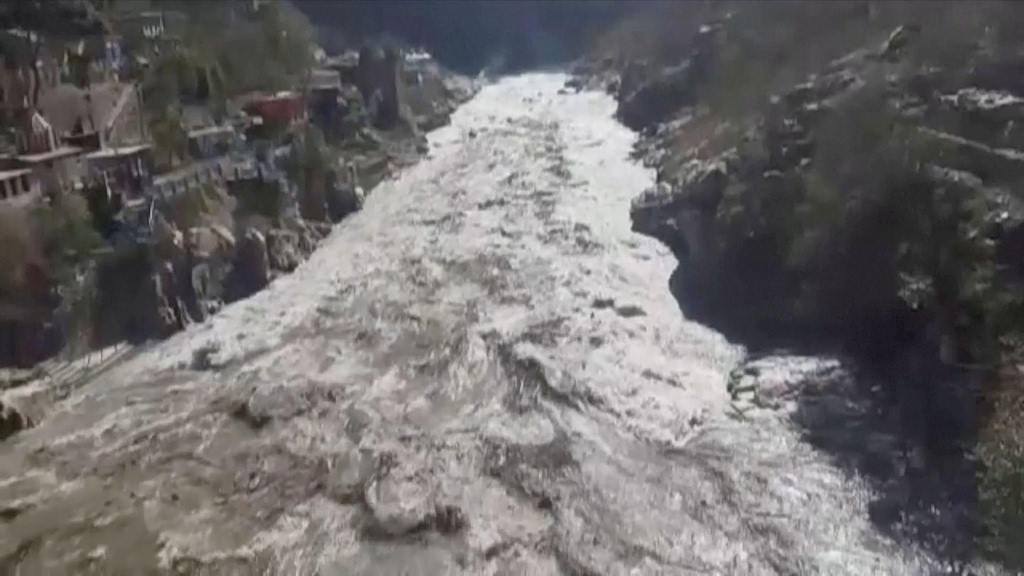
General view during a flood in Chamoli, Uttarakhand, India February 7, 2021 in this still image obtained from a video. ANI/REUTERS TV/via REUTERS ATTENTION EDITORS – THIS IMAGE HAS BEEN SUPPLIED BY A THIRD PARTY. INDIA OUT. NO RESALES. NO ARCHIVES.
In the 20th century, several catastrophic glacial lake outbursts took place, including a 1941 incident in Peru that killed at least 1,800 people.
In the Himalayas, which span Pakistan, India, Nepal, Bhutan and China, the impact of a lake burst can be particularly destructive. These lakes are often located at high altitudes, sitting above river systems that help channel burst waters far downhill. At the same time, countries have added new hydropower and other infrastructure below them.
In 2024, a glacial lake in Nepal burst, cascading into another lake that also burst, washing away Thame, the hometown of Tenzing Norgay, who, alongside Edmund Hillary, achieved the first recorded summit of Mount Everest.
A study of about 2,400 large Himalayan glacial lakes by India’s space agency found that about 600 of them had more than doubled in size between 1984 and 2023.
India’s tiny state of Sikkim is a particular hot spot for glacial lakes, with at least 16 deemed by authorities to be of high risk of bursting.
Less than three weeks before it burst, Indian and Swiss disaster experts journeyed to South Lhonak Lake to put up a weather monitoring station, the first step toward installing an early warning system.
Mozart Maxon, then a consultant for India’s National Disaster Management Authority, was awed when he saw the lake for the first time.
“It was a beautiful monster—a massive lake,” he said. “We never thought it would come down [so soon], but we had a feeling it would come down at some point.”
These lakes are prone to failing because they are precariously dammed by walls made of frozen earth, rocks and ice created by the movement of a glacier. Rising temperatures are making these walls, called moraines, increasingly unstable.
“The ice, the frozen material, basically it’s kind of…a glue,” said Ashim Sattar, an assistant professor at the Indian Institute of Technology, Bhubaneswar, who led research examining the South Lhonak Lake burst. “When it melts…the strength of that material will be lost.”
Apart from a moraine collapsing, an avalanche or an unusual amount of rainfall can destabilize a lake. Other times, the immediate trigger isn’t known.
In 1985, Nepal’s Dig Tsho lake, in the Everest region, burst after part of a hanging glacier fell into it, destroying houses and infrastructure below. It helped catalyze scientific interest in Himalayan glacial lakes.
About two decades ago, the study of glacial lakes was boosted with high-resolution satellite imagery, and scientists began analyzing time-series data, said Umesh Haritashya, a professor of geosciences and sustainability at the University of Dayton, Ohio.
Scientists built out a global inventory of glaciers and measured lakes forming around them.
“There were tiny lakes that started collapsing, coalescing and becoming one big, larger lake,” said Haritashya. “And then there were a couple of large incidents that brought to the forefront that these lakes are really dangerous lakes.”
South Lhonak Lake was first captured by a covert CIA satellite surveillance program designed to focus on the Soviet bloc. In 1962, the program spotted a small wedge of lake forming on the eastern side of the Lhonak glacier. Over the next six decades, as the glacier retreated, the wedge expanded into a long finger, and the size of the lake grew twelvefold.
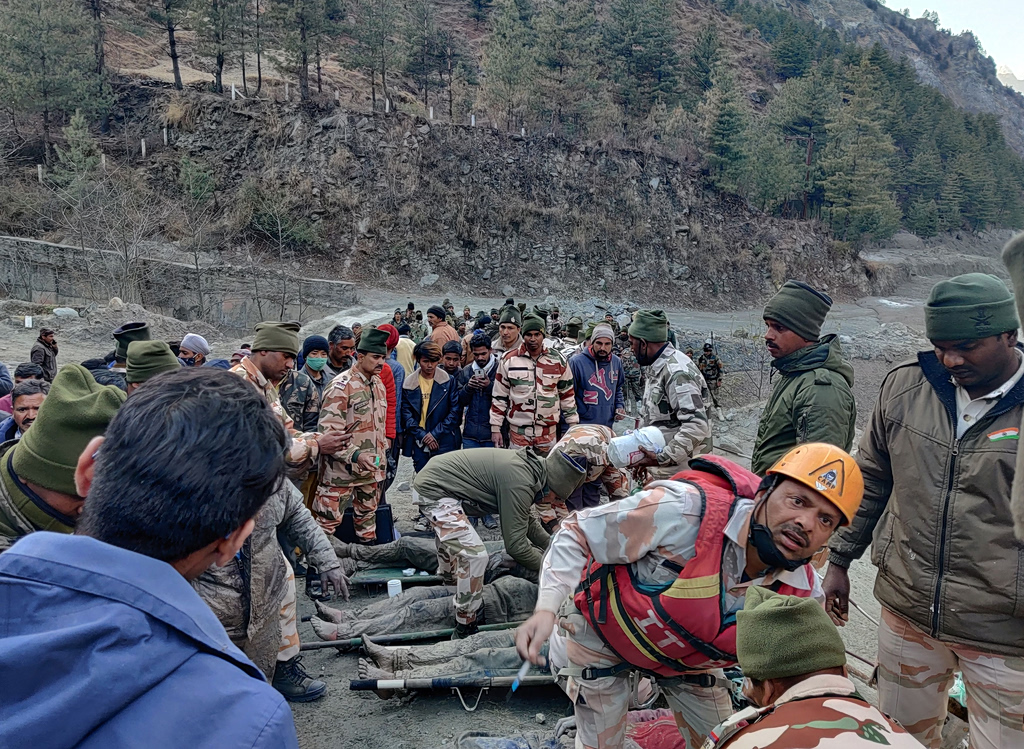
Members of Indo-Tibetan Border Police (ITBP) tend to people rescued after a Himalayan glacier broke and swept away a small hydroelectric dam, in Chormi village in Tapovan in the northern state of Uttarakhand, India, February 7, 2021. REUTERS/Stringer NO ARCHIVES. NO RESALES.
When part of its moraine slid into the lake a little after 10 p.m. on the night of Oct. 3, 2023, seismic monitors picked up the collapse. Strong waves broke through another part of the lake’s wall and about half the lake’s water gushed out, Sattar and his co-authors estimated in a research paper in the journal Science.
The flood triggered multiple landslides and picked up debris. The volume of debris it absorbed was five times greater than the volume of water alone.
“The water comes out in very fast movements, with a high velocity, and it scrapes away all these materials” from the valley, said Sattar, creating a “hyper-concentrated” flood that is savage in its power.
At around 11 p.m. on a rainy night, Sukraj Rai, 42, a schoolteacher in Rangpo Forest, began getting frantic calls warning him that the Teesta was rising and that the Chungthang dam had broken.
He and members of the youth group rushed over the next few hours to wake people in the lowest part of the town of 3,000. Many of them were asleep after celebrating till midnight at a birthday party.
Near Rangpo, the Teesta joins with another river and carries on toward the Bay of Bengal.
That night, the Teesta was flowing so fiercely that it pushed the other river back and sent it into the town. The water washed away some two dozen low-lying houses, a church and part of a mosque.
As the floodwaters careened through the town, Rai ran into Prasad, shirtless and crying, and urged him to get to higher ground. Nothing could be done for his family. Later, Rai took stock of the unfolding catastrophe from above. In a flash of lightning, he saw a “huge tsunami-like wave crashing through large trees with a terrifying roar,” he said.
More than 100 people died in the flood, according to Indian authorities, and many of the bodies that were found were unidentifiable. The alert sent by the border police from their camp near the lake was a stroke of luck that prevented more lives from being lost, scientists say.
At the lower Rangpo area, close to the Teesta River, only a mosque remains, surrounded by piles of sand, some reaching the height of its roof.
Prasad is still struggling to comprehend the forces that stole his family. It wasn’t a typical time of year for floods—the monsoon season was over and cooler months were on their way. When he put his wife and child in the car, there was no water around his house.
“If I had just gotten in the car and driven off with my wife and child at that exact moment, everything would have been fine,” he said. “We thought maybe a little bit of water was coming, and since this is the river’s path, the water would just flow out through it. We had no idea such a terrifying amount of water would come.”