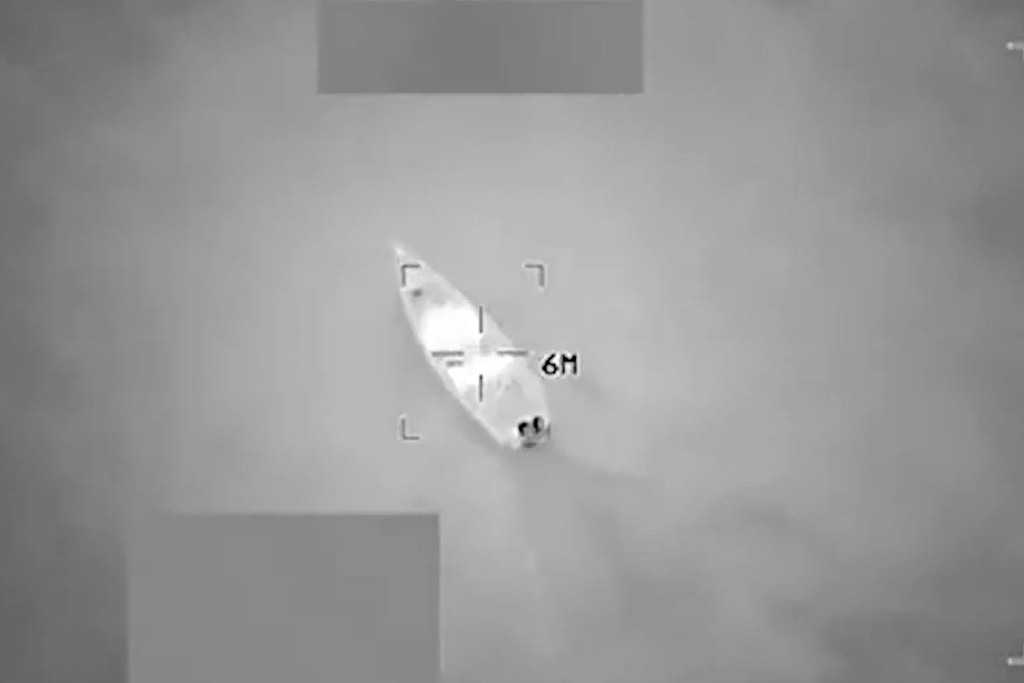


Venezuela has become a major launchpad for huge volumes of cocaine shipped to West Africa, where jihadists are helping traffic it to Europe in record quantities.
Corrupt military officers and drug gangs smuggle shipments by light aircraft, fishing boats, semi-submersible vessels and freighters heading east, international law-enforcement officials have said publicly. The cocaine flows to West Africa, where an informal network of jihadist-linked smugglers and their allies then move the drug north to feed high and rising demand in Europe.
“Cocaine in the 1980s is not the same as the one we see today,” said Jesus Romero, a retired U.S. military intelligence officer. “There are direct linkages to terrorist organizations to support their cause.”
Unprecedented levels of cocaine production in Colombia in recent years have overwhelmed traditional smuggling routes, leading traffickers to exploit Venezuela’s strategic location, ineffectual security institutions and long coastline, the law-enforcement officials have said. That has led cocaine consumption to rise worldwide in regions that hadn’t been major consumers, from Australia to Eastern Europe, United Nations drug researchers say.
The confluence of drug smugglers, jihadists and corrupt officials is part of a growing global alignment among criminal gangs, militant groups and rogue governments that threatens democratic norms and social stability, with profound potential ramifications.
Now, the Trump administration’s pressure campaign against Venezuelan leader Nicolás Maduro—who it asserts is heavily involved in drug smuggling—has brought global attention to the country’s role in the drug trade. Maduro has denied the allegation.
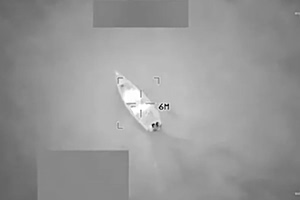
Trump has ordered strikes on boats allegedly carrying drugs to the U.S. from Venezuela, but experts say the South American country sends far more narcotics for distribution to Europe, mostly through West Africa and islands near its coastline. The U.S. has also hit drug boats leaving Colombia, the world’s biggest producer of cocaine.
There in Africa, smugglers link up with al Qaeda-affiliated groups that escort the cargoes north and extort payments from the overland convoys, said current and former rebel leaders in northern Mali.
Surging trans-Atlantic drug flows mean that cocaine seizures in Europe now exceed those in North America, according to the United Nations Office on Drugs and Crime.
“The quantities have gone up so much, the problem that traffickers have now is moving them,” says Jeremy McDermott, co-director at InSight Crime, a think tank focused on organized crime in the Americas.
Bertrand Monnet, a professor of criminal risk at French business school Edhec, said Venezuela has become a top Latin American transit route to Europe, though cocaine is also shipped to Europe from Brazil, Guyana and other countries in large quantities.
Secretary of State Marco Rubio cited Venezuela’s role as a drugs transit hub as a justification for the U.S.’s strikes on alleged drug boats. He said that instead of Europeans criticizing the U.S. action, “maybe they should be thanking us.”
Antidrug officials say there are increasing signs of Venezuelan involvement in the European drug trade, with Spanish police in recent weeks detaining 13 members of the Venezuelan gang Tren de Aragua, a first in Europe.
Drug cargoes often pass through multiple hands en route to consumers, with numerous actors participating almost independently of each other. Almost no coca leaf, the plants used to make cocaine, is grown in Venezuela, and few labs there refine the final cocaine product. But Colombian traffickers typically bring cocaine overland into the country, before it is shipped to Africa.
In September last year, two cocaine-laden Gulfstream private jets took off from a makeshift airstrip in Apure, a Venezuelan state on the Colombian border. One of the aircraft was seized during a stop in the tiny West African nation of Guinea-Bissau with 2.6 tons of cocaine on board, according to Guinea-Bissau authorities, a record seizure for a country long known as a narcotics hub.
The second aircraft reached nearby Burkina Faso, another country ravaged by Islamist extremists, said Romero, the former intelligence officer, who was briefed on the flights.
Traffickers are flying at least one cargo a week from Venezuela to West Africa, say current and former Western officials. Smugglers turn off their planes’ transponders to hide their movements and bribe air-traffic controllers to switch off their tracking systems when drug planes pass overhead, according to InSight Crime.
Corruption at airports has also enabled organized criminals to ship large quantities of drugs through commercial airliners. In 2013, shortly after Maduro’s election, a British drug trafficker shipped almost 1.4 tons of cocaine hidden in suitcases on a flight from Caracas to Paris, where it was seized by French police.
In 2020, the U.S. accused Maduro and his ally Diosdado Cabello , now Venezuela’s interior minister, of involvement in the case, citing communications intercepts. Cabello has long denied drug allegations, saying they are being used to justify toppling the Maduro government.
The record seizure last year in Guinea-Bissau was intended for northern Mali, according to Guinea-Bissau judicial police, where the illegal trade is funding local al Qaeda groups, say the current and former Western officials.
After al Qaeda took control of the desert region in 2012, veteran Algerian jihadist Mokhtar Belmokhtar fought secular Malian Tuareg factions to gain control of cocaine smuggling routes, according to a public European investigation. Local drug traffickers also started working with the jihadist group to preserve their trade routes, say current and former European security officials.
From Mali, the drugs cross the Sahara and into Algeria, Morocco and Libya, say Western officials. A Russia-backed Libyan faction is collecting fees on cocaine transiting from Niger to Egypt, according to a 2024 U.N. report. From Northern Africa, the drugs are shipped across the Mediterranean Sea to Southern Europe.
Traffickers also often take advantage of corruption at ports and along Venezuela’s coastline to send vessels to Portugal or Spain, according to InSight Crime, as well as other European countries.
In one of the biggest seizures to date, Spanish authorities last December seized 3.3 tons of cocaine aboard a Spain-bound Venezuelan fishing vessel near the Canary Islands. Another ship, the MV Matthew, whose seizure in 2023 with 2.2 tons of cocaine was the biggest haul in Ireland ever, had loaded the drugs in waters near Venezuela, according to Irish police.
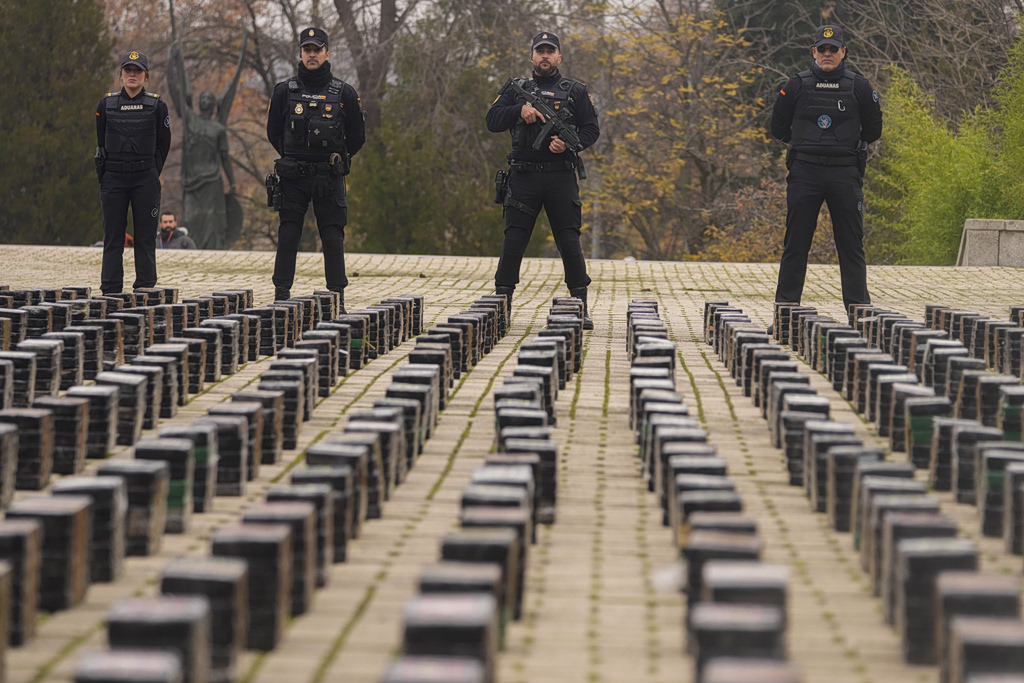
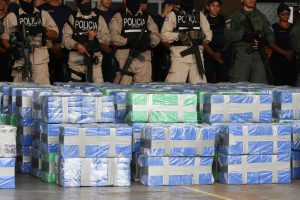
Police officers stand by part of a haul of 11 tons of cocaine, displayed in the patio of a police station in Madrid, Spain, Tuesday, Dec. 12, 2023. (AP Photo/Paul White)
Colombian drug dealers also use semi-submersibles from Venezuela to move cocaine to Spain, according to InSight Crime. Portuguese police earlier this month detained such a vessel with 1.7 tons of cocaine, manned by a Venezuelan crew, as it sailed across the mid-Atlantic.
European law-enforcement authorities have boosted cooperation with African countries, but failed to keep pace with rising volumes. In the Sahel, the fight has suffered a setback from a breakdown in cooperation following military coups, said Aurélien Llorca, a fellow at the Geneva Graduate Institute who investigated the illicit trade.
“Coups and instability are making things worse,” Llorca said.
Write to Benoit Faucon at benoit.faucon@wsj.com