BUTTE COUNTY, Idaho—One of the most hyped projects in the energy market is an excavation pit scattering dust in the high desert of the Snake River Plain, where nuclear startup Oklo is building one of America’s first new reactors in a generation.
Renewed interest in nuclear power is colliding with mania over artificial intelligence here at the Idaho National Laboratory’s desert campus, a remote site that spans an area nearly twice the size of Los Angeles.
Oklo and rival developers hope to drive an AI revolution and nuclear renaissance that powers the American economy for decades to come—but they have much to prove. No developers outside China and Russia have yet completed a commercial version of what’s known as a small modular reactor, or SMR.
“We’re finally in build mode and not kind of playing games around the edges,” said Jacob DeWitte , Oklo’s co-founder and chief executive.
Success in Idaho is a crucial step toward Oklo’s first major commercial project : sending electricity to the grid to support data centers operated by Facebook parent Meta Platforms . Eventually, Oklo plans to build more than a dozen reactors at an Ohio campus that could generate up to 1.2 gigawatts of electricity, enough to power 1,200 Walmarts.
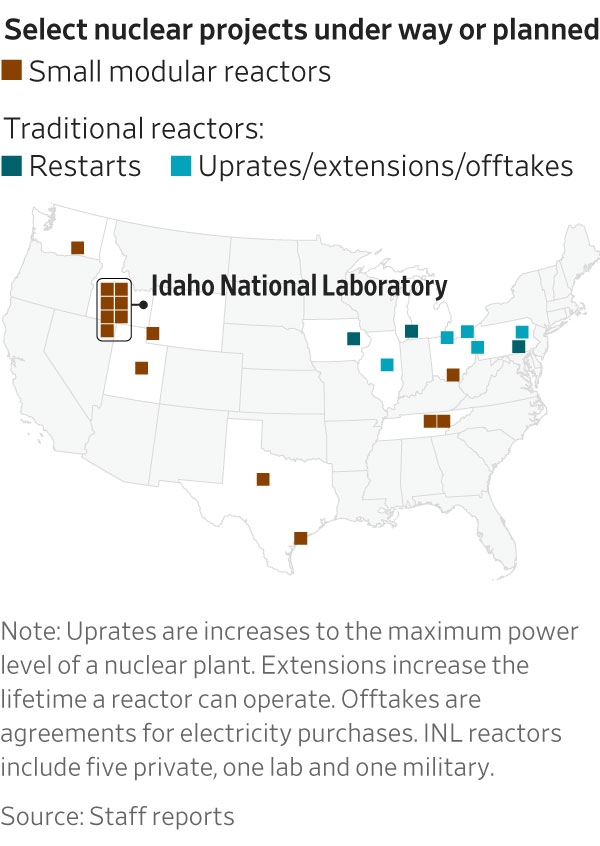
Oklo—which was backed by OpenAI’s Sam Altman , who took the company public in 2024—is part of a noisy and crowded field. Its Idaho site is one of 22 active reactor projects in the U.S., according to think tank Third Way. The World Nuclear Association tracks more than 130 SMR designs in development globally.
The hurdles are high. Revenue from power generation remains years away, and when it comes to building nuclear plants, the U.S. is rusty. America’s last new reactors, two big AP1000s from Westinghouse Electric, came online in 2023 and 2024 around $20 billion over budget and seven years behind schedule .
Ray Rothrock, an early investor in several advanced-reactor companies, including Oklo, said there is a narrow opening in the energy market for SMR developers that can squeeze through, but only a small number are likely to survive.
“It’s a single digit,” Rothrock said. “It’s not a double digit.”
The customer
Many of the small reactors under development are backed by big technology companies trying to solve one of the most daunting challenges of the AI boom: how to secure power for data centers that can guzzle as much electricity as a city.
In addition to its deal with Oklo, Meta plans to buy electricity from TerraPower, a reactor developer founded by Bill Gates almost 20 years ago. Google has paired with Kairos Power. Amazon .com invested in, and is a customer of, X-energy , which went public earlier this year .
Carolyn Campbell, the former head of clean technology innovation at Meta, and her team oversaw a request-for-proposal process in late 2024 that eventually led to the pairings with Oklo and TerraPower. She said Meta’s goal is to help developers reach “cost competitiveness sooner rather than later, were it not for our involvement.”
Amazon’s 2024 deal with X-energy was a turning point for the sector, said Michael Johnson, managing director for JPMorgan Chase’s security and resiliency initiative.
“It was private capital formation and offtake and real support from Amazon that had people believe not just in the future of X-energy, but in the future of small modular reactors,” he said.
Shares in the only two SMR firms that were publicly traded at the time, Oklo and NuScale, “took off,” Johnson added. “That was the wake-up call.”
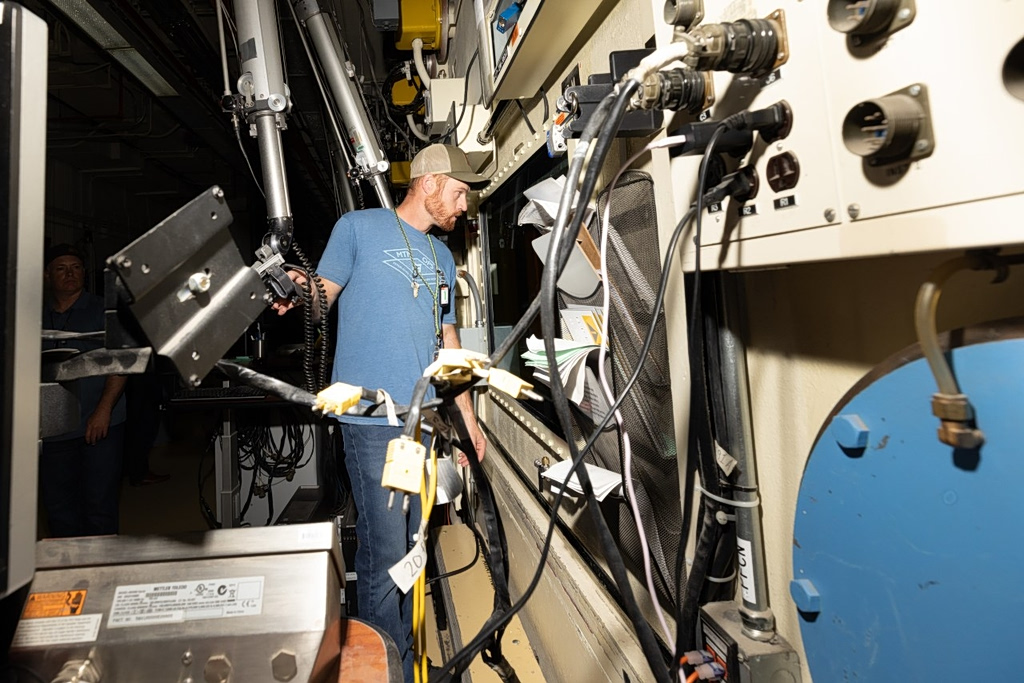
The Hot Fuel Examination Facility at Idaho National Laboratory. A detail from the original Experimental Breeder Reactor II Control Room at the Materials and Fuels Complex.
The finances
Capital has surged into the once-sleepy sector. PitchBook tracked $2.9 billion in venture-capital fundraising at fission companies last year, up from $103 million in 2020. Startups that once struggled to secure funding have turned to the public markets.
“I think everyone’s view was like, hey, maybe you can raise a couple hundred million dollars at most over a life cycle,” Oklo’s DeWitte said. “And now it’s like no, there’s billions of dollars flowing in.”
Oklo said it grossed around $307 million in its public debut and has since raised around $3.2 billion in stock sales. At least 10 other reactor designers, including X-energy, have gone public— or plan to do so . Some investors describe the excitement around the sector as a moment of peak hype.
Skeptics say that presents its own risks. Shares of Oklo, NuScale and X-energy have fallen sharply this year. The stocks tend to trade in line with the latest headlines about the trajectory of AI and are subject to big one-day swings.
Oklo’s market value swelled above $30 billion at its peak last fall and has since fallen to about $8.2 billion, still a mighty sum for a company without profits that is just starting to build power-generation assets. Even now, Oklo’s market cap is approaching that of some established energy companies such as AES, a Virginia-based utility and power producer with more than 30,000 megawatts of generation.
Guggenheim Securities analysts project Oklo could have 1.1 gigawatts of assets by 2032, though they say free cash flow will likely be “further off as long as the company continues to add assets.”
JPMorgan’s Johnson says investors seem convinced that SMRs will be built.
“What’s unusual about it is that the market is looking pretty far into the future for cash flow,” said Johnson, who projects the market has room for three to six SMR companies.
The challenges
Cost and competition are two of the industry’s biggest hurdles, but developers say they can avoid the pitfalls of big projects with smaller, safer designs that can be built quickly.
It won’t be easy. TerraPower received a construction license in March for a project in Wyoming after a shortened review period of about 18 months—but it took 1,000 engineers to make that happen, Chief Executive Chris Levesque said.
“Have you done the thousand-person design? There’s no shortcut,” Levesque said. “Because this is a smaller reactor doesn’t mean a smaller design effort because it’s still fission.”
Rothrock, the early-stage investor, says he expects large conventional reactors, such as the AP1000 , to provide much of the nuclear power that will be built in the next few decades. SMRs are likely to occupy narrower markets, including those for heavy industry, he said.
“They’re not going to be the mainstream. There’s no way,” Rothrock said, comparing it with trying to power the entire grid with rooftop solar.
Microsoft, for now, is betting big on a conventional reactor. It agreed in 2024 to a 20-year power deal to support Constellation Energy’s restart of the undamaged reactor at Pennsylvania’s former Three Mile Island, the site of the most infamous U.S. nuclear accident.
“I don’t know that the goal is necessarily to be a first mover, but to be an early adopter,” Microsoft Vice Chair and President Brad Smith said of SMRs.
Working in Oklo’s favor are its political connections. Energy Secretary Chris Wright once served on its board. DeWitte, Oklo’s CEO, was present at the White House last year when President Trump signed an executive order meant to turbocharge nuclear power. And in March, he was appointed to the President’s Council of Advisors on Science & Technology alongside the likes of Jensen Huang, Sergey Brin, Michael Dell and Mark Zuckerberg.
The desert
Down the road from Oklo’s construction trailers at the Idaho National Lab, a campus of mostly Cold War-era buildings is abuzz with activity.
Aalo Atomics, Antares Nuclear, Radiant Nuclear and Deployable Energy are also developing or testing small reactors at the lab, hoping to channel the success of its storied past. Established in 1949, it was the test site for the world’s first reactors used in nuclear submarines and for civilian power.
“We’re doing stuff that I didn’t ever think we’d do again in my career,” said Brady Orchard, project director of the Materials and Fuels Complex at the lab, where he has worked for 19 years.
“It’s been analyze, analyze, analyze, and the focus now is, ‘Do the right analysis, but let’s build, too,’” Orchard said. “Everybody wants to be first.”