
 Μake us preferred on Google
 One of two physicians jailed in connection with the death of Greek pop star Giorgos Mazonakis has disputed key elements of the account surrounding the singer’s collapse and subsequent death, saying he immediately began CPR, that a defibrillator showed a flatline and, therefore, was not used, and that paramedics never requested that he accompany Mazonakis to the hospital.
The physician, one of two owners of the medical practice, along with his wife, said he could not explain with certainty what caused Mazonakis’ cardiac arrest, stressing that the forensic examination had not provided a definitive answer.
Asked about a possible cause, the 58-year-old referred to unstable angina, saying that the condition can be associated with cocaine use and could, in theory, explain cardiac arrest. The reference to cocaine was an unsubstantiated allegation raised by the doctor himself.
His account of the emergency
He said he was informed of Mazonakis’ deterioration at 4:15 p.m. and immediately began CPR.
“I checked his pulse and immediately started CPR, chest compressions and artificial respiration, three to one, as required by the protocol,” he said.
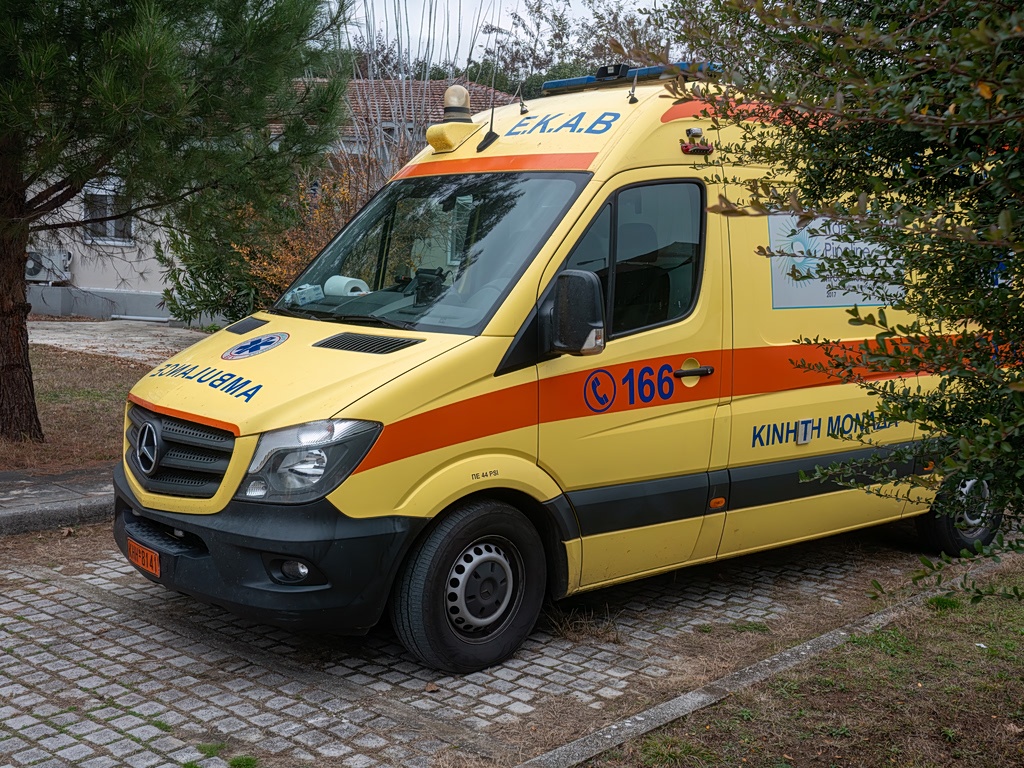
He said one milliliter of adrenaline was administered in his presence and that he instructed staff to call the national ambulance service, adding that an estimated that four to five minutes passed between his entering the room and the emergency call.
The practice had a defibrillator, he noted, but he did not use it because the device showed asystole, better known as a flatline. He said the same finding was subsequently shown by the defibrillators used by the paramedics and the public Elpis Hospital.
He said both he and his wife knew how to operate a defibrillator and that he believed the device was functioning, although he acknowledged that he had never personally tested it and did not know whether his wife had done so.
The doctor, I.T., also rejected an account attributed to an emergency responder over who entered the ambulance, saying he initially boarded but was then told to leave because there was apparently no room.
Why he didn’t accompany Mazonakis
Asked why he did not accompany Mazonakis to the Elpis Hospital, he was not the physician’s attending physician and had nothing further to offer.
He said his wife, who had been treating Mazonakis, had already provided emergency responders with the necessary information and that both of them had provided their telephone numbers so they could be contacted by the ambulance crew or hospital staff if additional information was required.
The emergency response has become one of the central issues under scrutiny in the case, alongside the operation of the private medical facility, its equipment and the treatment Mazonakis was undergoing.
Questions over medical equipment
According to more accounts of his statements, he also addressed the equipment at the practice, including the device associated with the plasmapheresis treatment Mazonakis was reportedly undergoing.
He said his wife used the equipment within its stated indications and described the particular machine as belonging to what he called a “borderline category,” saying its regulatory status had not been clearly defined.
He maintained that his wife had obtained the machine believing its use within a regenerative and holistic medical approach was adequately covered by regulatory controls.
The physicians’ use of medical equipment and the authorization of the private facility are among the issues being examined following Mazonakis’ death.
He began his statement by saying he had been “slandered” and subjected to public abuse. He said his family had also been affected and objected to being characterized as a fraud by the political leadership of the health ministry.
He also referred to the six-month suspension of his practice and a financial penalty imposed by the Athens Medical Association, arguing that these measures had been taken before the legal process had properly begun.