We men are trying. Truly! We’re trying to be there for our partners and our kids. Struggling to follow the rules as they were presented to us: work hard, fly straight, die on the beach with a daiquiri in hand. But we’re struggling. We’re confused and conflicted because the game we thought we were playing turns out to be just as rigged against us as it is against everyone else.
Television is now saturated with self-doubting, affluent white male characters dealing with a world that no longer gives priority to their needs. The problem, as a trio of newish shows suggests, is that the old scripts for proving one’s vaunted manliness no longer function the way they once did—if they ever did.
As Andy Coop, Jon Hamm’s character in Apple TV’s “Your Friends and Neighbors” puts it, “We all have a dream…But I was starting to suspect that my dreams had been every bit as full as s— as the rest of me.”
In “Rooster,” Steve Carell plays Greg Russo, a divorced bestselling author roped into accepting a writer’s residency at the university where his daughter teaches. Russo’s literary creation, the titular “Rooster,” is everything he wishes he could be: cool, confident and ready to shoot the bad guy in the face—a throwback to a time when men solved problems with whiskey and fists.
“DTF St. Louis” features two lost male antagonists, Jason Bateman and David Harbour, playing the rarest of characters: straight men who love each other unreservedly. The friends struggle with familiar middle-aged maladies. Cooling marriages, money troubles, stagnant careers, fatherhood. In seeking deliverance from ennui, they push the boundaries of friendship into something far more intimate and bizarre.
The new rules of masculine engagement seem to drive these television men crazy. Many real-world men don’t appear to be faring much better.
Masculinity itself is often labeled as “toxic.” And then there’s the “ male loneliness epidemic .” A 2021 study from Survey Center on American Life found that men have far fewer friendships than they did in decades past, with 15% reporting they have “no close friends” at all. The perception that we are in trouble may partly explain the manly appeal of these shows.
And it’s that word— manly —I kept returning to while watching. To be “manly” is to be secure in one’s maleness. John Wayne was manly. Carell? Not so much.

In 2003, another television comedy about affluent, lost white men, “Two and a Half Men,” featured a theme song whose lyrics resonate today as much as when they were first composed: “Men, men, men, manly men, men, men.”
But how were we supposed to feel about those manly men? Were we meant to laugh at Charlie Sheen’s womanizing on “Two and a Half Men,” or emulate it? And when does poking fun at arrested manhood cross into enabling it? Is it when the phrase “tiger blood” first slips from the mouth?
The men on these new shows present tortured visions of modern masculinity and the alternately hilarious and horrifying ways things can go awry.
Carell’s Russo envies the ease with which his literary alter ego moves through life, so unlike the awkwardness of a dad struggling to reclaim his life and to protect his daughter from the heartbreak caused by a caddish, cheating husband (as well as the house fire she may or may not have intentionally set out of revenge).
On “Your Friends and Neighbors,” Andy Coop alleviates his middle-aged impotence (figurative, not literal) by sliding into a life of crime. Coop’s larcenous ways awaken something in him that the straight-laced corporate life had repressed.
“Rooster”’s Russo ticks all the boxes for the modern American male. He’s loving and kind. He’s also flailing and vaguely pathetic. In fact, the so-called positive attributes men are told to cultivate aggravate his woefulness.

Steve Carell attends the premiere of HBO’s “Rooster” at 787 Seventh Avenue on Tuesday, March 3, 2026, in New York. (Photo by Andy Kropa/Invision/AP)
No doubt Russo and his fictive alter-ego have heard the popular prescriptions for curing arrested development—empathy, vulnerability, emotional intelligence.
Russo embraces this idealized New Man while his character rejects it. Only one of the two seems happy—and it’s not the emotionally available one. Russo is a good guy, yes, and one for whom we root, but in his effort to protect his daughter, he plumbs seemingly bottomless depths of humiliation.
The same could be said for Harbour’s Floyd Smernitch. A onetime Playgirl centerfold model, Floyd’s youthful vigor and vitality have been replaced with a doughy midsection and a broken penis (in Floyd’s case, the impotence is literal).
His second wife, played by Linda Cardellini, has done what she can to “fix” Floyd, but his dreams don’t lie along manhood’s traditional path. He’s a helper in a world that still looks slightly askance at male nurses and male elementary school teachers—or, in Floyd’s case, at male American Sign Language interpreters.
Deep in debt and struggling to connect with his stepson, Floyd finds what he believes to be a kindred spirit in Bateman’s Clark Forrest, a local St. Louis weatherman whose own dreams have started to feel, to paraphrase Hamm’s character, full of s—.
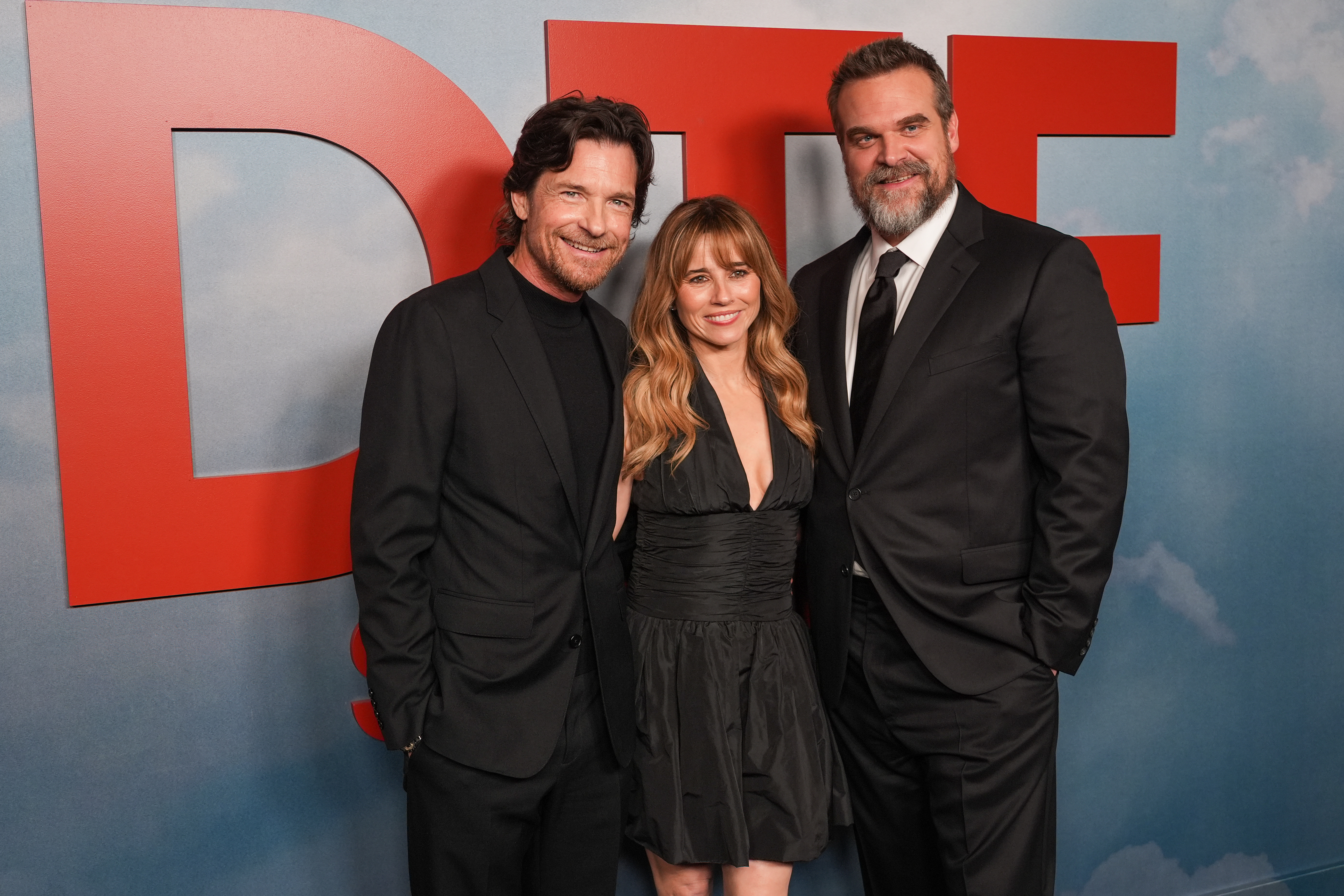
Jason Bateman, from left, Linda Cardellini, and David Harbour arrive at the premiere of “DTF St. Louis” on Tuesday, Feb. 24, 2026, at DGA Theater Complex in Los Angeles. (AP Photo/Chris Pizzello)
When these men take charge, when they take action to course correct, we feel relief. When Coop burglarizes the homes of his affluent neighbors, we find ourselves disagreeing with the means of his deliverance, but cheering on his derring-do. This, we think, is the way of men.
In taking action, Coop becomes a modern Jean Valjean, minus the gorgeous singing voice. Men do not seek permission or sublimate themselves to the status quo. Men fight for what they want. Men take. They tell themselves they do so in service to others, but how often are they only doing so to prove something to themselves? And what, exactly, are they trying to prove?
Perhaps this: That somewhere beneath the softened midsections and professional disappointments, there remains a version of ourselves capable of decisive action, of consequence, of being the protagonist rather than a supporting character in our own lives.
What’s striking about the men in this troika of prestige TV isn’t just their flailing, but their confusion. They’ve internalized two competing directives. Be better, be softer, be more evolved. But also, you still need to be ready to shoot the bad guy in the face.
When those directives collide, the result isn’t growth but short-circuiting. They make bad choices and do bad things. They don’t become monsters, exactly. They become heartbreaking. And ridiculous.
Which is why some of the best moments in these shows are moments of absurdity. A cuckold in a motel room closet. An attack with a ladle. Uncomfortable drunken party banter. The dawning realization that the problems these men face aren’t failures at being men. It’s that they never figured out what being a man means in the first place.
Just as there’s no one-size-fits-all for American women, there ought not be one for the modern American man. Even the most privileged among us occasionally find ourselves adrift and ill-equipped to deal with our own capsized lives.
The men on these shows are not bad men. They’re just men—nuanced, complicated, struggling to maintain a sense of normal, everyday manhood.
But as one character tells Floyd in DTF St. Louis, in a line that gets repeated several times: “No one’s normal. It just looks that way from across the street.”