 Μake us preferred on Google
 Though referring mainly to classical Greece, nowhere on earth can one palpably experience the truth of the poet’s oft-quoted words more than at the National Archaeological Museum of Athens.
The imposing neoclassical building that houses the museum was built at the end of the 19th century. It was designed by Ludwig Lange and completed by the famed German architect Ernst Ziller, who designed hundreds of neoclassical buildings in Athens, including the splendid Academy of Athens and the National Library, both on Panepistimiou Street in central Athens. Some in the 19th century referred to the Greek capital as “Ziller’s Athens”).
By all accounts one of the most significant in the world, the museum, was inaugurated and opened its doors to the public in 1889, and its exhibits cover a vast expanse of time.
About 6,500 years of art
It displays seven chronological periods: the Neolithic (c. 6500–3200 BC), the Bronze Age (c. 3200–1050 BC, including Cycladic and Mycenaean civilizations), the Early Iron Age / Geometric period (after 1050 BC), the Archaic period (c. 700–480 BC), the Classical period (5th–4th centuries BC), the Hellenistic period (323–31 BC), and the Roman period (to about the 4th–5th century AD).
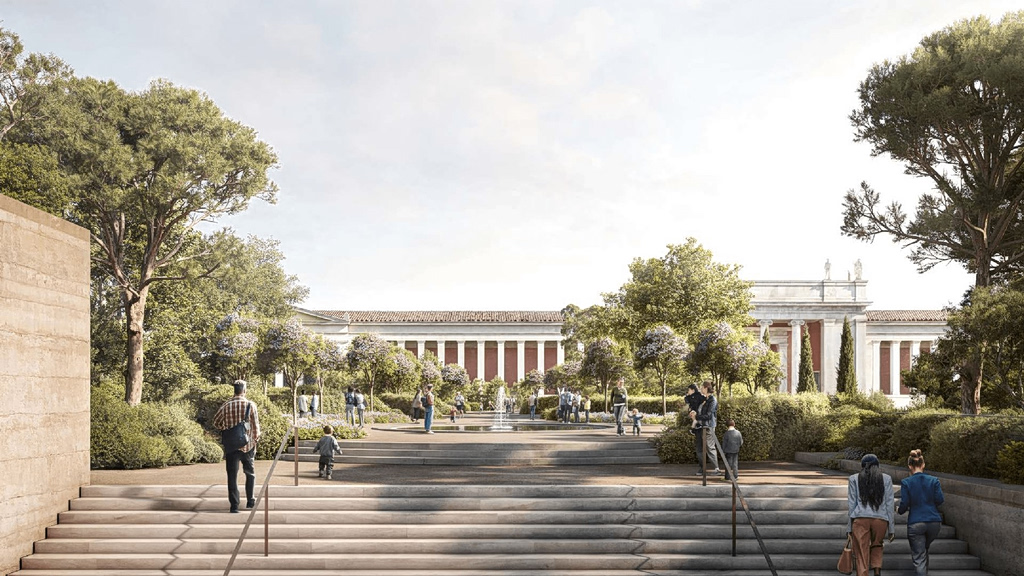
Photorealistic rendering of the exterior of the renovated National Archaelogical Museum.
Expansion, renovation, rethinking
Nearly a century-and-a-half after its inauguration, and receiving 500,000-600,000 visitors annually, the museum is slated to close its doors to the public for a minimum of five years for a sweeping, underground spatial extension, a radical re-conceptualization of how its artefacts – every single one will be removed for the restoration -will be displayed, a complete re-landscaping of the surrounding grounds that will integrally connect them to the museum.
There will also be a total remodelling of the adjacent Epigraphic Museum, a unique institution with thousands of inscriptions on stone that bear witness to a huge historical timespan, including a stele recording the taxes paid by the members of the Delian League (an alliance) to imperial Athens.
To obtain a comprehensive overview of the significance of Greek art and the international importance of the museum, To Vima International was granted an exclusive joint interview by the museum’s president, Ioanna Dretta, and its deputy director, Dr Konstantinos Nikolentzos, an archaeologist who is head of the Department of Prehistoric, Egyptian, Cypriot and Near Eastern Antiquities Collections.
A civil engineer by training, Dretta is an executive with a track record in the public and private sectors, and with over 20 years of experience in change management, crisis management, national policy development, strategy development and marketing, and communication strategy, according to her LinkedIn bio.
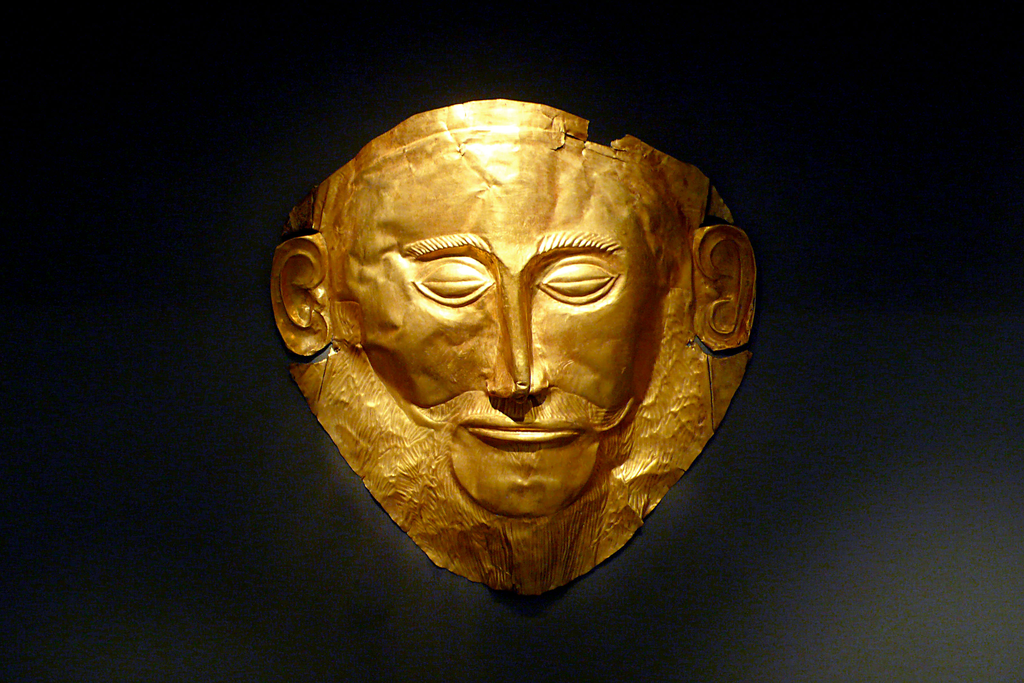
The “Mask of Agamemnon” is a 16th century BCE gold death mask found in 1876 by Heinrich Schliemann at Mycenae.
Greek culture still relevant in many areas of human endeavour
The administrative and scientific heads of Greece’s most important museum (along with the Acropolis Museum), first of all underline the relevance of classical and ancient Greek art and archaeology in the 21st century, and the exceeding international importance of the museum.
“Ancient Greek civilization is present in every aspect of our lives. Neoclassical buildings adorn the centres of Western metropolises, while values such as competition, equality of speech, and democracy govern both interpersonal relationships and the relationship between citizens and the state. Ancient Greek tragedy is performed and taught in theatres all over the world and continues to move audiences. The foundational concepts of Sigmund Freud’s psychoanalytic theory were based on archaeology and his deep fascination with classical antiquity, likening traumas to “psychic antiquities” (seelische Altertümer). Moreover, many objects in our daily lives derive their names or symbols from our classical period,” they say.
The Grand Plan: Renovation, expansion, conceptual rethinking
By mid-2027, a series of studies will have been completed, concerning the organisation and preparation of the project in every detail.
Studies that have already been carried out or are expected to be completed include: Museological, architectural, structural, and electromechanical ones, and another for landscape architecture.
“We believe this is a major project of global significance, being prepared holistically by an interdisciplinary team, under the supervision, oversight, and guidance of the museum and the relevant Directorates of the Ministry of Culture.”
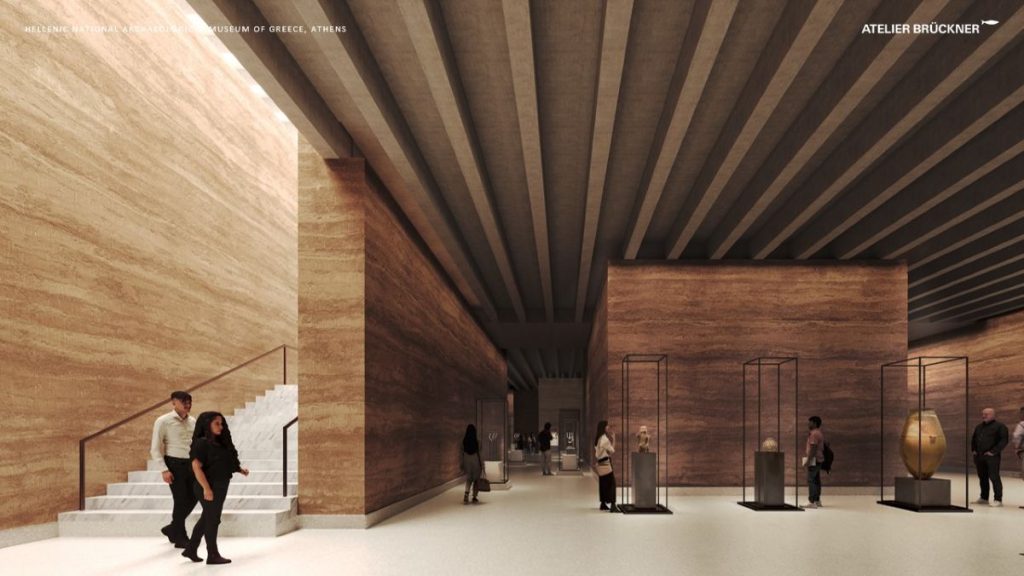
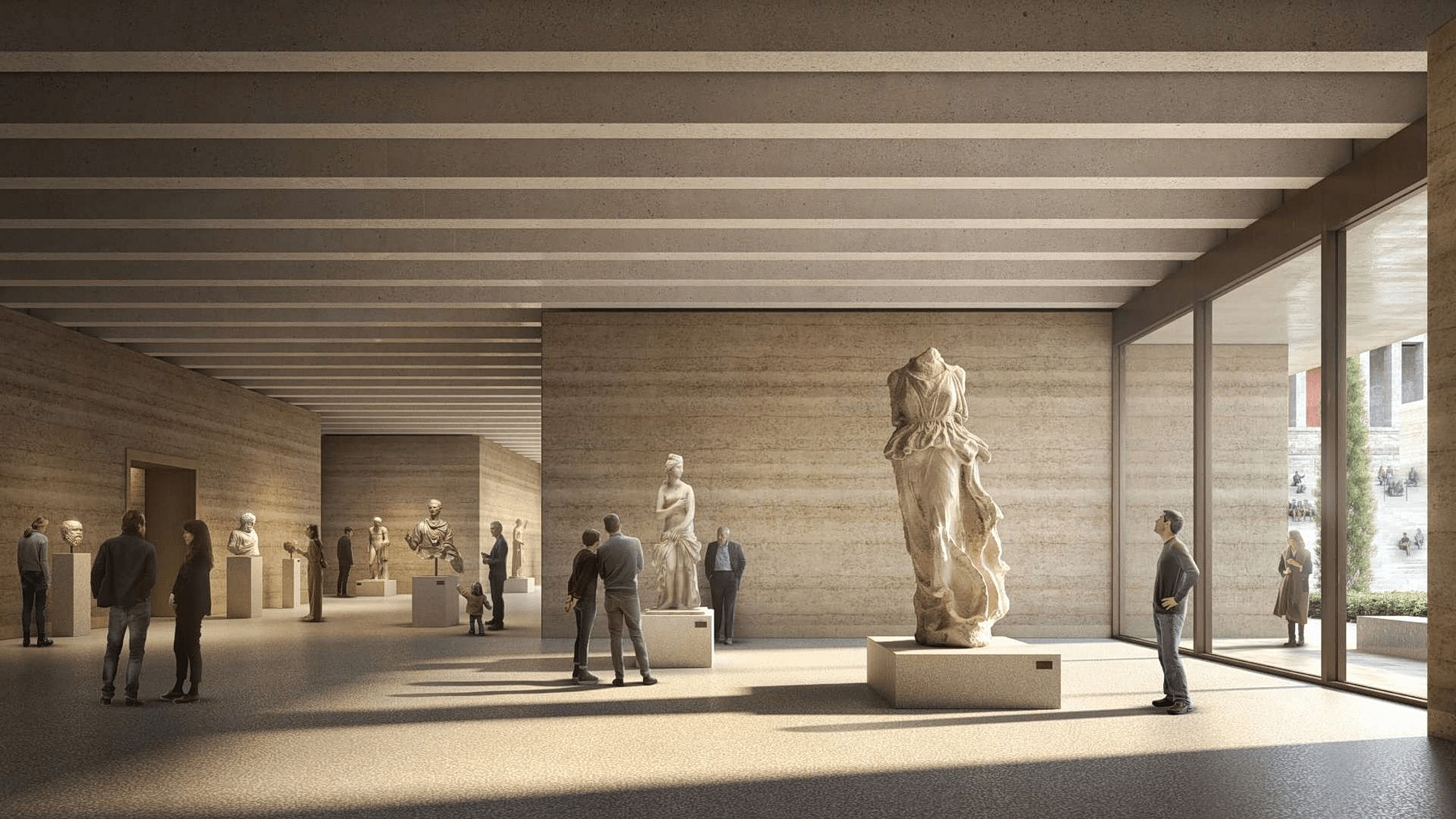
Photorealistic rendering of the interior of the renovated National Archaeological Museum.
David Chipperfield: Mr. Museums
A tender concluded in 2023 assigned the enormous project to the world- famous architectural firm of Briton David Chipperfield (in conjunction with the Greek architectural firm Tombazis and Associates), and Wirtz International Landscape Architects (Schoten).
Chipperfield has a reputation for incorporating modern, minimal designs into historic buildings, and that is exactly what he is expected to do with the museum’s wonderful 19th century neoclassical building.
Chipperfield gained praise for his reconstruction of the Neue Museum (New Museum) in Berlin (2010), famed, inter alia, for its collections of Egyptian, Prehistoric, and Early Historic art and of papyri).
Museum restructuring an expensive proposition
Most notably, the famed British architect has undertaken the reconstruction of the fabulous Pergamon Museum in Berlin (closed for 14 years for the renovation) where the initial 261mn euro budget ballooned to 477mn by 2016 (artnet.com), and now stands at 1.5bn euros.
Its prize possession is the Hellenistic Pergamon Altar’s sublime high reliefs, and it drew 1mn visitors per year.
The Greek government has made public a 40mn euro grant for architectural and other studies from [shipowner, real estate investor (including the Ellinikon Athens Riviera development), and banker] Spyros and Dorothy Latsi, but the projected final budget has not been formally announced.
Although the culture ministry has made no official announcement about the projected budget for the entire expansion and upgrade, two weeks before Prime Minister Kyriakos Mitsotakis and Chipperfield unveiled the project in February 2023, the newspaper Proto Thema reported that Architecture Professor Andreas Kourkoulas (who headed the selection committee that picked Chipperfield) and Culture Minister Lina Mendoni in briefing journalists said that they projected an estimated 300mn euro total price tag. As noted above, however, the renovations of museums often greatly exceed initial budget projections.
The cost will be covered by both state and EU funding, the PM said.
Mitsotakis at the time noted that less than 10 percent of the museum’s collection is on display and that the number of items will be vastly increased with the expansion.
He also said he expects that with the expansion and restructuring, the currently meagre number of 500,000 visitors annually will greatly multiply, as befits one of the world’s most important museums.
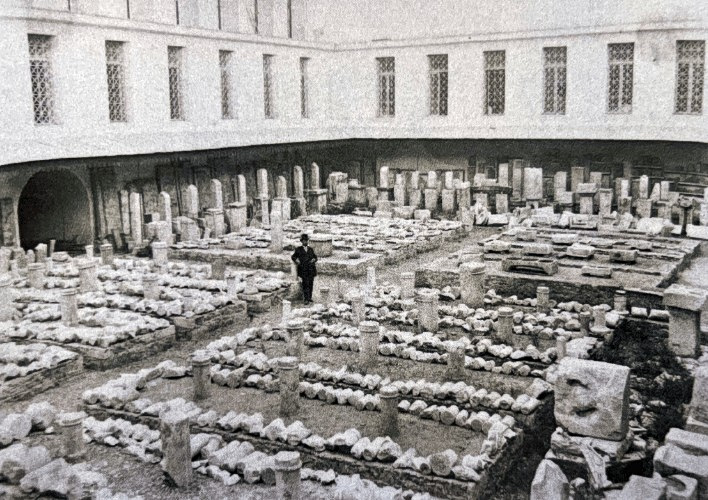
Epigraphic Court during the Ziller period (1887-1889).
Interaction with, upgrade of urban landscape
The PM and Culture Minister Lina Mendoni have stressed that the new museum will be designed to interact with the surrounding historical centre of Athens, which has been downgraded over many decades.
“This [extension and restructuring (with a large surrounding park becoming an integral part of the landscape)] of the National Archaeological Museum is deeply anthropocentric, and contributes decisively to the rebirth of the broader area of the historic centre of Athens,” Mitsotakis said.
“It projects the national dimension of the museum, which links it to the international cultural world. We are creating an extroverted museum that is open to the city and in a constant dialogue with society, a museum with a dynamic view toward the future.”
Meticulous culture ministry oversight
Τhe entire project is being scientifically reviewed at every stage, from the preliminary to the final design, by the advisory councils of the Ministry of Culture (Museum Council, Central Archaeological Council, Central Council of Modern Monuments).
“All of the planning is also the result of the systematic and collective work of the entire permanent and scientific staff of the National Archaeological Museum. Archaeologists, conservators, and engineers have collaborated and continue to work on the preparation of the studies,” the museum officials say.
Once the studies are completed, the building permit is issued, and the tender documents are prepared, the project will begin.
It is currently scheduled to start at the end of 2027. That leaves art lovers something over a year-and-a-half to visit before the closure of the museum for five years.
That timeframe could conceivably be considerably longer if currently projected timetables for construction – and for the re-installation of now exhibited and the installation of an extremely large number of new objects – prove unfeasible.
It is expected that a suitable venue(s) will be found to exhibit a collection of the museum’s more important artefacts, but no one yet knows where or when.
“According to the plan, the works and the return–reinstallation of the antiquities will take about five years. In the meantime, the presence of the National Archaeological Museum is planned to be dynamic, through various means that will be announced soon,” the museum officials say.
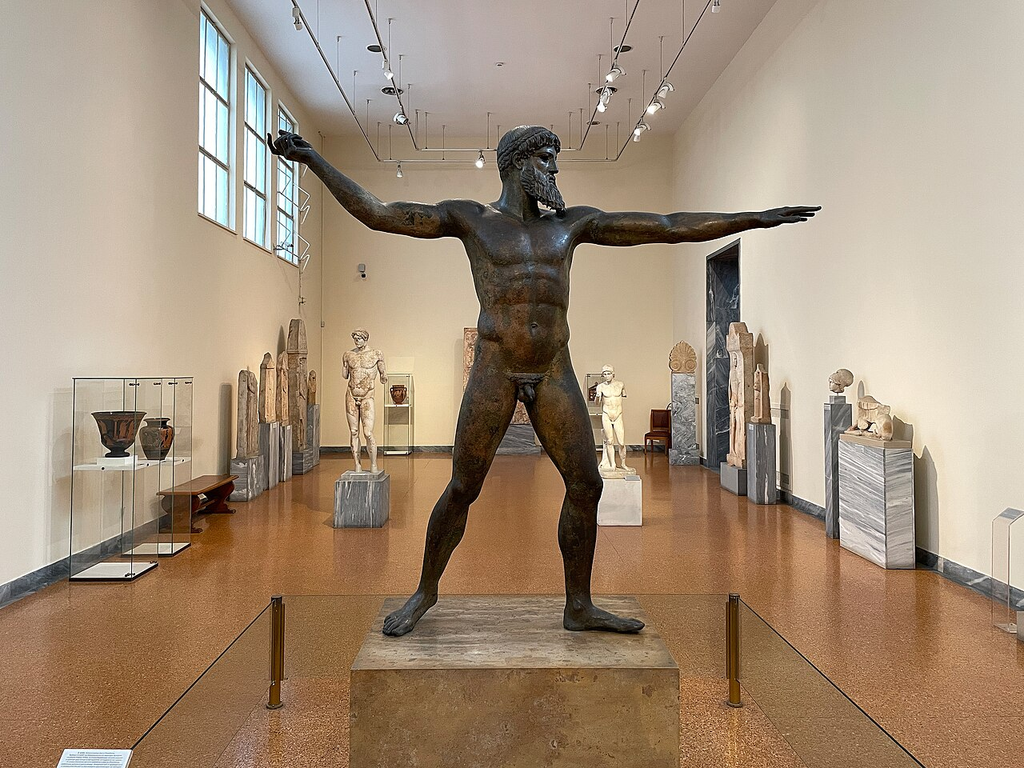
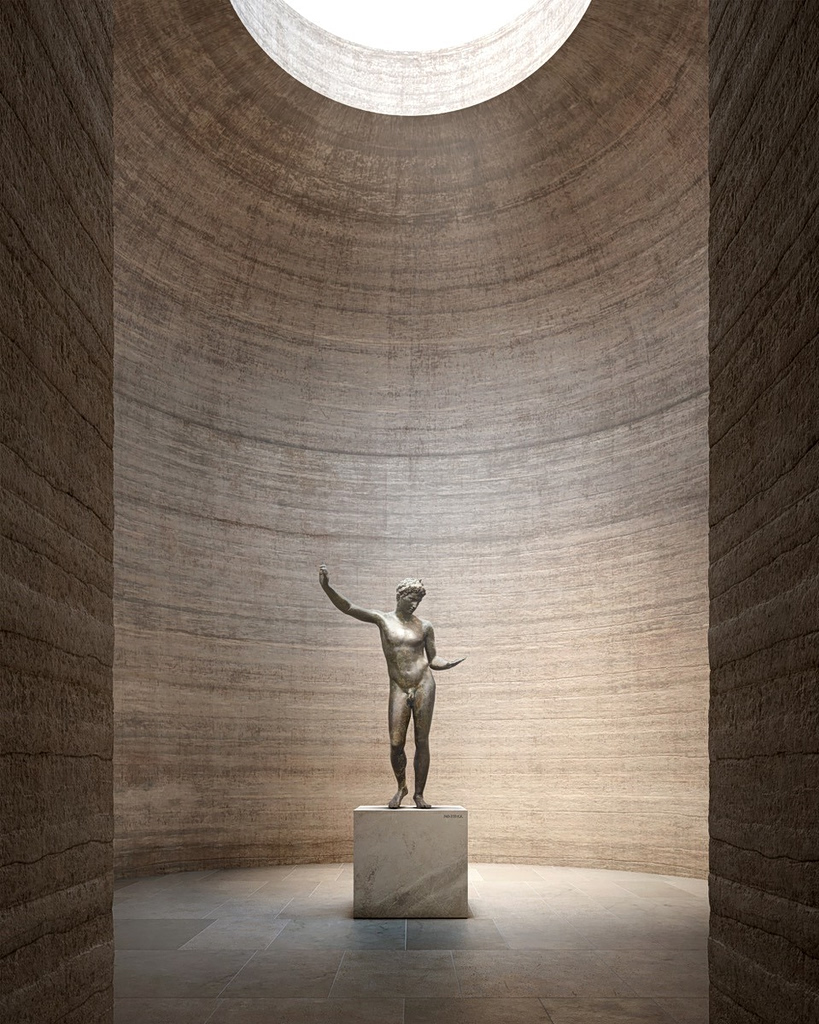
The Artemision Bronze (named after Evia’s Cape Artemision where it was found underwater), most likely depicting Zeus but some have argued for Poseidon.
New museum, new conceptual narratives
In planning the conceptual approach to exhibiting artefacts spanning thousands of years, it appears that a rethinking is in store.
Until now, the Classical collections largely tended to follow an art-historical approach rather than an archaeological one (focusing on broad developments across Greek culture rather than on individual sites).
A number of archaeologists have argued in favour of exhibiting together all findings from specific excavations so as to provide a deep insight into the social structures and conditions in which they were produced and the functions they served.
Nikolentzos and Dretta suggest there will be a fundamental rethinking of museological approaches that “radically transform the museum experience offered to visitors”
In order to create an outward-looking, inclusive museum/cultural institution, the archaeological planning aims to achieve, “a multi-layered presentation of ancient Greek civilisation, with emphasis on its contribution to the emergence and development of philosophy, political systems, and, of course, the evolution of art,” they say.
This revised approach will move along six discrete axes that greatly revamp the narrative approach by enriching and elucidating the context and meaning of the exhibits.
The Jockey of Artemision is a rare and celebrated 2nd-century BC (c. 150–140 BC) Hellenistic bronze.
Travelling exhibitions, returns, more regional representation
The National Archaeological museum is already preparing exhibitions with different themes that can travel either within the country or abroad.
The culture ministry intends to return a large portion of the enormous reservoir of artefacts that will not be displayed in the new, expanded National Museum to the regional museums and the Ephorates of Antiquities from which they originated.
It is unclear whether the local archaeological museums will have the space and funding needed to exhibit them, or if they will simply have to put them in storage.
The planned new narrative aims to present the image of ancient Greek civilization across the entirety of Greek territory. Geographical regions that are underrepresented will be strengthened in the new reinstallation, through loans from the competent Ephorates of Antiquities.
The must sees for visitors before the museum’s closure
The museum officials point to the unparalleled collection of ancient Greek sculptures when asked what should be the focuses of visitors in the last stretch before the shutdown.
“The National Archaeological Museum houses one of the most important collections of ancient Greek sculpture in the world, and visitors can follow the development of the depiction of the human form in relation to social transformations,” they say.
“It is particularly interesting to understand how art is influenced by the evolution of a society—from an oligarchic system to a democratic one, from individuality to collectivity, from “I” to “we,” from the charioteer to the hoplite phalanx.”
A special parting treat with a major Mycenaean exhibition
The public is invited to visit especially a major temporary exhibition scheduled to begin in May.
Entitled “The Pylos of Nestor: A Mycenaean Kingdom Revealed”, (the era in which deputy director Nikolentzos is chief curator), the exhibition has been organised in collaboration with the Ephorate of Antiquities of Messenia.
The “Palace of Nestor”, uncovered by American archaeologist Carl Blegen in 1939, is the best-preserved Mycenaean Greek palace.
The exhibition was first displayed at the Archaeological Museum of Kalamata, and then at the J. Paul Getty Museum in Los Angeles (June, 2025-January, 2026), where it was entitled, “The Kingdom of Pylos: Warrior-Princes of Mycenaean Greece”.
“The exhibition offers a conceptual journey through the space and time of Mycenaean Messenia. It combines a chronological narrative—from the 17th to the late 13th century BC—with geographical “stops”: from the early local chiefdoms to the formation of one of the most important Mycenaean kingdoms of mainland Greece, centred on the palace complex of Ano Englianos, known as the “Palace of Nestor”, Nikolentzos explains.
“A total of 225 objects of unique significance are presented from the Ephorate of Antiquities of Messenia and the National Archaeological Museum, while an interpretive connection and interaction is attempted with other objects from Messenia included in the Museum’s permanent exhibition.”