The government of Lebanon is barely able to manage the basic requirements of statehood. It can provide electricity for only a few hours a day, and people avoid its flattened currency in favor of dollars. Its military is only the second-most-powerful force in the country after Hezbollah—or the third counting Israel, which has been expanding its monthslong occupation.
But it is now being pressed by the U.S., Israel and many of its own people toward a confrontation with Hezbollah that risks tilting the country into a new civil war.
The growing pressure comes via a new and already-strained ceasefire deal to end the war with Israel that has rocked Lebanon since early March, when Hezbollah sided with Iran and began firing rockets across the border. The agreement requires the Lebanese state to take back control of its territory a little at a time as it disarms and dismantles the militant group.
It is a plan that was tried after Israel’s last war with Hezbollah in late 2024 and made some progress before faltering when Hezbollah—which represents many of Lebanon’s Shia Muslims and is one of the world’s most powerful nonstate militias—dug in and refused to disarm.
The atmosphere in the country has only grown more tense as Lebanon becomes central to the broader regional conflict. Iran wants a ceasefire in its war with Israel and the U.S. to also include Lebanon. Israel and Iran exchanged volleys of fire after Israel struck Beirut’s southern suburbs Sunday, in a tumultuous resumption of violence testing President Trump’s fragile Middle East ceasefire.
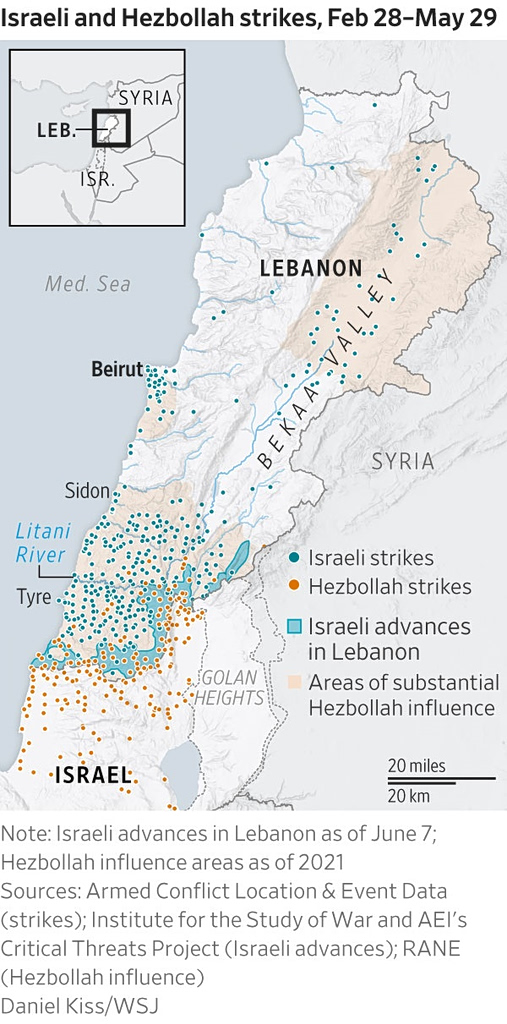
Israel’s recent ground invasion and air raids have created more than a million internal refugees, many of whom now live in tents on the streets of Beirut. Displaced Shia Muslims are shunned for fear they will bring Israeli airstrikes to typically sheltered Christian, Druze and Sunni Muslim neighborhoods and towns. Anger against Hezbollah for pulling the country into another war has swelled, but the group, weakened by Israeli attacks in 2024, has been emboldened and now openly calls for Lebanese to take to the streets and resist their government.
“We know how attempting to disarm Hezbollah militarily would begin, but we don’t know how it would end,” said Khalil Helou, a former general in Lebanon’s military who opposes the group.
Lebanon has long teetered on the edge of being a failed state. Caught throughout its history between Syria, Israel and powerful sectarian militias, it never seemed to achieve full sovereignty.
Its fissures exploded into the chaos of the 1975-1990 civil war, when rival Shia, Sunni, Maronite Christian, Palestinian and Druze militias run by strongmen carved up the country into enclaves defended by checkpoints and summary executions. Fighting shattered Beirut, which was split by the Green Line that rival factions dared not cross.
Amid the havoc, Israel invaded Lebanon in 1982 to attack the Palestine Liberation Organization, which drew its fighters from refugees and their descendants displaced during the founding of Israel in 1948. Israeli troops reached as far as Beirut and, with the help of some Christian-led militias, occupied significant chunks of the south until 2000.
The latest Israeli invasion, Hezbollah’s militancy and the deepening sectarian strife echo for many those dark days. An extended trip in Lebanon revealed that divisive forces are building again, putting its society under the most pressure it has faced in years.
“The state? Where is the state?” said Ali al-Dayekh, a recently married 33-year-old living with his wife in a tent on the street after his home and the bakery he worked at in Beirut’s southern suburbs were destroyed during this year’s war. “We are on our own.”
In the high-end waterfront district of Beirut’s Zaitunay Bay, the wealthy eat at fancy restaurants near the Four Seasons Hotel and host yacht parties. On the same street, hundreds of people , mostly Shia but also including Palestinians and Syrian refugees, live in tent encampments. Some said they are there because landlords from other groups refused to rent them apartments.
The nearby Sunni al-Kantari Mosque took the opposite approach, opening its doors and providing supplies to Shias sheltering at a neighboring Sunni school.
Imad Sobh, the mosque’s religious leader, said some worshipers were upset he welcomed the constituency of the group that dragged Lebanon into the war. They also worried they could be targeted if a Hezbollah member ends up in their midst.
Local community leaders say that the government’s inability to rein in Hezbollah is leading to distrust and vigilantism. In an area of Christian east Beirut known for its right-wing gangs, groups of black-clad men hung out near a building that displayed a four-story portrait of a rifle-wielding Bachir Gemayel, the Maronite Christian militant and political leader killed in 1982.
“This war is much different than the war in 2024. Now there are grudges, divisions, discrimination on sectarian lines. I have even heard some Sunnis say that they are supportive of Israel’s war against Hezbollah, its supporters and Shias at large,” Sobh said. “I have never heard such things from Sunnis before. I am trying to tamp down these sentiments and bring people together.”
The Israeli military said it will go after Hezbollah members wherever they are, including outside of the group’s traditional strongholds, which include swaths of Lebanon’s south, Beirut’s southern suburbs and the Bekaa Valley in the country’s east.
An Israeli strike in Ain Saadeh, a Christian town in the mountains outside Beirut, killed Pierre Mouawad along with his wife and a neighbor. He wasn’t Hezbollah but an official in the Lebanese Forces, a historically Christian party staunchly opposed to the militant group. The Israeli military said the attack was aimed at a Hezbollah military command center and that it regretted harming civilians.
After the incident, landlords kicked several Shia families out of apartments in the area, according to local officials. Armed men at Mouawad’s funeral flashed pistols and rifles, firing them in the air in a show of force.
“We are trying to calm the streets to make sure things don’t escalate further,” said Razi El Hage, a Lebanese Forces member of parliament representing the area.
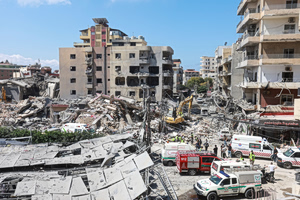
Days later, in the middle of the afternoon on April 8, Israel in 90 seconds struck 100 targets across Lebanon in one of the deadliest bombings in the country in recent years. The attack hit some upscale neighborhoods and central tourist areas in Beirut, shook the psyche of Lebanese society, and led some politicians to call on constituents to prevent unknown people among the displaced from renting homes.
Lebanon neared a state of anarchy half a decade ago after a severe banking crisis, an explosion at Beirut’s port that leveled nearby neighborhoods and shook faith in the government, and a political tug of war with Hezbollah kept the country from electing a president for two years.
Israel’s drubbing of Hezbollah in 2024 opened the door for a turnaround. The parliament elected Joseph Aoun as president, and the U.S. hailed the opportunity for the government to assert its sovereignty and disarm the militant group.
The Lebanese army went to work clearing Hezbollah positions and weapons caches in the south in an effort the U.S. and even Israel acknowledged was having an effect. At times it got help from Israeli intelligence . But by last fall, progress had stalled as Hezbollah rearmed, and Israel was warning it would attack again in force .
“Israel’s objective was to prevent Hezbollah from rebuilding its capabilities, while we, on the other hand, were working to restore them and willing to pay the cost for doing so,” Hezbollah media relations director Youssef al-Zein told a small group of reporters over a recent breakfast in Beirut .
Lebanon’s government couldn’t prevent Hezbollah from joining the war alongside Iran. The country’s prime minister announced a ban on the group’s military activities on March 2, but Hezbollah just ignored it. Later that month, the Foreign Ministry ordered Iran’s ambassador out of the country. He refused to leave.
“Understand clearly: Disarmament is extermination, and we will never accept it,” Hezbollah Secretary-General Naim Qassem said in a May speech during which he also called on Lebanese people to stand against the government.
Lebanon’s government isn’t only impoverished and outgunned, it’s riven by the same sectarian splits as the society as a whole. The U.S. Treasury said in May that Hezbollah gets intelligence tips from officials within Lebanon’s state security organizations, including the Lebanese military.
The U.S. is the Lebanese Armed Forces’s biggest backer, providing more than $3 billion in funding since 2006 and offering training for Lebanese troops. The weak military lacks advanced air-defense systems and missile capabilities, and possesses only a handful of attack planes. Pay is so low many soldiers take second jobs.
Current and former Lebanese military officials acknowledge that the army acts as a unifying institution rather than a formidable fighting force. Its tens of thousands of active-duty soldiers reflect the mosaic that is the country, with representation from all sects. Since Lebanon’s civil war ended in 1990, the army has disarmed various nonstate actors, played intermediary between rival political factions and has cracked down on drug smuggling and Islamist groups.
This time, though, is more fraught. Lebanese soldiers don’t want to be perceived as doing Israel’s dirty work and many don’t have the will to confront their fellow countrymen, even if they are in Hezbollah, U.S. and Lebanese officials say. Secretary of State Marco Rubio has said that the U.S. is working toward establishing a system in which vetted Lebanese military units have the training and equipment to go after Hezbollah so that Israel doesn’t have to.
Israel struck at Hezbollah thousands of times after the ceasefire in November 2024 and ramped up attacks this spring but is in a bind. Despite the punishment, the group bounced back. It has restocked rockets, antitank missiles and artillery via seaports and still-functioning smuggling routes through Syria, The Wall Street Journal reported late last year. The group has also re-established control of old caches, and has manufactured some new weapons itself.
Hezbollah militants are now using new tactics including explosive drones guided by fiber-optic wire that Israel is struggling to counter . Israel risks being dragged into another long-term war and complicated occupation if it aims to disarm Hezbollah itself, analysts say.
The alternative is a U.S.-led peace process between Israel and the Lebanese government that doesn’t directly involve Hezbollah. Lebanon’s president even relies on using an intermediary to talk to Hezbollah, rather than communicating directly with the group, senior Lebanese officials said.
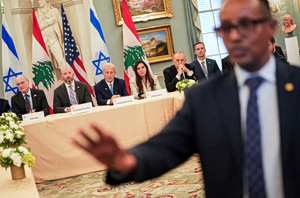
Washington has been hosting rare direct ambassador-level talks between the two states. It has also brought together Israeli and Lebanese army officials to enhance security coordination around their shared opponent.
President Trump wanted Aoun and Israeli Prime Minister Benjamin Netanyahu to meet, but Aoun has resisted, considering it too high of a political risk , senior Lebanese officials said.
At the same time, he understands that Israel wants to secure its northern communities and wants to ensure that Lebanese troops are the only force on his country’s side of the border, the officials said.
His plan has been for Israel to pull back gradually, letting the Lebanese army come in and establish control in areas that will grow, they said. That is essentially the plan Lebanon and Israel agreed to last week. On Thursday, Israeli troops pulled out of the southern municipality of Dibbin and were replaced by the Lebanese.
Senior Lebanese officials think war has again given the government an opening. While Hezbollah points to invading Israeli soldiers as evidence its armaments are needed for the country’s defense, the recent trail of destruction and the group’s embarrassing infiltration by Israeli intelligence has battered its standing even among Shia.
The U.S. has pledged to help build up Lebanon’s army. It isn’t yet the strongest party in this fight. The buzz in Beirut of Israeli drones overhead, along with the constant din of poorly regulated diesel generators, underscores the government’s weakness.
Routine policing is a challenge. In April, security forces fired in the air as they entered a Sunni area of Beirut to arrest a generator operator wanted for allegedly disregarding regulations. Clashes erupted with local residents who shut down the streets. If the government won’t enforce the law against Hezbollah, why should Sunnis submit, they argued.
“People are fed up with the selective and uneven implementation of laws,” said Waddah Sadek, a member of parliament representing the neighborhood where the clashes occurred. “Beiruti Sunnis are sending a message that, ‘Look, we can block the roads, too.’”
The hostilities haunt many Lebanese, who endured the country’s last chaotic civil war.
“The ingredients of civil unrest are there,” said Helou, the former Lebanese general. “Emotional tensions are rising.”
Write to Omar Abdel-Baqui at omar.abdel-baqui@wsj.com