Two men broke a previously inconceivable barrier at the London Marathon on Sunday, both running 26.2 miles in under two hours and smashing the world record.
Kenya’s Sabastian Sawe finished in 1:59:30, obliterating the previous record of 2:00:35 set at the 2023 Chicago Marathon by Kenyan Kelvin Kiptum. Ethiopia’s Yomif Kejelcha finished in 1:59:41.
It was the first time any human had run a marathon in less than two hours in a record-eligible race. The astonishing results capped a decade of technological and training innovation that has pushed the sport into uncharted territory over road racing’s most iconic distance.
The world record has now been broken four times in less than a decade—lowering the 2014 record by a total of 3 minutes, 37 seconds.
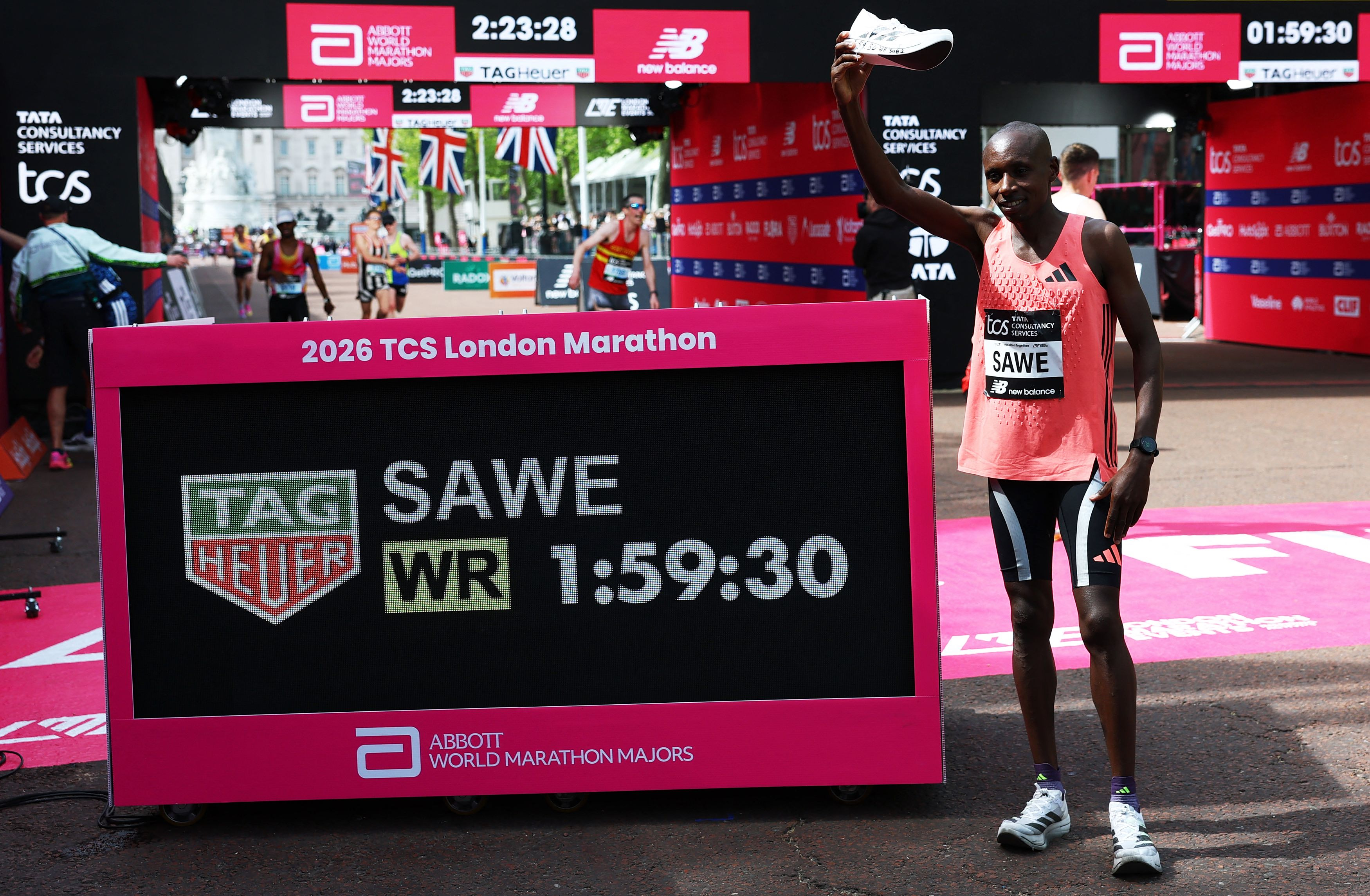
Athletics – London Marathon – London, Britain – April 26, 2026 Kenya’s Sabastian Sawe celebrates with a shoe after winning the men’s elite race and setting a new world record with a time of 01:59:30 REUTERS/Matthew Childs
On Sunday, the two men pushed each other along the flat, fast course, especially late in the race. Sawe actually gained speed, running the second half nearly 1 ½ minutes faster than the first half.
Sawe, who is 31 years old, had been chasing the world record for more than a year. In December 2024, he won his marathon debut in Valencia in 2:02:05, then won the 2025 Berlin Marathon and the 2025 London Marathon.
Ethiopia’s Yomif Kejelcha, who ran 1:59:41, was just as surprising, considering that Sunday was his first ever competitive marathon. He had previously been the world-record holder in the half-marathon and a silver medalist in the 10,000 meters at last year’s world championships.
Even London’s third-place runner broke the previous world record: Uganda’s Jacob Kiplimo finished in 2:00:28 to complete the podium.
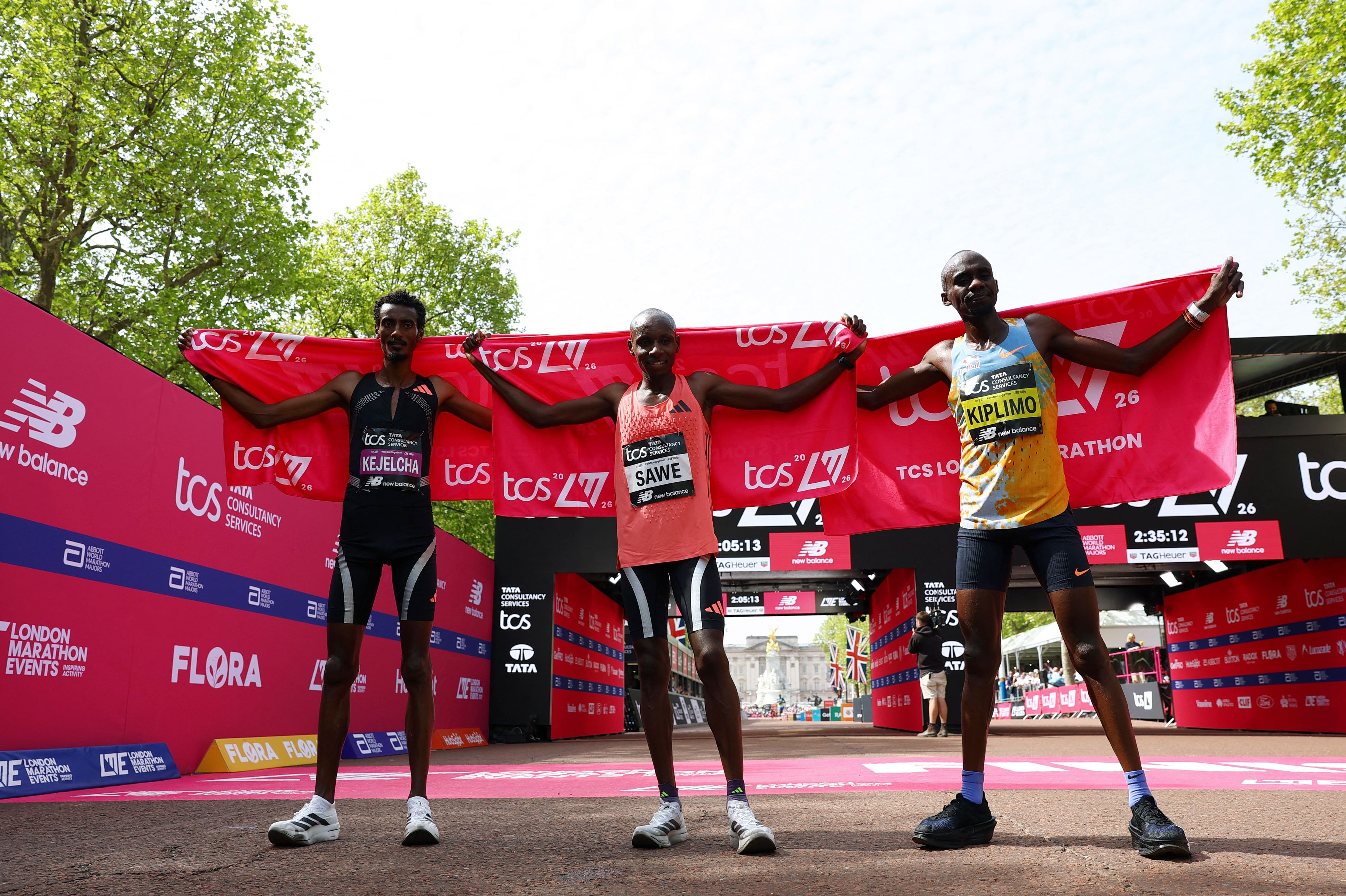
Athletics – London Marathon – London, Britain – April 26, 2026 Kenya’s Sabastian Sawe celebrates after winning the men’s elite race with second place Ethiopia’s Yomif Kejelcha and third place Uganda’s Jacob Kiplimo REUTERS/Matthew Childs
The London Marathon has long been known for record-setting performances. But Sunday also was the culmination of a decade of breakneck innovation across the sport. And nothing has propelled runners more than the revolution in footwear.
A decade ago, Nike created mysterious prototypes featuring giant soles and rigid interior plates that functioned like springs, unleashing the “super shoe” era across the sport. Since then, high-tech foams have been perfected to return more energy to the runner than ever and come in lighter than previous materials. Studies show super shoes can increase running economy by roughly 4%—a massive help during a 26-mile race.
In 2019, Kenyan Eliud Kipchoge wore a Nike super shoe called the Vaporfly to run a 1:59:40 marathon on a closed course in a specially tailored race in Vienna. Because of Kipchoge’s use of wind-breaking pacemakers and other measures, the mark wasn’t eligible for a world record.
Despite initial controversy that super shoes were fundamentally changing the sport, the world governing body of running, World Athletics, eventually legalized them with only a few limitations.
On Sunday in London, Sawe and Kejelcha wore Adidas’ lightest model yet. The Adizero Adios Pro Evo 3 weighs just 3.4 ounces, barely more than a deck of cards, for a men’s size 9.
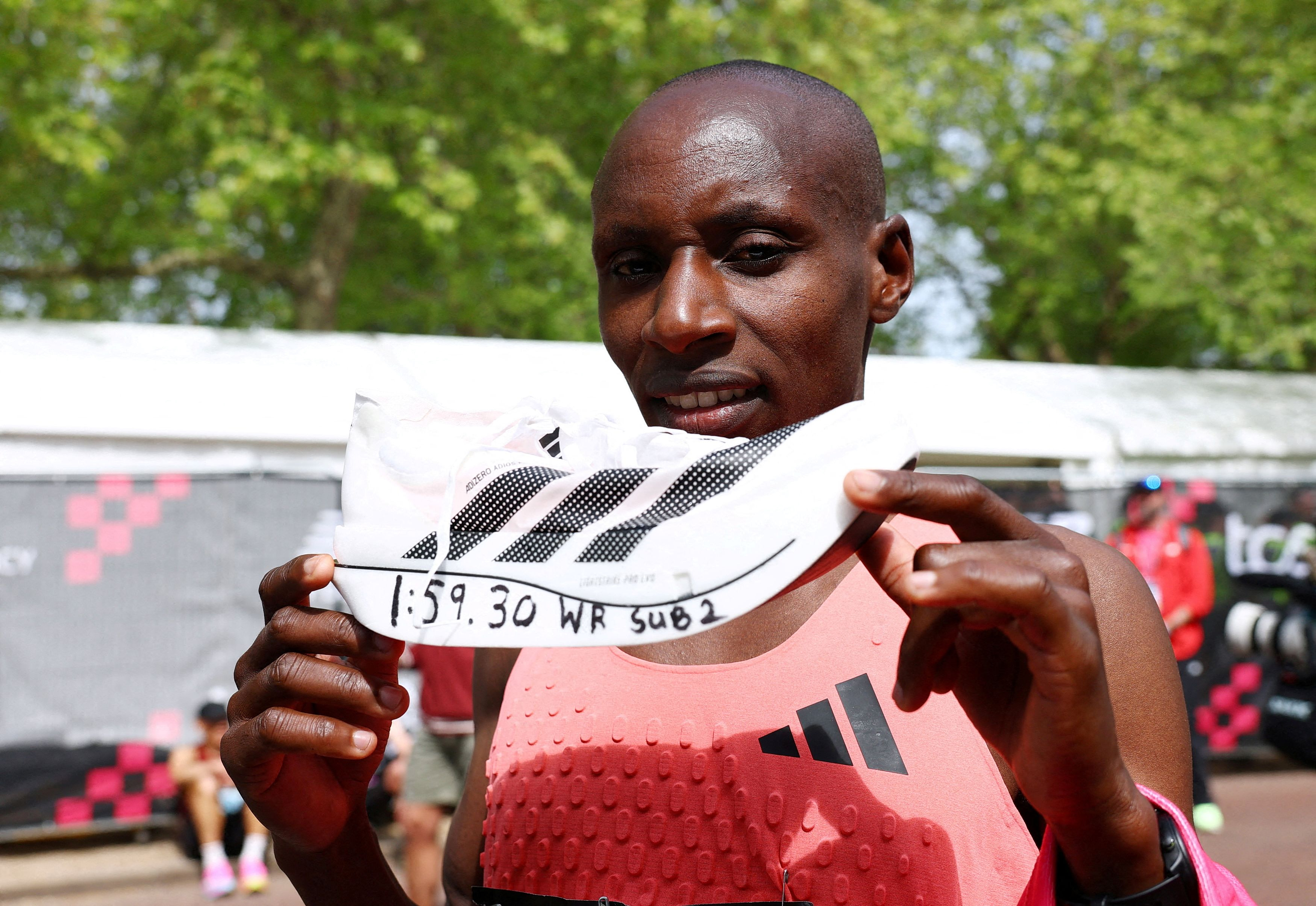
FILE PHOTO: Athletics – London Marathon – London, Britain – April 26, 2026 Kenya’s Sabastian Sawe celebrates with an Adidas Adizero Adios Pro Evo 3 shoe after winning the men’s elite race and setting a new world record with a time of 01:59:30 REUTERS/Matthew Childs/File Photo
Kiplimo, the third-place finisher, wears Nike.
The blistering finishes in London could spur suspicion, since several marathon runners have been disqualified for doping offenses in recent years. So as Sawe began chasing the world record last year, he took the extraordinary step of undergoing extra drug testing. He underwent 25 out-of-competition tests in the two months before he won the Berlin Marathon last year. That extra testing has continued into this year, his support staff has said.
“I am so happy,” Sawe said. “It is a day to remember for me.”