
 Μake us preferred on Google
 VATICAN CITY—President Trump, who said God supports U.S. military operations against Iran, has fulminated against Pope Leo XIV’s antiwar stance. Vice President JD Vance has even told the pope to be more careful about theology, because Catholic tradition includes the idea of a just war.
But the Catholic Church has come to doubt that almost any modern wars are just.
It isn’t just Leo, who has challenged Trump since January over his growing use of military force. The Vatican’s perspective on war has shifted over the past century. Modern popes have taken the view that the sheer destructive power of modern weaponry has changed the nature of conflict, so that principles of just war developed in antiquity and the Middle Ages are rarely if ever satisfied.
That means the Vatican will continue to be an awkward, even fiery opponent of a U.S. foreign policy that trusts in American muscle, not in a rules-based international order.
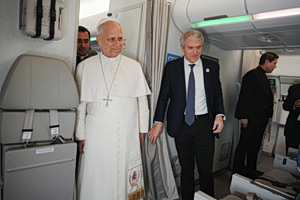
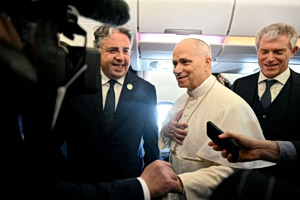
“As a pastor, I cannot be in favor of war,” Leo told reporters on Thursday while flying home to Rome after a tour of Africa. Too many innocents have been killed, he said, adding that he carries with him a photo of a child who greeted him in Lebanon last year, and who was killed in the current war.
For weeks, Leo has denounced not only the U.S.-led war on Iran, but war in general. He has criticized the pro-war prayers and biblical invocations of officials such as Defense Secretary Pete Hegseth.
“This is our God: Jesus, King of Peace, who rejects war, whom no one can use to justify war,” Leo said during a Mass in St. Peter’s Square on Palm Sunday. “He does not listen to the prayers of those who wage war, but rejects them, saying: ‘Even though you make many prayers, I will not listen: Your hands are full of blood,’” he said, quoting from the Bible.
God on our side
Vance, a Catholic convert, cried foul. One can debate the merits of a given war, but Leo was going too far, he said. “When the pope says that God is never on the side of those who wield the sword, there is more than a thousand-year tradition of just war theory,” Vance told a Turning Point USA event at the University of Georgia in mid-April. Was God not on the side of American GIs, he asked, when they liberated France from Nazi occupation? “If you’re going to opine on matters of theology, you’ve got to be careful. You’ve got to make sure it’s anchored in the truth,” he admonished the pontiff.

ATHENS, GEORGIA – APRIL 14: U.S. Vice President JD Vance participates in a “fireside chat” during a Turning Point USA event in the Akins Ford Arena on the campus of the University of Georgia on April 14, 2026 in Athens, Georgia. Chip Somodevilla/Pool via REUTERS
Has the papacy turned its back on just war theory and become pacifist? Not quite. But Vance wasn’t the only person to raise the question.
“I really do think the Vatican needs to be a little clearer on just war,” said the Rev. Robert Sirico , co-founder of the Acton Institute for the Study of Religion and Liberty, a conservative think tank in Grand Rapids, Mich.
Early Christianity was overwhelmingly opposed to war and military service, said Vincent Miller, a professor of theology at the University of Dayton, Ohio. Many accepted martyrdom rather than compromise their faith.
By the late fourth century, however, Christianity was the official religion of the Roman Empire, including its soldiers and generals. The Empire was crumbling; the Visigoths had sacked Rome. Should followers of Jesus really turn the other cheek?
St. Augustine, a bishop from Roman North Africa, gave a pessimistic answer: Men lived in a fallen earthly realm ruled by violence and lust for domination, and defending the innocent with force was sometimes a tragic necessity for the state. Later, the 13th-century Italian friar St. Thomas Aquinas turned Augustine’s thinking into a formal set of criteria for a just war, including a legitimate authority pursuing a just cause such as self-defense with the right intentions.
In practice, popes often used “just cause” elastically, blessing the expansionist campaigns of kings and emperors and sometimes even donning armor themselves.
But the theory at least tried to limit war. Catholic thinking became a major influence on modern international law—including the United Nations Charter, which prohibits war except for self-defense or missions mandated by the Security Council, and rules limiting military force to what is necessary and proportionate and distinguishes soldiers from civilians.
Just war theory is still part of the Catechism, the official summary of the church’s beliefs published under St. John Paul II in 1992, which says: “Legitimate defense can be not only a right but a grave duty for one who is responsible for the lives of others.” There are strict criteria. Even a defensive war must be a last resort after all other efforts to prevent aggression have failed.

Just say no
But with the rise of industrialized warfare in the early 20th century, a second strand in papal thinking emerged, said Daniel Philpott , a political scientist at the University of Notre Dame: “A strong teaching that there’s something deeply tragic and lamentable about modern war.” In this perspective, war has become so devastating, particularly through the aerial bombing of cities, that it’s always a defeat for humanity. “Virtually every pope in the past century has voiced this theme pointedly, vociferously and continuously,” he said.
This theme coexists alongside the church’s support of legitimate defense, and “there may be some tension between them,” said Philpott.
Pope Francis, in his 2020 encyclical “Fratelli tutti,” suggested just war theory was outdated. The idea of defensive war has been so abused by “overly broad interpretation,” and new technologies have given war such “uncontrollable destructive power,” that “it is very difficult nowadays to invoke the rational criteria elaborated in earlier centuries to speak of the possibility of a ‘just war,’” he wrote. “Never again war!”
In a footnote, Francis said Augustine had “forged a concept of ‘just war’ that we no longer uphold in our own day.”
After Vance criticized Leo this month, Italian bishop Antonio Staglianò responded by taking Francis’ logic even further in a pacifist direction. Just war was always a pragmatic compromise with history, never a core doctrine, said Staglianò, the president of the Pontifical Academy of Theology in Rome, in an article published on a Vatican website.

People pass damaged buildings amid a 10-day ceasefire between Lebanon and Israel, in the southern suburbs of Beirut, Lebanon, April 20, 2026. REUTERS/Marko Djurica
The theory presupposed armies that met each other in a field, he said—not modern high-tech war with its heavy civilian death tolls. “Every war today is a crime against humanity. Not ‘some wars.’ Not ‘unjust wars.’ Every war,” he said. The article suggested Christians should embrace nonviolent resistance and the tradition of martyrs.
That isn’t Leo’s position, according to other senior clergy.
Bishop James Massa , the top doctrinal official of the U.S. bishops’ conference, said the pope is upholding just war theory. “To be a just war it must be a defense against another who actively wages war, which is what the Holy Father actually said,” Massa said in a statement following Vance’s comments.
Other U.S. bishops and cardinals have said that just war theory remains valid—but that the U.S. war on Iran didn’t meet the bar.
Updating Augustine
Leo’s speech to Italian military chaplains last month suggested he isn’t a pacifist. Christian soldiers, he said, have a job to do: to defend the weak, including in international missions to preserve peace and restore order.
On April 7, just before the U.S. and Iran began a cease-fire, Leo called on people of good will “to reject war, especially a war which many people have said is an unjust war…and which is not resolving anything.” Citing innocent deaths and the global energy and economic fallout, he said: “Come back to the table, let’s talk.”
“My judgment is that the pope is expressing a continuous and consistent line of concern about the nature of modern warfare: about how suffering is routinely born by civilian populations, as much as or even more than it is by a country’s military,” said Joseph Capizzi , professor of moral theology at the Catholic University of America in Washington, D.C.
Some observers hope Leo, a former head of the Augustinian religious order, will explain in more detail how Catholic antiwar and just war thinking fit together—and update Augustine’s mix of idealism and realism for an age of missile and drone wars.
Augustine’s idea of peace is made up of security, order, justice and freedom, said George Weigel , a Catholic author and political analyst.

The D-Day invasion of the coast of Normandy, France, during World War II in 1944.
“As a son of St. Augustine, Pope Leo should be in a strong position to initiate that broader discussion, and then help fit a renewal of the just war tradition of moral reflection—which addresses the complex question of how the proportionate and discriminate use of armed force can help restore or establish that peace—into that,” he said.
Write to Marcus Walker at Marcus.Walker@wsj.com