WASHINGTON—The Supreme Court on Monday blocked the Trump administration from imposing new requirements for mail ballots, averting what state and local officials warned would have been a crisis in the midterm elections.
In an unsigned one-paragraph ruling , over the dissent of two conservative justices, the court said the U.S. Postal Service can’t enforce new rules that would have compelled states to quickly redesign their ballot envelopes, submit lists of voters to the federal government and get signoff from postal officials before ballots could be mailed to voters.
The Postal Service adopted the new rules last month at the behest of President Trump, who has frequently disparaged mail voting and has said that limiting the practice would help Republicans. State and local officials argued the rules were unconstitutional and exceeded the Postal Service’s authority. They also said that implementing the rules before the Nov. 3 midterms would be logistically impossible , because many ballots have already been prepared, and some states, including North Carolina and Wisconsin, have already started mailing ballots to voters.
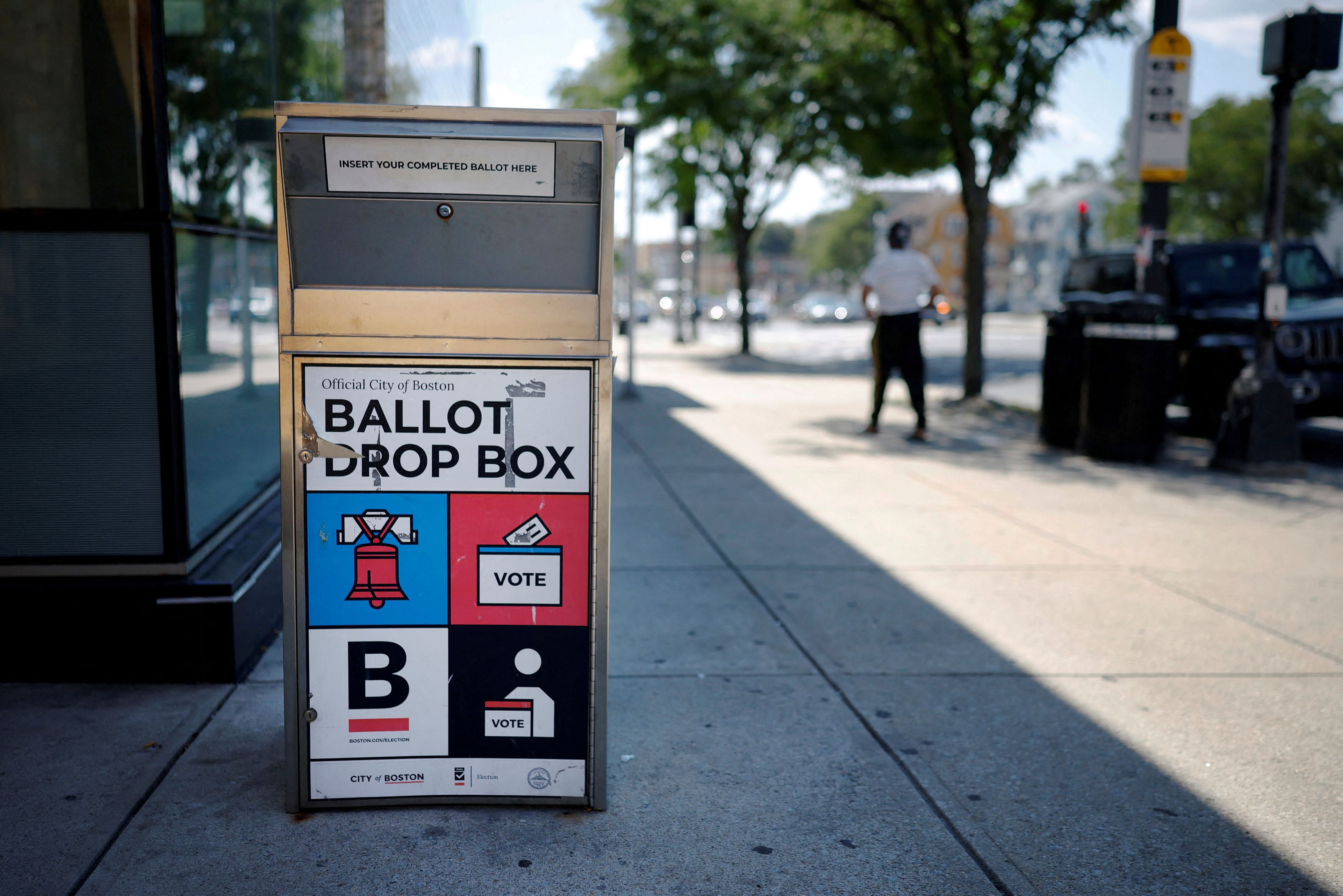
A ballot drop box outside a public library, ahead of the midterm primary election, in Boston, Massachusetts, U.S., August 20, 2026. REUTERS/Brian Snyder/File Photo
Nearly a third of American voters used mail ballots in 2024, and some states conduct their elections primarily by mail.
Justices Clarence Thomas and Samuel Alito dissented from the high court’s decision.
The ruling, which rejected an emergency appeal by the administration, deals the president another Supreme Court loss on one of his top priorities, and it comes during a hotly contested midterm battle that will determine control of Congress during his final two years in office. With Election Day seven weeks away, the justices might be called on to referee additional fast-moving voting-related disputes. Last week, the court blocked a new Republican-friendly congressional map in Missouri. And it could soon weigh in on a different Trump administration plan to use an immigration database it says could screen voters’ eligibility.
Under the planned mail regulations, the Postal Service would have refused to deliver ballots sent by states to voters unless the states complied with several new conditions. In particular, the states’ ballot envelopes would have had to include individualized bar codes and other new design features, and states would have had to upload into a new online portal the names, addresses and bar codes for all of the states’ voters who are eligible to vote by mail. The Postal Service acknowledged in a Sept. 3 court filing that the portal wasn’t yet up and running, and an anonymous whistleblower said the agency was bungling the hasty rollout.
The Supreme Court offered minimal reasoning for its decision against the rules. Using legalese, it said tersely that the administration was “unlikely to succeed on the merits of its challenge” to a district judge’s injunction that blocked the rules. The court added that “equitable factors” didn’t favor an emergency ruling lifting the injunction.
Alito wrote an eight-page dissent, arguing that the Postal Service has “broad power to regulate the delivery of mail.” He also said the challengers “bear a substantial share of the blame” for the late timing of the agency’s rules, which were delayed by litigation over a March executive order from Trump that prompted them. Thomas signed onto Alito’s dissent.
Justice Brett Kavanaugh , a Trump appointee, added a one-paragraph concurrence agreeing with the court’s decision. He said that, in his view, there is “at least a fair prospect” that the Postal Service rules fall within the agency’s legal authority, but that election officials “do not have sufficient time to reasonably implement” them before the midterms.
By maintaining the injunction against the rules, the high court’s decision effectively guarantees that they will remain on ice during the midterms. Further litigation is expected over whether the Postal Service can enforce the regulations in future elections.
The decision was the second time in three weeks that the high court has weighed in on the administration’s efforts to revamp mail voting. On Aug. 24, the court ruled that an earlier legal challenge was premature because it was brought before the Postal Service unveiled its final rules.
The justices are also weighing a separate case on their emergency docket about the administration’s bid to deploy a citizenship database that officials say could detect ineligible voters. Two lower courts have blocked the administration from letting states use the Department of Homeland Security database after challengers argued it violates federal privacy laws and would be prone to mistakes.
Election officials around the country and voting-rights groups have argued that Trump’s maneuvers around mail voting—including policies that are being implemented in a hurry and for the first time—would risk disenfranchising large numbers of citizens. In particular, opponents said, the Postal Service rules would have deprived millions of Americans of the ability to vote because many jurisdictions wouldn’t have had any feasible way to comply in time for the midterms.
While Democratic officials have led legal challenges to Trump’s efforts, some Republican election officials also raised serious concerns, telling the Supreme Court in a legal brief that it was far too late in the election cycle to implement such sweeping and untested measures.