Stephany Falcon couldn’t believe her luck.
In just 15 minutes at a Manhattan arcade, the 20-year-old college student and her boyfriend had collected three prizes from the rows of claw machines. After snagging a pink-and-red monster plushie, she excitedly jumped up and down.
The claw machine—that infamous promiser of childhood treasures, known for stealing your quarters and almost never yielding up its flimsy prizes—has gotten an upgrade.
Modern games, trimmed with neon lights, are filling storefronts and bringing life to malls in cities and suburbs across the U.S. They’re stocked with luxe plush toys, Hermès bags , fresh vegetables and even sourdough starter.
But the biggest change may be that today’s operators actually want their customers to win—at least once or twice.
“We only win if you win,” said Brad Howard, co-founder and managing partner of Fantasy Claw Arcade, which is expanding through franchising. “You were gonna buy it for $20. We want to sell it to you for $20. But we’re going to sell it to you in the form of game play.”
That’s hooked Falcon and her boyfriend, Hirael de Jesus. The pair like the plushies they win but return to the machines because of the fun they have playing together.
“If I, let’s say, I win one and I win another one and I feel like I’m on a winning streak, I’ll wage at least maybe $70, at most like $100 or more,” Falcon said.
Couple the gamification of everything from languages to health with Americans’ fascination with collectibles , and it was only a matter of time before claw-machine arcades took off in the U.S., retail experts say. Plus, arcade tokens tend to be cheaper than tickets for a concert or sports match.
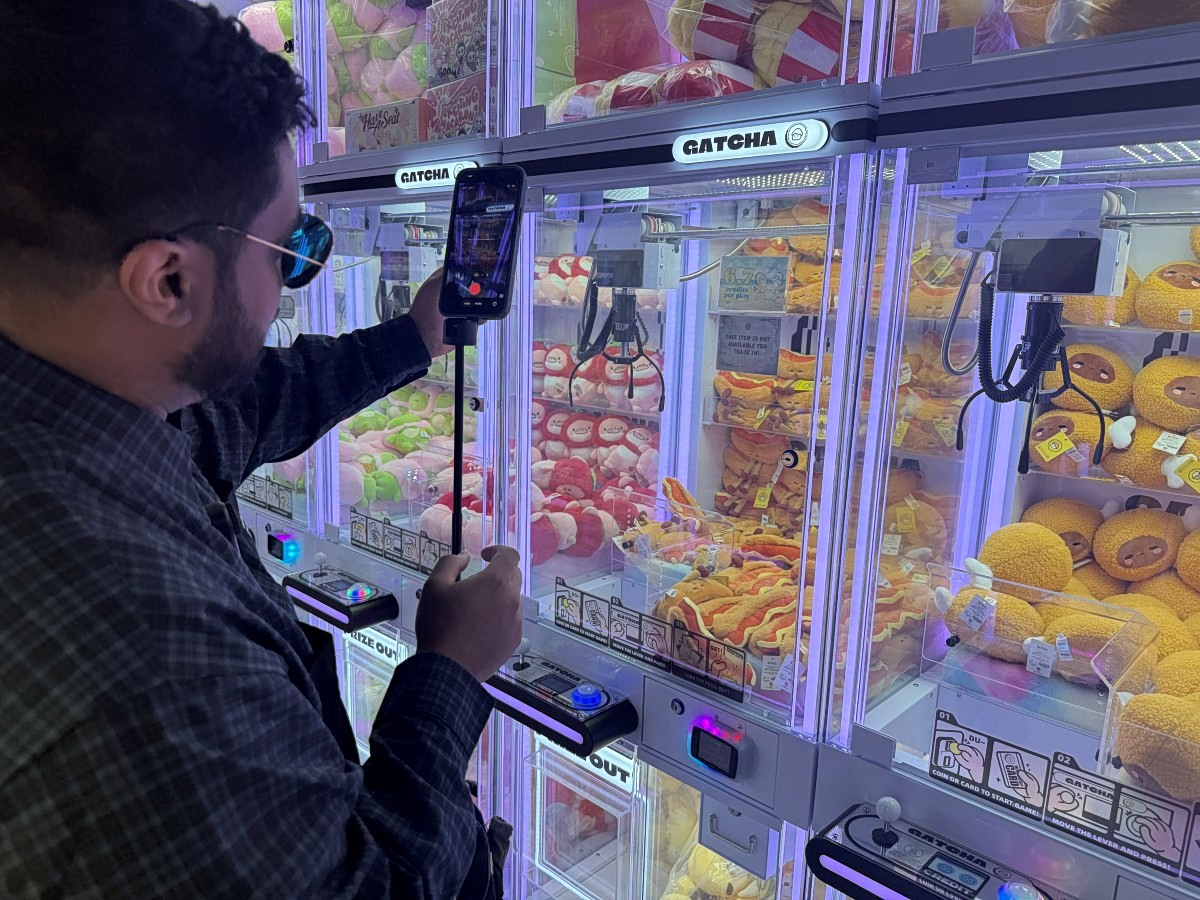
Social-media creators like Myooran Yokerathinam are offering tips on mastering claw machines, helping to fuel their popularity. Lily Belle Poling/WSJ
“I don’t even care about the toys,” said Myooran Yokerathinam, better known as Clawmaster_30 to his hundreds of thousands of followers on social media, where he posts highlight reels of his winnings—and the tricks he uses to maximize them. “I do it for the love of the game.”
On a recent Tuesday at the Gatcha arcade in Manhattan’s Koreatown, Yokerathinam pointed out a machine stocked with Pikachu plushies. Looking through aviator shades, he explained that the Pokémon mascot is one of his preferred targets, not just because he likes the character but because Pikachu’s long ears make the claw much more likely to hang onto the toy.
In two attempts, Yokerathinam snagged his Pikachu.
As he wove through the rows of machines, Yokerathinam pointed out more hacks: If you press the release button as the claw approaches a prize, you might manually force the claw to clamp around a toy, he said. Also, it’s best to go for something that’s close to the exit chute, in case the claw drops it prematurely.
After nabbing a plush hot dog and a red-and-white rabbit, Yokerathinam flashed his prizes into his phone’s camera, illuminated by the portable light he’d attached to a neighboring machine.
“There you go,” he said as he retrieved a prize from the chute.
Fantasy Claw’s Howard estimates there are roughly 300 to 400 “clawcades” across the U.S. The new storefronts have especially been a boon for malls, which flailed after the rise of online shopping.
“Someone can buy that collectible online, but they can’t recreate that excitement of playing the game or the anticipation of the huddle cheering when someone finally does win,” said Alison Krueger, a leasing manager at Mall of America, which operates a claw-machine arcade with more than 100 machines, plus bubble tea and Korean shaved ice.
The other draw for players: claw machines leverage some of the exact same cognitive hooks as slot machines, said Elliot Ludvig, a University of Warwick psychology professor who studies rewards-based decision-making.
When a claw lifts a plushie and drops it inches from the chute, the brain doesn’t register a failure, Ludvig said. Instead, the psychological tease convinces the player that a win is imminent, spurring them to pay for another try.
Claw machines can be set to yield a prize after a certain number of attempts, and today’s operators are choosing more reasonable settings. Multiple clawcade operators said customers spend, on average, about $30 a visit.
Alice Greene spent part of a recent Tuesday evening at a clawcade in Manhattan with two friends, trying to pick up “blind boxes” that contain miniature mystery figurines. Five minutes in, she hadn’t successfully grabbed one.
“It’s fun to see if you can do it or not and, like, you probably can’t. It’s kind of a scam,” said Greene. “It’s gambling, but it’s disguised by cuteness.”
On my first trip to a small storefront in Chinatown, I spent about $20 to play nine times. Each attempt was a bust. Meanwhile, the little girl next to me picked up a plush pigeon keychain with ease.
But that was before I met Yokerathinam. Picking up some of his tricks, my luck turned during other visits.
After spending $40 more, I eventually walked away with two cute plushies—a fuzzy chicken leg with a penguin face and a purple tea cup with a smiley face embroidered on its side—and my dignity intact.
Was it worth $60? I’m not so sure…