

DAMASCUS—During 13 years of revolution and war, the Syrian dictatorship of President Bashar al-Assad set a high water mark for cruelty in the 21st century, disappearing tens of thousands of perceived political opponents and flattening entire neighborhoods. Now that the regime has fallen, the hunt is on for one of Assad’s most brutal enforcers.
Maj. Gen. Jamil al-Hassan , the former head of Syria’s Air Force Intelligence agency, was notorious as an architect of the regime’s collective-punishment campaign to break the rebellion.
Shadi Haroun, a young leader of the Arab Spring protests that spread to Syria, met the general face-to-face in 2011 after he was arrested and brought to Air Force Intelligence headquarters at Mezzeh air base in Damascus. In a four-hour encounter, Hassan questioned him in a level but domineering voice.
“I will keep killing to keep Bashar Assad in power,” the general warned, according to Haroun. “I will kill half the country if I have to.”
The protests continued, and the general delivered on his threat. Under his orders, Air Force Intelligence approved the bombing of civilian neighborhoods, played a role in chemical attacks and tortured and disappeared thousands of Syrians. In secret meetings with Assad and other leaders, he pushed the Syrian president to take an ever-harder line.
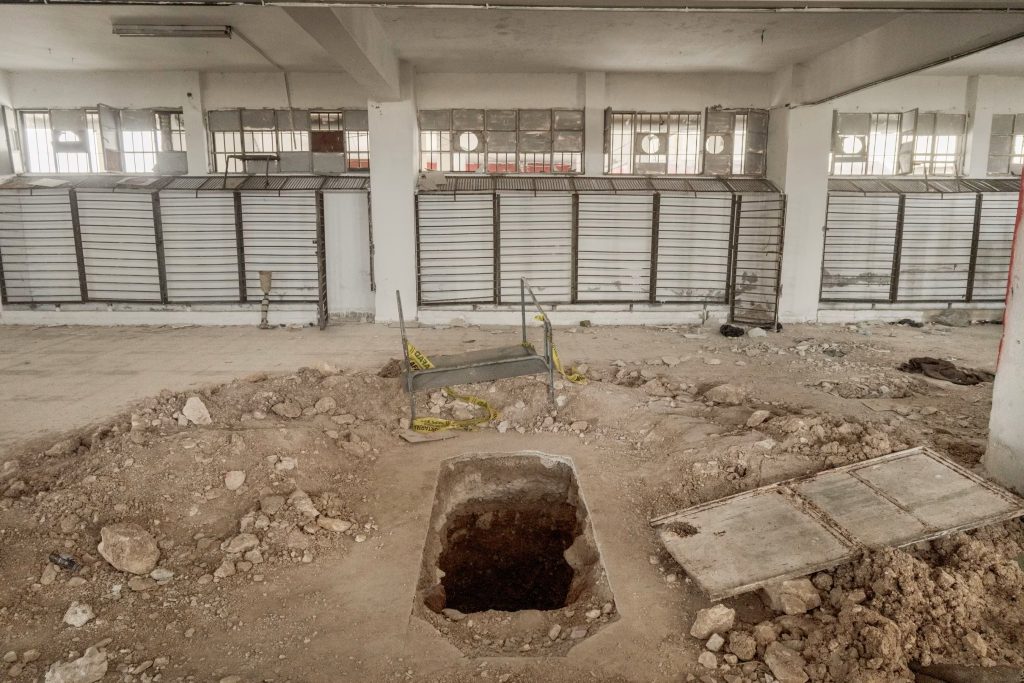
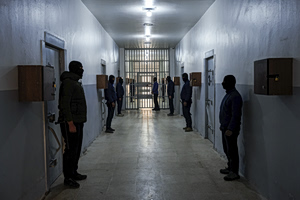
A hole opened in the floor of the main entry hall of the prison—where new inmates once received a ‘welcome’ beating. After the fall of the regime Syrian civilians went in search of possible secret cells in the basement of the facility. Photographs by Manu Brabo for WSJ
“Those taking part in the protests are no longer protesters. They are terrorists” and “must be eliminated,” he said in a speech to other Syrian officers in July 2011, according to a witness whose testimony was collected by the Commission for International Justice and Accountability, or CIJA, a nonprofit that gathers evidence for use in war-crimes prosecutions.
Speaking approvingly of China’s 1989 massacre in Tiananmen Square, Hassan later argued that killing more people at the outset would have crushed the Syrian rebellion sooner. “If the Chinese state had not settled the student chaos, China would have been lost,” he told a Russian news agency in 2016.
“He was a psychopathic personality,” said Haroun, who is now a national figure in the campaign for justice in Syria after surviving years in Saydnaya prison, a notorious execution center.

Shadi Haroun, a one-time political prisoner who met Hassan face-to-face, calls him ‘a psychopathic personality.’ Photography by Manu Brabo for WSJ
Hassan is now one of the world’s most hunted war-crimes suspects. Convicted in absentia in France for his role in crimes against humanity, he is subject to an arrest warrant in Germany and wanted by the Federal Bureau of Investigation for his alleged role in the kidnapping and torture of American citizens.

A photo of Jamil Hassan released by the FBI.
Like many other regime officials and government leaders, Hassan fled Syria when Assad’s regime collapsed last December. Assad flew with his wife to Russia . Other regime officials scattered across the Middle East. Hassan’s hideout is uncertain, but multiple current and former Syrian and Western officials suspect he is in Lebanon, where former regime intelligence officials are rebuilding a network of support.
France and Syria have sent requests to the Lebanese authorities asking for Hassan’s arrest, according to a French official. A senior Lebanese judicial official said his government doesn’t have confirmed information about Hassan’s whereabouts.
The hunt is one of the most important tasks on Syria’s difficult road to reckoning with the violence of the civil war, which left victims and unresolved grievances across the country.
Many lower-ranking police, soldiers and bureaucrats were permitted to seek amnesty from Syria’s new government, a process intended to stabilize the country while pursuing some of the worst alleged criminals from the old regime—including Hassan.
“Every Syrian, including me, would be happy if he is arrested,” said Abdulbaset Abdullatif, the head of Syria’s National Commission for Transitional Justice, which was set up by new Syrian President Ahmed al-Sharaa earlier this year. “His hands are covered in Syrian blood.”
“Jamil Hassan is like Eichmann to Assad’s Hitler,” added Mouaz Moustafa, the executive director of the Syrian Emergency Task Force, an advocacy group in Washington.
Hassan was born into Syria’s Alawite community in 1953 near the town of Qusayr on the country’s border with Lebanon. He joined the military and rose through the ranks under President Hafez al-Assad , the family patriarch who seized control of Syria in a coup in 1970 and founded a dynastic dictatorship that ruled for half a century.

Hafez al-Assad and his wife, Mrs Anisa Makhlouf. On the back row, from left to right: Maher, Bashar, Basil, Majid, and Bushra al-Assad.
As a young officer, Hassan was sent in 1982 to help crush a Muslim Brotherhood uprising in the western city of Hama. Assad’s forces killed tens of thousands and flattened much of the city in a crackdown that made clear the regime intended to stay in power at any cost. The world was horrified by the massacre. Hassan saw it as a model. “The decision at that time was a wise one,” he said in the 2016 Russian news-agency interview.
Hassan got further scope to exercise his instincts after Hafez al-Assad died in 2000, bequeathing power to his second son, Bashar, a British-educated eye surgeon. The elder Assad, an Air Force officer, had set up Air Force Intelligence as one of the innermost layers of a system intended to coup-proof the regime. It played a special role among Syria’s four intelligence agencies, which all spied on one another, and was put in charge of sensitive security matters including a role in the country’s chemical-weapons program, according to a sanctions notice by the U.S. Treasury. Hassan took charge of the agency in 2009.
“It was always mentioned as being the most elite or the most inner-sanctum intelligence service,” said Aron Lund, a fellow at Century International and longtime analyst of Syrian security affairs.
Two years later, as Syrians joined the Arab Spring revolutions, Hassan viewed the protests as an existential threat after a wave of rebellion toppled three other Arab heads of state.
Hassan and the leaders of the other security agencies gathered in central Damascus to plan a campaign of disinformation and a violent crackdown that they laid out in a document they all initialed. The document was shown to The Wall Street Journal by one former Syrian security official and verified by another.
At the time, there was still debate within the highest ranks of the regime over how to handle the uprising. Some preferred to mix repression with cosmetic reforms that might placate the protesters. Hassan favored overwhelming and deadly action. His effective message to Assad, according to government documents and a witness to their discussions, was, do as your father did in Hama and crush the rebellion.
Anywhere protests spiraled out of control should be put under siege, they wrote in the document. Snipers would be sent to fire into the crowds with orders to obscure the source of the gunfire and kill no more than 20 people at a time to avoid an obvious link to the state, the document says.
“No leniency will be shown towards any attack on the highest symbol, regardless of the cost, because remaining silent will only embolden our adversaries,” the document says.
Documents gathered by the CIJA and reviewed by the Journal show Hassan told security forces to fire on peaceful protests. That decision sent Syria hurtling on the path to civil war. Demonstrators picked up guns, and armed rebels joined in. Hassan and his lieutenants upped the ante by approving the use of helicopters and planes to bomb hospitals.
A 2011 uprising in the Damascus suburb of Daraya, within striking distance of the regime’s seat of power and right next to Air Force Intelligence headquarters at Mezzeh air base, drew a brutal response. Gunfire and shelling from Mezzeh smashed into the neighborhood each day. The blasts ripped off the sides of some buildings and reduced others to dust.
The military sent in tanks, and Hassan’s intelligence men came with them. For two years, Daraya residents said, intelligence agents went from house to house seizing young men in an effort to root out protesters and rebels.

A perimeter fence surrounds the base where the Syrian Air Force housed its intelligence headquarters in Daraya, and the main gate to the facility. Photography by Manu Brabo for WSJ
For many of the arrested, Air Force Intelligence headquarters was their first and last stop. More than 160,000 people were disappeared by the regime during the uprising and subsequent war, according to the Syrian Network for Human Rights.
Former detainees said they were stripped naked, strung up from the ceiling, subjected to electric shocks and burned with acid. Some later told U.S. federal investigators they saw blood on the walls.

Signs and marks made by former prisoners are seen on the wall of a cell room at underground prison “Branch 215” which was operated by Syrian Military Intelligence, after rebels seized the capital and ousted Syria’s Bashar al-Assad, in Damascus, Syria December 11, 2024. REUTERS/Amr Abdallah Dalsh
“They took my three sons,” said 80-year-old Mohamed Khalid Al-Balshi. “No one came out. They’re gone.”
In September 2011, security officials handed over the remains of a young activist who had been detained, Ghiath Matar, his body bearing the marks of apparent torture. After Matar’s funeral, attended by hundreds of civilians and the U.S. ambassador, Hassan rolled into the heart of Daraya demanding answers.
“Who attended Ghiath Matar’s funeral?” Hassan demanded of a local resident as he stepped out of his car. The resident, Abdel-Ghaffar Janah, who is now 70 and runs a real-estate office, replied that he didn’t know. “If you see anything, tell me,” Hassan told him before storming back to his car.
A few hours later, Air Force Intelligence men fanned out across the neighborhood, arresting more people and firing their guns.
“He was willing to kill millions of people,” said Janah, standing next to a pile of rubble that once was a house.
Dina Kash was detained by Air Force Intelligence in 2011 after the agency arrested her husband, a wholesale distributor who was among the many political opponents of the regime who later died in prison.
Agents placed her under house arrest and moved in with her, spending 26 days in the couple’s Damascus apartment and forcing her to cook and clean for them. At one point, an officer handed her the phone saying Jamil Hassan wanted to speak with her. “Your husband says he threw his phone in the toilet, is that true?” Hassan asked. She said she didn’t know.
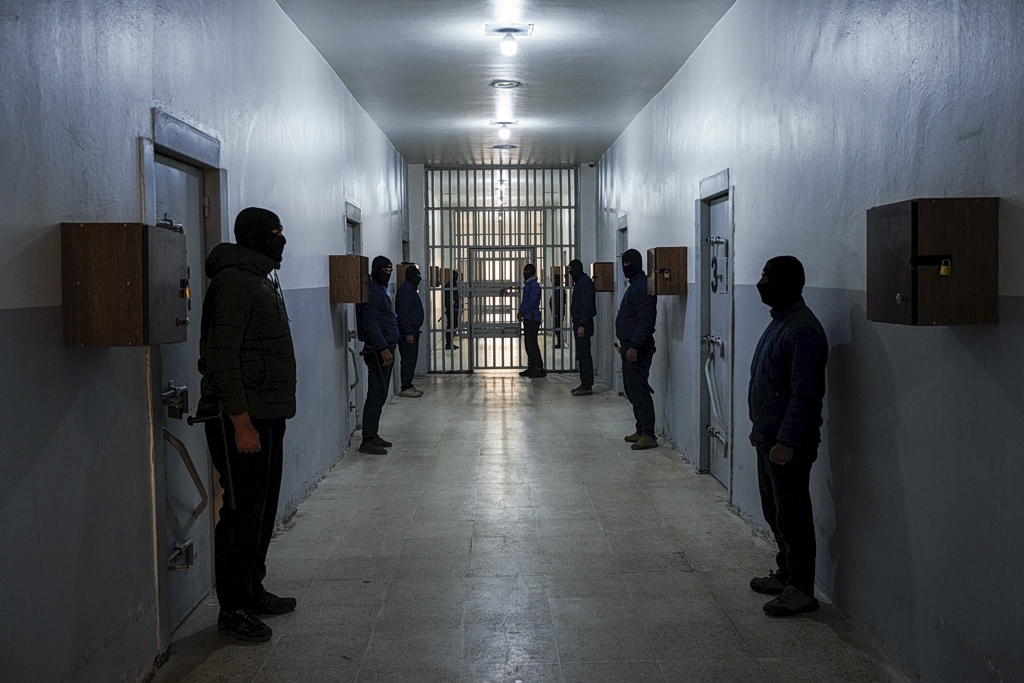
The security men jailed her at Mezzeh air base, where inmates slept crammed together in overcrowded, unheated cells ridden with lice. They could hear screams and the sizzling of electrical wires echo through the building.
Former detainees told the Journal they often saw an older man with gray hair they believed was Hassan. Kash later testified to the FBI that she believed he had a personal role in disappearances and torture.
“Jamil Hassan was essentially prescribing torture to all men and women,” she said. Apart from his broad commanding role, she added, “He would essentially say, OK, this detainee, this female detainee will be under this kind of psychological torture, that kind of physical torture.”
Kash was released weeks later and fled the country.
Yazan Awad, who at the time was an engineering student, was jailed by Air Force Intelligence for several months after joining the protests against Assad at Damascus University in 2011. He told the Journal he was mercilessly beaten, shocked and strung up by his wrists. He estimated his cell was designed to hold about 10 people, but at one point held more than 100. They slept crushed together on the floor “like noodles,” he said.
Awad was sentenced to death, but his parents paid a bribe for his release before he could be executed, he said. Official records listed him as dead anyway, making it impossible to continue his studies in Syria. He fled to Germany, where he later testified in the war-crimes case that would result in the 2018 arrest warrant against Hassan.
Air Force Intelligence had its own working military field court at Mezzeh that sentenced people to death or dispatched them to the Saydnaya prison. The Air Force site also had its own mass grave, according to the Syrian Justice and Accountability Center in Washington, which based its findings on satellite photos and a visit to the site after the regime fell.
Forensic photos of people executed in Assad’s prisons smuggled out of Syria by a whistleblower code-named Caesar included 352 people who are believed to have died inside Air Force Intelligence’s facilities between October 2011 and late 2013. Awad identified several of his friends when the photos were released.
The killings and abuses inside his prison set Hassan apart even from other leaders within Assad’s regime, war-crimes investigators say.
“The difference is the level of brutality allowed,” said Mohammad Al Abdallah, the executive director of the Syrian Justice and Accountability Center.
The FBI has been investigating Hassan for about a decade. It was spurred to action after an American aid worker, Layla Shweikani, was detained and tortured in Syria and ordered executed in 2016.
U.S. investigators concluded that Hassan and one of his lieutenants were responsible for the detention and torture of a large number of people including U.S. citizens and dual nationals. The Justice Department would later accuse Hassan of orchestrating a campaign of torture that including whipping detainees with hoses, pulling out victims’ toenails, beating their hands and feet until they could no longer stand, bashing in their teeth and burning them with cigarettes and acid.
The findings contributed to Hassan’s federal indictment in Chicago for conspiracy to commit war crimes. The Justice Department made the charges public last December—a rare case of indicting a foreign military official for abuse of a U.S. citizen abroad. “The FBI continues to seek the public’s assistance in locating Jamil Hassan,” a spokeswoman said.
A Paris court last year convicted Hassan and two other senior Syrian security officials of crimes against humanity including torture, forced disappearance and murder in connection with the abduction of a French-Syrian student and his father in 2013. Hassan and his co-defendants were sentenced to life in prison in absentia.
In Germany, a pair of Syrian lawyers along with nine Syrian women filed a criminal complaint against Hassan in 2017. The case detailed the torments that took place inside the Air Force Intelligence detention center, including beating with hoses, pipes and wooden poles with nails attached.
Germany issued an arrest warrant for Hassan in 2018 and sought his extradition from Lebanon in 2019 when he was visiting for medical treatment. Assad replaced Hassan as the leader of Air Force Intelligence the next year.
“He was one of the architects of the system of torture,” said Patrick Kroeker, a Berlin lawyer who helped bring the complaint in Germany, “and that’s why he bears among some others the highest degree of responsibility that you can have for thousands and thousands of deaths.”
Write to Jared Malsin at jared.malsin@wsj.com and Summer Said at summer.said@wsj.com