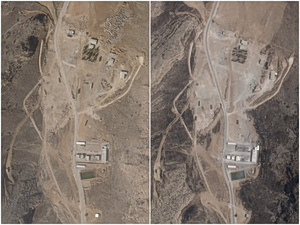
The U.S. military has deployed scores of combat aircraft across the Middle East and will soon have a second aircraft carrier within range of Iran if President Trump gives the order to strike. Over the past month, dozens of jet fighters and support aircraft have flown from the U.S. and Europe to bases in Jordan and Saudi Arabia, according to flight-tracking data.
For decades, the U.S. military has located warplanes at bases throughout the Middle East that have served as launching points for conflicts in Iraq, Afghanistan, Syria and Yemen. However, Saudi Arabia and the United Arab Emirates won’t allow the U.S. aircraft to use their respective airspace to strike Iran. That has prompted the U.S. to base many fighters farther away in Jordan, which means warplanes would need to rely more on aerial refueling to reach their targets and return to the bases.
The U.S. has deployed F-22s and F-35s, whose stealthy designs allow them to evade being targeted by surface-to-air missiles. These same jet fighters escorted B-2 stealth bombers when Trump ordered military strikes on Iran’s nuclear sites in June 2025.
EA-18G jamming aircraft would likely be used to disrupt Iran’s missile launchers, as they were last month during the U.S. mission to capture former Venezuelan leader Nicolás Maduro . After a strike on Iran, F-15E and F-16 fighters would likely be used to intercept Iranian drones launched in response at Israel or bases with a U.S. military presence in the region.
Even though they are not based in the region, long-range bombers, including the B-2, could launch from the U.S. and fly nonstop missions over Iran with the help of aerial tankers.
The U.S. Navy has 13 ships in the region to support a potential operation. This includes the aircraft carrier USS Abraham Lincoln and nine destroyers that could shoot down Iranian-launched ballistic missiles. The destroyers could also launch Tomahawk cruise missiles at targets in Iran. The aircraft carrier USS Gerald R. Ford, which supported military operations in Venezuela, is also on its way to the region .
Support aircraft and ships would also play a major role in any combat operations in Iran. Dozens of aerial tankers, including the KC-135, would likely refuel fighters, bombers and support aircraft, such as helicopters, or early warning radar planes, such as the E-3 Airborne Warning and Control System and E-2 advanced early warning aircraft.
During a prolonged campaign, large cargo planes, such as the C-17 and C-5, could be used to resupply spent munitions and other equipment. Cargo and supply ships would be used to replenish warships, as well.
The U.S. over the past month has prepositioned its most advanced Thaad and Patriot interceptors to protect American assets and allies in the region. Thaads can intercept ballistic missiles above the Earth’s atmosphere, while Patriots defend against lower-altitude, shorter-range threats.
In June following the U.S. strike on Iran’s nuclear sites, American and Qatari Patriots intercepted most of the 14 missiles Iran fired at the Al Udeid Air Base in Qatar, home to the U.S. air command center in the region that is used by American warplanes.
The 12-day conflict between Israel and Iran in June 2025 shined a light on just how quickly the U.S. could burn through its interceptor stockpiles.
While the U.S. military buildup in Iran is smaller than the 1991 Gulf War, it is the largest buildup of air power in the region since the U.S. invaded Iraq in 2003.
Note: Diagrams aren’t to scale
Graphics sources: Institute for National Security Studies, U.S. Navy (assets); American Security Project (bases); Air Force (F-16, A-10, F-15E, F-22, CMV-22, C-17, KC-135, C-10); Navy (F-35C, F/A-18F, EA-18G, USS Abraham Lincoln, USS Gerald R. Ford, USS Georgia, E-2D, USNS Henry J. Kaiser); U.S. Carriers (Arleigh-Burke class); Seaforces.org (Independence class); Missile Defense Advocacy Alliance (E-2D range); American Special Ops (MH-60); General Dynamics (USNS Carl Brashear) U.S. Congress (Thaad); MissileThreat (Patriot)
Write to Roque Ruiz at roque.ruizgonzalez@wsj.com , Marcus Weisgerber at marcus.weisgerber@wsj.com and Carl Churchill at carl.churchill@wsj.com