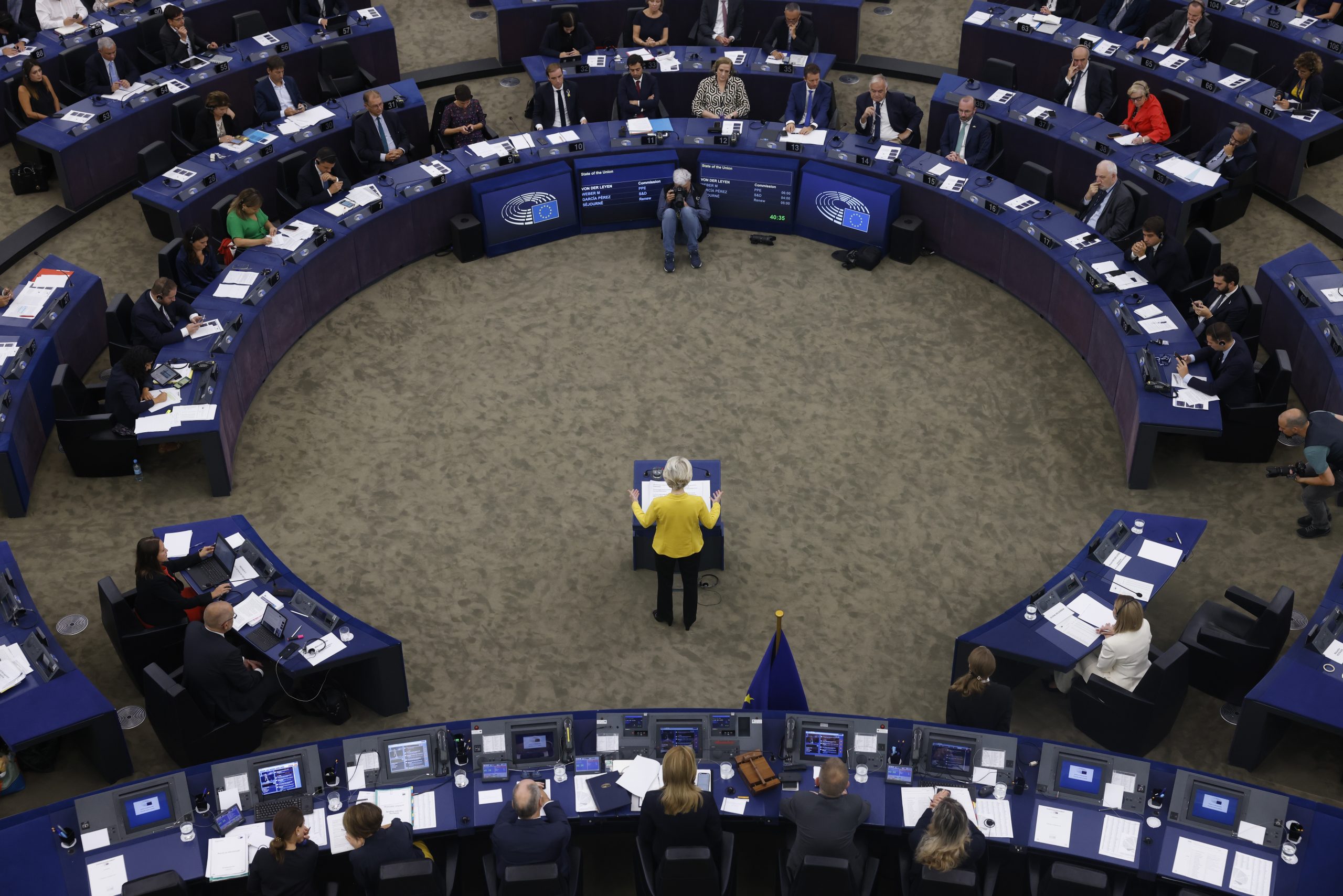
BRUSSELS—With geopolitical tensions flaring in June, European Commission President Ursula von der Leyen wanted to get President Trump alone at a Group of Seven summit in Canada. She surprised his security team, taking Trump by the arm and leading him to a sofa for a chat. There, the two discussed Ukraine, China and trade.
It was one of the moments, her aides say, that has helped her bridge a divide with Trump and thaw frosty trans-Atlantic relations .
The 66-year-old von der Leyen—a mother of seven and a doctor who specialized in women’s health—has pushed for months to convince Trump of the European Union’s value to the U.S. To get there, she and her team put aside clashing styles and political differences with Trump in search of comity.
Von der Leyen tapped lessons from a sometimes rocky career in shaping her approach. She worked to engage Trump directly, often using his own language and avoiding specific terms he dislikes. When they speak, aides say, she marks her red lines and specifies her goals, without relying on talking points.
“She can resist the temptation to take a fight if that fight doesn’t serve a purpose,” said former EU competition commissioner Margrethe Vestager , adding that von der Leyen is handling relations with Trump well.
The effort has shown signs it is paying off. Trump, a longtime EU critic, showered praise on his European colleagues at a recent White House meeting on Ukraine, calling von der Leyen one of Europe’s most powerful people. The two leaders echoed each other’s comments on the plight of Ukrainian children abducted by Russians at the meeting. Trump has also lauded a trade deal he negotiated with von der Leyen.
Now, von der Leyen’s strategy is facing fresh tests from both sides of the Atlantic. Trump recently threatened Europe with new tariffs and trade restrictions over EU tech regulations. Some European business leaders and politicians have denounced the trade agreement , reached in late July at a meeting at one of Trump’s Scotland properties, accusing her of rolling over to the U.S. president.
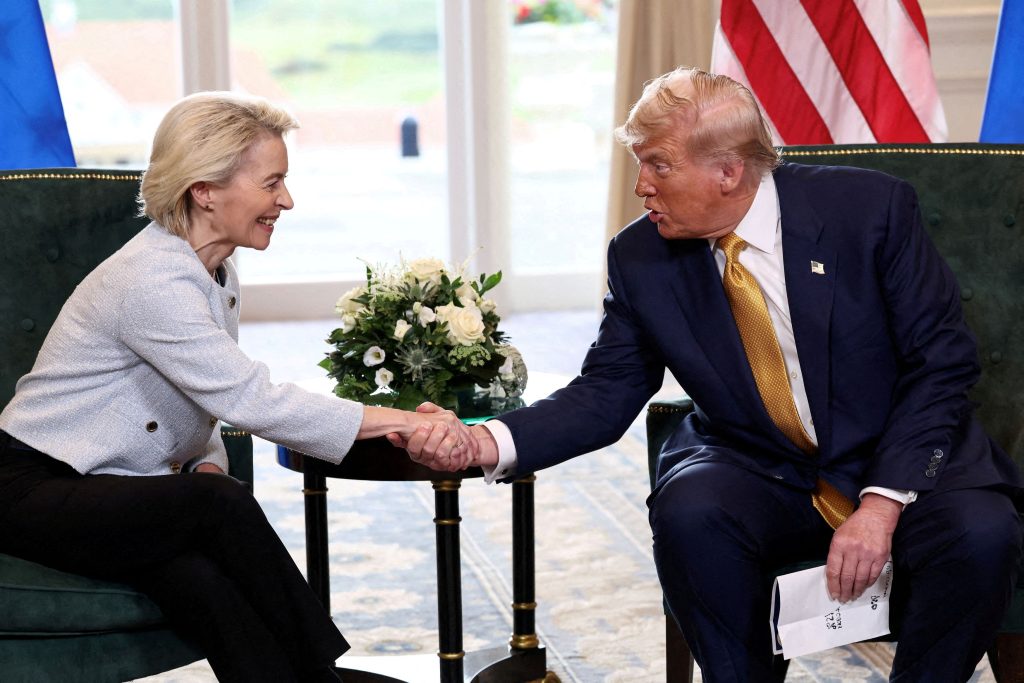
U.S. President Donald Trump shakes hands with European Commission President Ursula von der Leyen, after an announcement of a trade deal between the U.S. and EU, in Turnberry, Scotland, Britain, July 27, 2025. REUTERS/Evelyn Hockstein/File Photo
Former French EU commissioner Thierry Breton , who quit last year after von der Leyen moved to replace him, lambasted her stance with Trump on X recently, paraphrasing Winston Churchill: “We were told to accept humiliation to avoid instability. Now we have both.” Sahra Wagenknecht , head of Germany’s left-wing populist BSW party, told a German newspaper that the trade agreement was “not a deal but a disaster” and called for von der Leyen to quit.
Von der Leyen, unapologetic, stresses Europe’s need to cooperate with the U.S. “When the EU and U.S. work together as partners, the benefits are tangible on both sides,” she said in announcing the July trade deal with Trump.
The EU leader honed her political skills working for former German Chancellor Angela Merkel . From her mentor, von der Leyen learned that to be a woman in power she must be the hardest-working and best-prepared person in the room, aides say.
Diminutive, immaculately presented and polite in public, von der Leyen is a study in contrasts with Trump. Her speeches can be punchy but are never impromptu—the antithesis of Trump’s long, improvised on-camera group news conferences.
In Europe, von der Leyen is increasingly divisive. She has pushed to increase the power of her office and the EU, making enemies in Brussels and beyond. She recently faced down a confidence vote in the European Parliament.
Breton, the former French commissioner, and others say the Commission has strayed from its traditional collective decision-making. Hungarian Prime Minister Viktor Orban and some other euroskeptic politicians have accused her of weaponizing EU powers against opponents.
Guarded and tightly scripted, von der Leyen can appear aloof. When she suffered severe flu early this year, the Commission only acknowledged she had spent a week hospitalized following a German media report. Recent backlash against the trade deal surprised her team.
Aides acknowledge she can be demanding, pushing to understand critical issues even if that means stretching protocol to question lower-level officials.
Vestager, the former competition commissioner who left Brussels last year, said von der Leyen had high expectations but could be sympathetic. During a difficult workweek, she said, von der Leyen would text her to pop in for a cup of tea.
Von der Leyen was a surprise choice in 2019 to lead the European Commission. Then Germany’s defense minister, she was on a retreat with military officials when French President Emmanuel Macron unexpectedly called, with Merkel’s approval, to ask if she wanted the job. European leaders, divided over other candidates, quickly approved her as the first woman to hold the five-year posting.
She immediately set the tone by having living quarters installed for the first time next to her office atop the Commission’s main administrative building in Brussels so she could work longer hours. Officials say von der Leyen’s relentlessness is exemplified by an iron rule: Celebrate a political or policy success for two hours. Then back to work.
The Brussels post brought von der Leyen back to her birthplace. Her father, Ernst Albrecht , who became a powerful German conservative politician, was a senior European civil servant in the 1950s, during the early days of what became the EU.
When German police in the late 1970s feared left-wing extremists could harm Albrecht by kidnapping his daughter, she was sent to study at the London School of Economics, where she was registered as Rose Ladson for anonymity. The name Ladson came from her American great-grandmother.
Von der Leyen renewed her family ties to the U.S. in the early 1990s when her husband, Heiko von der Leyen , also a physician and professor from an old noble German family , taught at Stanford University. After returning to Germany, she shifted from medicine into regional politics.
Friends and colleagues say von der Leyen’s political stature grew thanks to her intellect, diligence and connections to mentors, including Merkel. She took her first ministerial position, in a state government, four years after the birth of her seventh child. She has spoken of the pressure on her to quit work after becoming a mother.
Instead, she built her political brand around her ability to combine heavy work duties with her big family. On movie nights, she, her children and her bodyguards would often fill an entire row at the theater, according to a friend. She won popular support by championing an expansion of German parental leave.
By 2019, her meteoric political rise had faltered during a difficult stint as defense minister, which ended amid accusations that the German military was unfit and probes into wrongdoing at the ministry. The Macron call resurrected her career.
Von der Leyen took office in December 2019 and met Trump briefly at an international gathering in Switzerland soon after. The encounter was cordial, aides say. The Covid-19 pandemic hit soon after, and they didn’t get to know each other.
After Trump’s inauguration this year, their first face-to-face meeting was a brief chat at the Vatican in April, at Pope Francis’ funeral. They now speak or text regularly.
The new relationship hasn’t matched the close ties von der Leyen and her team had in the Biden administration. As Russia prepared to attack Ukraine in 2021, she and her powerful top aide, Bjoern Seibert , worked with Washington to craft economic sanctions that the U.S. and EU imposed on Moscow after its large-scale invasion in early 2022.
Weeks later, she visited Bucha, the Kyiv suburb where Russian soldiers massacred hundreds, soon after it was liberated. Aides say it was a sign of her willingness to take risks and her leadership in Europe on Ukraine.
Another risk was a last-minute July meeting with Trump in Scotland. She arrived with minimal scheduling, unaware when a press conference would occur, her aides say.
In a freewheeling on-camera conversation before the closed-door talks, both leaders gave negotiations a 50% chance of success. Von der Leyen stayed cool as Trump dominated the discourse, and appealed to his vision of himself as a dealmaker.
“If we are successful, I think it would be the biggest deal each of us has ever struck,” she said. Trump agreed.
Write to Laurence Norman at laurence.norman@wsj.com , Bertrand Benoit at bertrand.benoit@wsj.com and Kim Mackrael at kim.mackrael@wsj.com