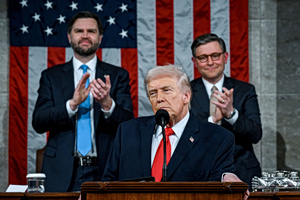
WASHINGTON—President Trump told a national audience on Tuesday that he had unleashed a new age of economic prosperity. One thing he didn’t say: I feel your pain.
At the core of Trump’s State of the Union address was a calculation that he can persuade Americans that the economy is in better shape than many think it is. In touting “a turnaround for the ages,” the president opted against sending a message to voters that he understands the anxiety that polling shows is widely felt, including among swing voters the GOP needs to preserve its congressional majorities in this fall’s midterm elections.
“Our nation is back: bigger, better, richer and stronger than ever before,” Trump declared at the start of his speech, which clocked in at a record one hour and 48 minutes.
Polls find that Americans are unhappy with Trump’s handling of the economy. In a Wall Street Journal survey last month, voters gave the president low marks when asked if he cares about “people like you,” is looking out for the middle class and has the right priorities.
For months, Trump’s top advisers have urged him to focus on the economy , but his attention has often shifted to other subjects, including foreign affairs. As he spoke, Trump was weighing military strikes in Iran .
On Tuesday, Trump made the economy a central focus of his speech, even as he touched on other subjects. He blamed his predecessor for high inflation and other problems and outlined affordability proposals. He said he would move to impose limits on investors buying large numbers of homes and give Americans without access to a retirement savings plan at work the opportunity to invest in the retirement plan for federal workers. He defended his aggressive use of tariffs, which have strained longtime GOP orthodoxy and given air to Democratic arguments he is driving higher prices on consumers.
In between remarks about the economy, Trump launched pointed attacks against Democrats over immigration and crime, setting off tense exchanges with lawmakers in the House chamber. He emphasized themes of patriotism and American exceptionalism, heralding the 250th birthday of the nation and celebrating the U.S. men’s gold-medal hockey team.
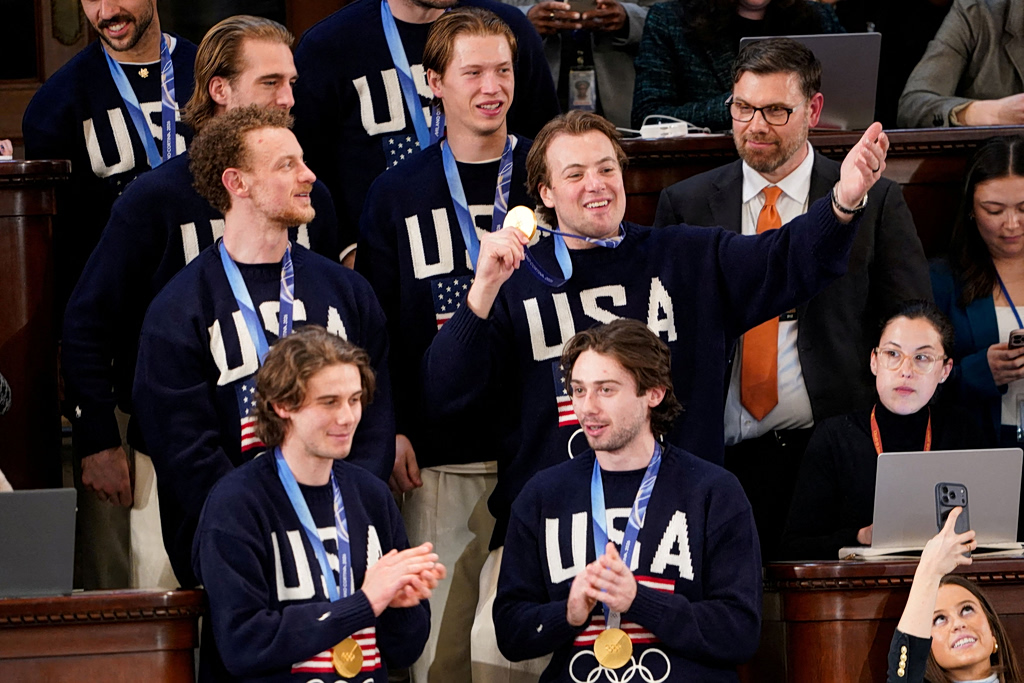
Members of the U.S. Olympic men’s hockey team that won the gold medal attend U.S. President Donald Trump’s State of the Union address to a joint session of Congress in the House Chamber of the U.S. Capitol in Washington, D.C., U.S., February 24, 2026. REUTERS/Nathan Howard
Trump might face hurdles in persuading Americans that the traditional measures of the nation’s economic health are strong at a moment when economic sentiment is low. While inflation has cooled, U.S. economic growth slowed at the end of last year. The economy created only 181,000 jobs in 2025, though gains rebounded in January.
Trump pointed to the robust stock market and 401(k) retirement accounts, as well as falling mortgage interest rates. He touted last year’s tax cuts, which are producing larger refunds this year, as well as provisions such as “no tax on tips” and deals to lower prescription-drug costs.
He announced a plan to shield consumers from electricity rate increases caused by AI data centers. He pressed Congress to pass legislation codifying the healthcare framework he released earlier this year, which calls for redirecting federal subsidies from insurers to consumers. That plan has lukewarm support among Republicans facing elections.
Some of the proposals showed Trump adopting a populist stance in which he is willing to intervene in markets and place restrictions on corporations, continuing his partial break from the traditional Republican pro-business outlook that long guided the GOP. He cast himself as the champion of voters disillusioned by political leaders.
“From trade to healthcare, from energy to immigration, everything was stolen and rigged in order to drain the wealth out of the productive, hardworking people who make our country great, who make our country run,” Trump said.
One of Trump’s challenges is that his natural impulses as a salesman conflict with what many strategists see as a political imperative to show that he understands the economic anxiety many feel. Last week in a speech in Georgia, Trump said, “I’ve won affordability,” citing lower gas prices and moderating inflation.
Matthew Bartlett, a Republican strategist, said Trump risked looking out of touch by touting positive economic numbers rather than more directly addressing economic anxiety. “I’m not sure any aspirational speech changes your electric bill, your grocery bill or tuition,” he said.
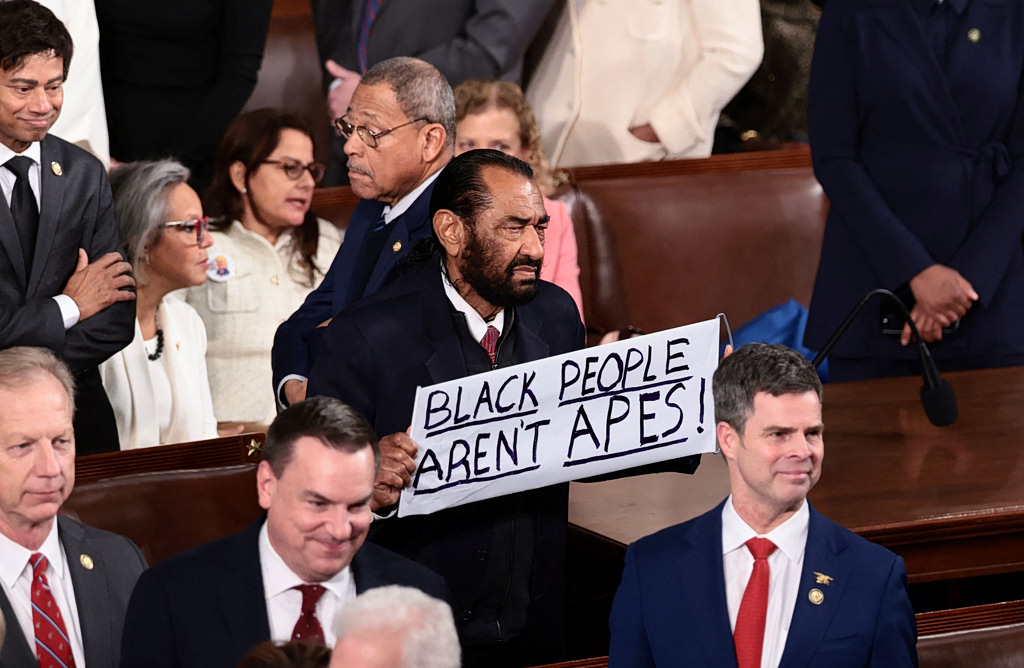
U.S. Rep. Al Green (D-TX) holds a sign after U.S. President Donald Trump arrived to deliver the State of the Union address to a joint session of Congress at the U.S. Capitol in Washington, D.C., U.S., February 24, 2026. REUTERS/Evelyn Hockstein
But Wes Anderson, a pollster whose clients include the House GOP campaign arm, said Trump probably helped himself by laying out affordability proposals. “The ‘I feel your pain’ has never been a Trump speech,” he said. “That’s not a gear in his gearbox.”
Former President Barack Obama unsuccessfully tried to persuade voters to stick with Democrats ahead of the first midterm election after he took office, as Americans were still reeling from the financial crisis of 2008. “Do we return to the same failed policies that ran our economy into a ditch, or do we keep moving forward with policies that are slowly pulling us out? ” Obama asked just before the 2010 midterms. Democrats ended up losing more than 60 House seats. Trump’s GOP has a razor-thin majority in the House.
Sitting in front of Trump were members of the Supreme Court, which he had called “incompetent” and unworthy of respect following last week’s landmark ruling that stuck down the most expansive element of his tariff regime. While only four of the nine justices appeared at the speech, the president shook hands with all of them as he made his way to the lectern, and he avoided personal attacks in his speech.
Americans have increasingly soured on Trump’s presidency, with 41% approving of his job performance and 57% disapproving, according to an average of polls collected by the nonpartisan Cook Political Report. That 16-point gap has widened from two points last March. Among independents, disapproval tops 66%.
Some 56% of voters say Trump doesn’t have the right priorities, a Wall Street Journal poll found last month, and 58% disapprove of his handling of inflation.
“Polling data has consistently shown that voters question whether the administration has consistently prioritized cost of living,” said Ken Spain, a Republican communications consultant who now advises businesses. “The president likely made incremental headway tonight, but there remains a sizable political deficit to make up.”
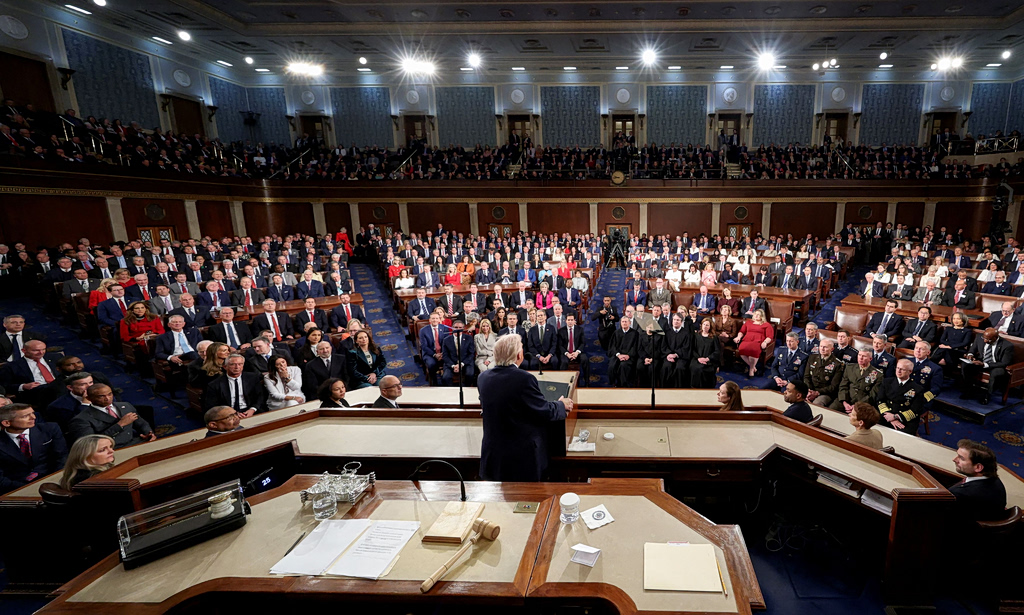
U.S. President Donald Trump delivers the State of the Union address in the House Chamber of the U.S. Capitol in Washington, D.C., U.S., February 24, 2026. REUTERS/Jessica Koscielniak/Pool
The nation’s fractured politics were on display Tuesday. Roughly 50 Democratic lawmakers—nearly one-quarter of the caucus— said they would skip the event . Many attended rallies in Washington, D.C., where they criticized the administration’s handling of the economy, cuts to healthcare and the immigration crackdown.
Trump echoed many of the themes that he has adopted since he first entered the political stage in 2015, with the president blaming immigrants for violent crime and fraud and alleging that Democrats want to cheat in elections. The speech at times took on the air of a campaign rally, as Trump castigated Democrats for allegedly failing to back efforts to remove violent criminals from the country. He called on Congress to pass a voter identification law that Democrats oppose.
At one point, Republicans chanted “U.S.A., U.S.A.!” as Trump accused Democrats of blocking the removal of people living in the country illegally.
“You should be ashamed,” yelled Rep. Ilhan Omar (D., Minn.), interrupting Trump as he criticized Democratic-led cities that have withheld support from federal immigration officers.
“These people are crazy,” Trump later said of Democrats.
Write to Alex Leary at alex.leary@wsj.com and Aaron Zitner at aaron.zitner@wsj.com